








iPhone 17e
The iPhone 17e is Apple's most affordable iPhone with Apple Intelligence.
Should You Buy the iPhone 17e?
Apple announced the iPhone 17e on March 2, 2026 and put it on sale on March 11. The “e” line is now on an annual cycle. The next refresh is expected in spring 2027.
At $599 for 256GB, the iPhone 17e is $200 below the standard iPhone 17 and $100 below the carry-over iPhone 16, which Apple still sells at $699. The iPhone 17e replaces the iPhone 16e directly and matches its predecessor’s launch price.
The iPhone 17e is sold alongside the $799 iPhone 17, the ultra-thin $999 iPhone Air, the $1,099 iPhone 17 Pro, and the $1,199 iPhone 17 Pro Max. Every iPhone 17 model above the 17e uses 120Hz ProMotion, the Dynamic Island, the new 18MP Center Stage front camera, and Apple’s N1 chip for Wi-Fi 7. Apple also still sells last year’s iPhone 16 at $699 for buyers who want a 60Hz iPhone with the Dynamic Island.
Compared to the iPhone 17, the iPhone 17e drops one GPU core, the Ultra Wide camera, the upgraded Center Stage front camera, ProMotion, the Dynamic Island, the Camera Control button, and Wi-Fi 7. It keeps the A19 CPU, MagSafe, the 48MP Fusion main camera, and the Action button. If those omissions are tolerable for you, the iPhone 17e saves $200.
According to Bloomberg‘s Mark Gurman, the iPhone 17e is a worthy alternative to the pricier iPhone 17, though Gurman flagged enough feature gaps to make spending the extra $200 easy to justify for many buyers.
The iPhone 17e is sold through Apple’s online store, Apple retail locations, U.S. carriers, and authorized resellers. The 256GB model starts at $599 in the U.S., or $24.95 per month over 24 months on Apple Card Monthly Installments. A 512GB tier is also offered.
Apple Trade In credits up to $100 toward an iPhone 17e for an iPhone 11 trade-in, or up to $195 for an iPhone 13. Apple’s launch announcement notes that carrier offers can reach up to $400 for an iPhone 11 and up to $599 for an iPhone 13 with eligible plans.
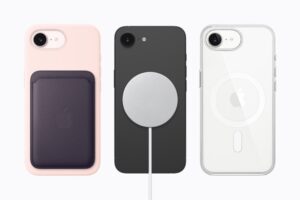
The iPhone 17e Silicone Case with MagSafe is $49 in six colors: black, anchor blue, light moss, vanilla, bright guava, and soft pink. It is compatible with the Crossbody Strap. The Clear Case with MagSafe is also $49.
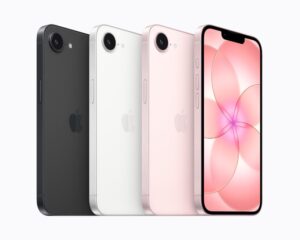
Reviews of the iPhone 17e ranged from positive to mixed. The most consistent praise centered on MagSafe finally arriving on Apple’s budget iPhone, the bump to 256GB starting storage at the same $599 price, the C1X modem, and the new soft pink color.
The Verge‘s Allison Johnson, in her iPhone 17e review, gave the device a 7 out of 10 verdict, recommending most buyers spend the extra $200 on an iPhone 17 for the ProMotion display, Dynamic Island, Ultra Wide camera, and larger main sensor.
Engadget‘s Cherlynn Low, in her review summarized by AppleInsider, scored the iPhone 17e 80 out of 100. Low praised faster performance, more storage, improved portrait mode, MagSafe, and the new soft pink color, while noting that A19 Neural Accelerator gains in everyday Apple Intelligence tasks felt minor in early use.
According to TechRadar‘s review by Jacob Krol, summarized in 9to5Mac‘s review roundup, the iPhone 17e earned 4 out of 5 stars and reads as a refinement of the budget formula introduced by the iPhone 16e rather than a reinvention of it.
Wired‘s Julian Chokkattu, in his review summarized by 9to5Mac, was harsher, calling the iPhone 17e overpriced relative to the competition and criticizing the 60Hz panel, while still recommending it for buyers who want a basic new iPhone rather than going to the used market.
PCMag‘s Eric Zeman, in testing reported by 9to5Mac, recorded a peak download speed of 419 Mbps on AT&T’s 5G network in New Jersey, suggesting noticeable real-world gains from the C1X over the C1.
Design
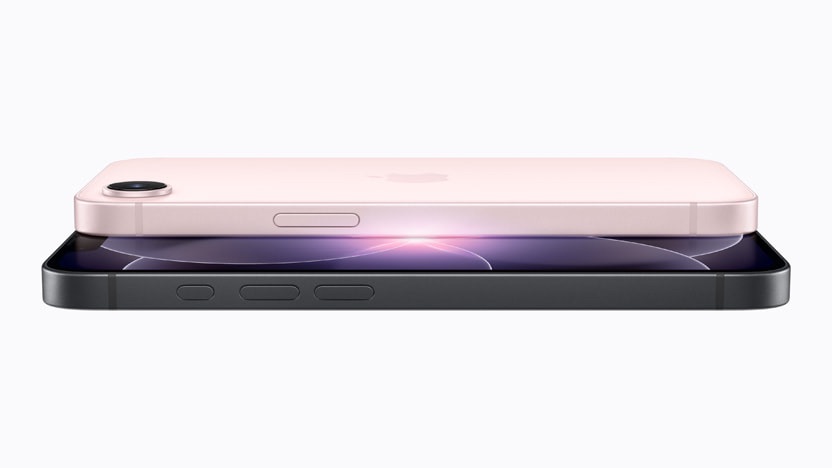
The iPhone 17e measures 5.78 inches tall, 2.82 inches wide, 0.31 inch deep, and weighs 5.96 ounces (169 grams). The chassis uses an aerospace-grade aluminum frame with a glass back. Three colors are offered: black, white, and a new soft pink, each with a matte back finish.
The front uses Ceramic Shield 2, with Apple claiming up to 3x better scratch resistance than the previous generation, plus an improved anti-reflection coating to reduce glare. This is the same cover material used on every iPhone 17.
Apple rates the iPhone 17e at IP68 to a maximum depth of 6 meters for up to 30 minutes under IEC standard 60529.
The chassis omits the new Camera Control button found on the iPhone 17, iPhone Air, and iPhone 17 Pro. It does include the customizable Action button on the left side along with the volume buttons, plus the side button on the right.
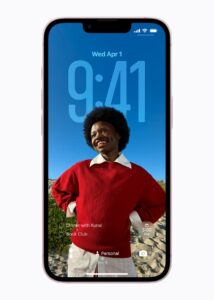
Up front, the display still uses the iPhone 14-style notch rather than the Dynamic Island that is now standard across the rest of the iPhone 17 line. This is the most visible cue separating the iPhone 17e from its more expensive siblings.
Display
The iPhone 17e has a 6.1-inch Super Retina XDR OLED display at 2532 by 1170 pixels and 460 ppi. Brightness is 800 nits typical and 1200 nits peak HDR. Contrast is rated 2,000,000:1 typical.
The panel runs at 60Hz with no ProMotion and no always-on display. According to The Verge‘s iPhone 17e review, the absence of ProMotion is one of the clearest trade-offs against the iPhone 17, since the rest of the 2025-2026 iPhone lineup uses 120Hz panels.
Other display features include True Tone, Wide color (P3), Haptic Touch, an oleophobic coating, and an anti-reflective coating. The notch houses the TrueDepth camera array used for Face ID. There is no Dynamic Island.
A19 Chip
Apple’s A19 chip in the iPhone 17e is built on a 3-nanometer process and uses a 6-core CPU split into 2 performance cores and 4 efficiency cores. The 4-core GPU has Neural Accelerators on each core and supports hardware-accelerated ray tracing. A 16-core Neural Engine handles on-device machine learning.
The iPhone 17e’s A19 has one fewer GPU core than the A19 in the standard iPhone 17, which uses a 5-core GPU. CPU configuration is identical between the two chips. The result is roughly equivalent CPU throughput and a measurable GPU gap.
According to 9to5Mac‘s review of early Geekbench 6 submissions, iPhone 17e single-core scores have averaged around 3,320, with multi-core averaging around 8,373 across early listings. Peak runs have reached 3,685 single-core and 9,241 multi-core. Metal scores have ranged from roughly 28,747 to 31,748.
For comparison, the standard iPhone 17 averages around 9,249 in Geekbench multi-core, putting the iPhone 17e roughly 4 to 10 percent behind on CPU performance and roughly 16 to 20 percent behind on GPU performance, according to multi-device benchmark aggregations reported by MacRumors.
Apple’s marketing comparisons benchmark the iPhone 17e against older iPhones. Apple says the A19 CPU is up to 2x faster than the iPhone 11 and up to 1.6x faster than the iPhone 12. The 4-core GPU is up to 2.2x faster than the iPhone 11 and up to 1.9x faster than the iPhone 12.
According to Bloomberg‘s Mark Gurman in his Power On newsletter, Apple is targeting the iPhone 17e at users in emerging markets and at enterprise buyers.
Camera
The iPhone 17e has a single 48MP Fusion main camera with a 26mm focal length, an ƒ/1.6 aperture, optical image stabilization, Hybrid Focus Pixels, and a sapphire crystal lens cover. The single-sensor design enables a 12MP optical-quality 2x telephoto at 52mm by cropping the sensor center, plus digital zoom up to 10x.
The iPhone 17e omits an Ultra Wide camera. The iPhone 17, iPhone Air, and iPhone 17 Pro all include one. According to The Verge‘s iPhone 17e review, the iPhone 17e’s main sensor is also slightly smaller than the iPhone 17’s, with implications for low-light performance and overall image quality. AppleInsider‘s review roundup described the smaller sensor as a problem for photographers but probably not a dealbreaker.
Photo features include next-generation portraits with focus and depth control, Smart HDR 5, Photographic Styles, Night mode, Panorama up to 63MP, and 24MP default capture for everyday photos. Apple says the portrait pipeline can detect people, dogs, and cats and saves depth information automatically, so users can apply background blur and adjust the focus point in Photos after the shot is taken.
The front camera is a 12MP TrueDepth camera at ƒ/1.9 with autofocus, Retina Flash, the Photonic Engine, Smart HDR 5, and 4K Dolby Vision recording up to 60 fps. The iPhone 17e does not include the new 18MP Center Stage square front camera Apple introduced across the iPhone 17, iPhone Air, and iPhone 17 Pro.
For video, the iPhone 17e records 4K Dolby Vision at 24, 25, 30, or 60 fps, and 1080p Dolby Vision at 25, 30, or 60 fps. Slow motion supports 1080p at 120 fps or 240 fps. Capture features include cinematic stabilization, continuous autofocus, audio zoom, Spatial Audio recording, wind noise reduction, and Audio Mix.
Battery Life
Apple rates iPhone 17e battery life at up to 26 hours of video playback and up to 21 hours of streamed video playback. According to GSMArena‘s iPhone 17e review, the battery itself is 4005 mAh, a figure Apple does not publish.
Wired fast charging reaches up to 50 percent in around 30 minutes with a 20W or higher USB-C adapter, sold separately. Apple’s testing was conducted in January 2026 on preproduction units.
The iPhone 17e supports MagSafe and Qi2 wireless charging up to 15W. The 7.5W Qi cap on the iPhone 16e is gone.
Smaller Changes
The iPhone 17e is the first device after the iPhone Air to use Apple’s second-generation cellular modem, the C1X. Apple says the C1X is up to 2x faster than the C1 in the iPhone 16e and uses 30 percent less energy than the modem in the iPhone 16 Pro. Apple also says the C1X matches the iPhone Air’s modem in throughput.
The iPhone 17e supports sub-6 GHz 5G with 4×4 MIMO and Gigabit LTE with 4×4 MIMO. mmWave 5G is not supported.
In the U.S., the iPhone 17e is dual eSIM only, with no physical SIM tray. It supports two active eSIMs and storage for eight or more eSIM profiles.
The iPhone 17e supports Emergency SOS via satellite, Roadside Assistance via satellite, Messages via satellite, and Find My via satellite. Crash Detection is also included.
Satellite features are free for two years from the activation of any iPhone 14 or later, including the iPhone 17e.
The iPhone 17e supports Wi-Fi 6 (802.11ax) with 2×2 MIMO and Bluetooth 5.3. It does not include the Apple-designed N1 wireless chip used in the iPhone 17, iPhone Air, iPhone 17 Pro, and iPhone 17 Pro Max. As a result, the iPhone 17e lacks Wi-Fi 7, Bluetooth 6, and Thread support. There is no Ultra Wideband chip.
The USB-C port supports charging and USB 2 data transfer at up to 480 Mb/s. There is no USB 3 or Thunderbolt support.
Authentication is handled by Face ID, powered by the TrueDepth camera in the notch. Sensors include a barometer, a high dynamic range gyro, a high-g accelerometer, a proximity sensor, and dual ambient light sensors.
Location services use GPS, GLONASS, Galileo, QZSS, BeiDou, and NavIC, plus a digital compass.
Apple Intelligence Updates
The iPhone 17e ships with iOS 26. Apple Intelligence is supported.
iOS 26 features Apple emphasized at the iPhone 17e launch include the Liquid Glass design language, Live Translation in Messages, FaceTime, Phone, and AirPods, on-screen Visual Intelligence, Call Screening, Hold Assist, and a Messages screen-from-unknown-senders filter.
Apple Intelligence is available in beta in English (U.S. and UK), Danish, Dutch, French, German, Italian, Norwegian, Portuguese, Spanish, Swedish, Turkish, Vietnamese, Chinese (Simplified and Traditional), Japanese, and Korean at launch. Engadget‘s review noted that the everyday impact of A19 Neural Accelerator gains felt small in early use.
In the Box
The iPhone 17e ships with the device, a 1-meter USB-C charge cable, and documentation. There is no power adapter and no EarPods in the box.
Packaging is 100 percent fiber-based. The iPhone 17e itself is made with 30 percent recycled content by mass, including 85 percent recycled aluminum in the enclosure, 100 percent recycled cobalt and 95 percent recycled lithium in the battery, and 100 percent recycled rare earth elements in all magnets. Apple says 55 percent of manufacturing electricity for the iPhone 17e is sourced from renewable electricity.
What’s Next for iPhone 17e
Apple has moved to an annual update cycle for the entry-level “e” iPhone, so the next refresh of the line is expected in spring 2027. Analyst Ming-Chi Kuo correctly predicted the spring 2026 launch window for the iPhone 17e back in May 2025, framing it as part of Apple’s split fall-and-spring iPhone strategy.
iPhone 17e Timeline
March 23, 2026 — The Guardian publishes its iPhone 17e review.
March 18, 2026 — GSMArena publishes its full iPhone 17e review with a 4005 mAh battery capacity figure.
March 14, 2026 — Bloomberg‘s Mark Gurman publishes a longer-form review framing the iPhone 17e as a worthy alternative to the iPhone 17.
March 11, 2026 — General availability begins for the iPhone 17e in more than 70 countries.
March 9, 2026 — First-wave reviews go live from The Verge, Wired, Engadget, TechRadar, PCMag, and others, summarized by 9to5Mac.
March 6, 2026 — First Geekbench 6 scores for the iPhone 17e surface, hinting at A19 performance roughly 6 to 10 percent ahead of the iPhone 16e on CPU.
March 4, 2026 — Pre-orders open at 6:15 a.m. PST in more than 70 countries.
March 2, 2026 — Apple announces the iPhone 17e with the A19 chip, MagSafe, the C1X modem, and a $599 starting price for 256GB.
February 8, 2026 — Bloomberg‘s Mark Gurman reports in Power On that an iPhone 17e launch is imminent, citing the A19 chip, MagSafe, and the C1X modem.
September 19, 2025 — Apple ships the iPhone 17, iPhone Air, iPhone 17 Pro, and iPhone 17 Pro Max, the sibling family the iPhone 17e slots beneath.
July 11, 2025 — Reports describe Apple’s move toward an annual update cadence for the entry-level “e” iPhone.
May 2025 — Analyst Ming-Chi Kuo confirms the iPhone 17e is on Apple’s 2026 roadmap as part of a split fall-and-spring iPhone launch strategy.
February 28, 2025 — Apple ships the iPhone 16e, the predecessor the iPhone 17e replaces, at $599 with the A18 chip, the C1 modem, and no MagSafe.
February 19, 2025 — Apple announces the iPhone 16e.
Changelog
May 3, 2026 — Initial publication.
Note: See an error in this roundup or want to offer feedback? Send us an email here.