








iPhone 17 Pro
Apple's latest Pro iPhones.
Should You Buy the iPhone 17 Pro?
Apple introduced the iPhone 17 Pro and iPhone 17 Pro Max on September 9, 2025, with pre-orders opening September 12 and in-store availability starting September 19, 2025 in more than 63 countries. The iPhone 17 Pro starts at $1,099 with 256GB of storage. The iPhone 17 Pro Max starts at $1,199 and tops out at a new 2TB tier, the first time Apple has sold an iPhone with that much storage.
Both Pro models sit at the top of a four-phone iPhone 17 family. The standard iPhone 17 starts at $799 and uses a non-Pro A19 chip with a dual 48MP camera, while the iPhone Air launched at $999 with a titanium frame and a single rear camera. The iPhone 17e arrived later, on March 11, 2026, at $599 as the most affordable model in the family.
According to 9to5Mac‘s Chance Miller in his iPhone 17 Pro review, the device “is unremarkable in the best way possible.” Miller wrote that the unibody aluminum feels better in hand than the iPhone 16 Pro, while calling the new two-tone back and the wider camera plateau the most polarizing iPhone design choices in years.
According to a February 2026 Bloomberg article citing Counterpoint Research data, the iPhone 17 lineup helped Apple register 8% growth in China in January 2026, against an overall market that fell 23% year over year. Counterpoint Research data reported by AppleInsider shows Apple’s China iPhone shipments grew 20% year over year for the quarter ending March 2026, the company’s largest quarterly gain there since Q4 2020. 9to5Mac, citing the same firm, reported a 23% year-over-year jump across the first 9 weeks of 2026 against a 4% market decline.
A new iPhone is not expected until September 2026, so anyone buying an iPhone 17 Pro now will be holding the current flagship for at least 5 months before the iPhone 18 Pro is announced. If you want the most advanced iPhone Apple sells, with the new triple 48MP system and the longest playback ratings in the lineup, this is it.
Design
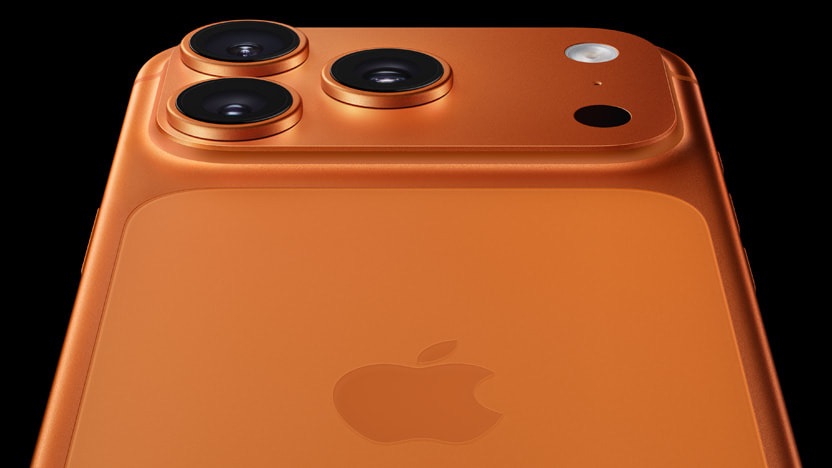
Apple replaced the titanium frame from the iPhone 16 Pro with what it describes as a “lightweight aerospace-grade 7000-series aluminum alloy” unibody, with a brushed finish on the sides and across the camera area. Ceramic Shield 2 protects the front, and Ceramic Shield covers the back for the first time on iPhone, except for a glass cutout that exposes the MagSafe wireless charging area. Apple says the new Apple-designed coating gives Ceramic Shield 2 3x better scratch resistance than the previous Ceramic Shield, while the rear is 4x more resistant to cracks than the back glass on previous models.
Both models are slightly larger than their predecessors. The iPhone 17 Pro measures 71.9 mm wide, 150.0 mm tall, and 8.75 mm deep at 206 grams. The iPhone 17 Pro Max measures 78.0 mm wide, 163.4 mm tall, and 8.75 mm deep at 233 grams. By comparison, the iPhone 16 Pro was 71.5 mm by 149.6 mm by 8.25 mm and weighed 199 grams. The new Pros are roughly half a millimeter thicker and 7 grams heavier at the smaller size, with the bulk going into a redesigned camera plateau and a larger battery.
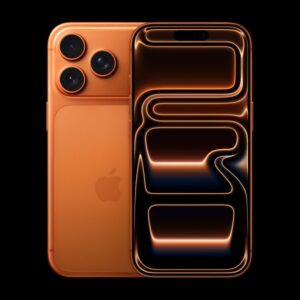
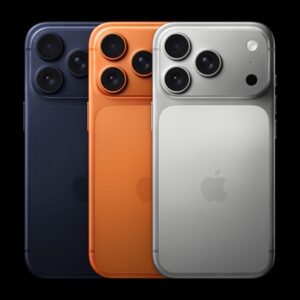
Apple sells the Pro models in 3 finishes: Cosmic Orange, Deep Blue, and Silver. There is no black option this generation, and no gray. Both phones are rated IP68 under IEC standard 60529, with a maximum depth of 6 meters for up to 30 minutes.
Apple built a new Apple-designed vapor chamber into the chassis using a laser-weld process, with deionized water sealed inside. The water transfers heat from the A19 Pro chip out into the surrounding aluminum frame. Apple says the new architecture is also what created enough internal volume for the larger battery in both models.
Scratchgate
Scratches and circular marks on retail demo units became a story almost as soon as the iPhone 17 Pro went on sale. According to Bloomberg‘s Mark Gurman, who reported the issue on launch day, demo units of the iPhone 17 Pro, iPhone 17 Pro Max, and the Space Black iPhone Air at Apple Stores in New York, Hong Kong, Shanghai, and London showed visible scuffs, often around the MagSafe area on the back.
Apple responded on the record. According to 9to5Mac‘s reporting from Apple, the marks were not scratches but material transfer from worn in-store MagSafe stands, and could be removed with cleaning. Apple said it was working to address the issue in stores; later coverage indicated retail employees were given a salt-substance cleaning solution and that silicone rings were being added to in-store MagSafe risers. Apple separately said the camera plateau edges have similar characteristics to anodized edges on other Apple products, including iPhones and MacBooks, and that small abrasions over time can be expected.
According to a materials scientist quoted in iFixit‘s teardown, the type of damage seen on the camera plateau edges is “spalling.” David Niebuhr explained that the sharp, flat edge of the plateau prevents the anodized layer from adhering as evenly as it does on flat or curved surfaces. Flat areas show only shallow scratches that don’t reach bare metal, while the plateau corners can flake and reveal the silver aluminum underneath.
Repairability
According to iFixit‘s teardown, the iPhone 17 Pro earned a provisional repairability score of 7 out of 10. The teardown found 3 iPhone-firsts inside the device: a screwed-in battery tray with 14 Torx Plus screws, the new vapor chamber, and the use of Torx Plus fasteners. The battery uses an electrically debonding adhesive that releases at 12V in roughly 70 seconds. Less positively, the iPhone 17 Pro removed the dual-entry design earlier Pro models had, so most major repairs now require removing the display.
iFixit also tested the new thermal design under load. According to iFixit‘s teardown analysis, an iPhone 16 Pro Max reached 37.8 °C and began throttling in side-by-side testing, while an iPhone 17 Pro Max held at approximately 34.8 °C without throttling. The teardown credited the aluminum frame and vapor chamber for the difference.
Display
Apple kept the same display sizes used on the iPhone 16 Pro family. The iPhone 17 Pro has a 6.3-inch Super Retina XDR OLED display at 2,622 by 1,206 and 460 ppi, while the iPhone 17 Pro Max has a 6.9-inch panel at 2,868 by 1,320 and 460 ppi. Both support ProMotion variable refresh up to 120Hz, the Always-On display, the Dynamic Island, HDR, True Tone, P3 wide color, and a 2,000,000:1 typical contrast ratio.
Outdoor brightness has climbed to 3,000 nits peak, up from 2,000 nits on the iPhone 16 Pro. Peak HDR brightness is 1,600 nits, typical brightness is 1,000 nits, and minimum brightness drops to 1 nit. The 1-nit floor is what allows the Always-On display to fade down without going dark.
Apple also updated the cover glass. The company says the new Apple-designed coating gives Ceramic Shield 2 better anti-reflection properties to cut down on outdoor glare, in addition to the scratch-resistance gains. The previous-generation iPhone 16 Pro used the older Ceramic Shield up front and a textured matte glass back, so this generation upgrades both surfaces at once.
A19 Pro Chip
The iPhone 17 Pro models use Apple’s new A19 Pro chip. It has a 6-core CPU with 2 performance cores and 4 efficiency cores, a 6-core GPU with Neural Accelerators built into each core, a 16-core Neural Engine, and hardware-accelerated ray tracing. Apple says the GPU has a larger cache and more memory than the A18 Pro. Apple calls the A19 Pro CPU “the fastest CPU in any smartphone.”
The vapor chamber is meant to keep the chip running closer to its peak for longer. Apple says A19 Pro and the vapor chamber together deliver “up to 40 percent better sustained performance” than the previous generation.
N1 Wireless Networking Chip
Apple also introduced N1, a new in-house wireless networking chip in the iPhone 17 Pro and across the iPhone 17 lineup. N1 enables Wi-Fi 7, Bluetooth 6, and Thread, replacing the third-party wireless silicon Apple used in earlier iPhones. Apple also says N1 makes Personal Hotspot and AirDrop more reliable.
Apple did not include its in-house C-series cellular modem in the iPhone 17 Pro at launch. The C1 modem debuted in the iPhone 16e in early 2025 and the C1X arrived in the iPhone Air, but Apple has not publicly named the cellular modem in either iPhone 17 Pro model.
Memory Integrity Enforcement
The iPhone 17 Pro and iPhone 17 Pro Max also turn on a new always-on memory-safety defense Apple calls Memory Integrity Enforcement. Apple describes MIE as “the most significant upgrade to memory safety in the history of consumer operating systems.” The protection is built around Apple’s secure memory allocators, Enhanced Memory Tagging Extension running in synchronous mode, and Tag Confidentiality Enforcement, and it hardens attack surfaces including the kernel and over 70 userland processes.
Apple says MIE is aimed at the mercenary spyware industry rather than at threats most users will encounter day to day, and it is enabled by default on iPhone 17 hardware.
Camera
The iPhone 17 Pro uses a triple 48MP Pro Fusion rear camera system. The Main lens is 24mm at f/1.78 with second-generation sensor-shift OIS and 100% Focus Pixels, and supports 24MP and 48MP super-high-resolution photos. The Ultra Wide is 48MP at 13mm and f/2.2 with a 120° field of view. The Telephoto is a 48MP, 100mm (4x optical) f/2.8 tetraprism lens with 3D sensor-shift optical image stabilization.
The Main lens enables a 12MP 2x optical-quality crop at 48mm, and the Telephoto enables a 12MP 8x optical-quality crop at 200mm. Total optical-quality range is 16x, with digital zoom up to 40x for photos. Apple says the new Telephoto sensor’s surface area is 56% larger than on the prior generation, and describes the 200mm 8x reach as “the longest optical-quality zoom ever on iPhone.”
For comparison, the iPhone 16 Pro had a 48MP Fusion main, a 48MP Ultra Wide, and a 12MP Telephoto with 5x optical zoom at 120mm. The iPhone 17 Pro replaces the 12MP 5x telephoto with a 48MP 4x telephoto whose larger sensor is what opens up the 8x optical-quality crop.
Center Stage Front Camera
The new 18MP Center Stage front camera uses a square sensor. Apple says it is the first square front camera sensor on iPhone, and the wider field of view lets you take portrait or landscape photos and videos without rotating the phone. AI-driven Center Stage for photos can automatically expand the frame and rotate from portrait to landscape to fit a group, and Center Stage for video calls keeps you in the frame.
The front camera also supports 4K HDR ultra-stabilized video and Dual Capture, which records the front and rear cameras at the same time.
Pro Video Features
Apple says the iPhone 17 Pro and iPhone 17 Pro Max are the first smartphones to support ProRes RAW, Apple Log 2, and genlock. Genlock works through the new Blackmagic Design Camera ProDock, and ProRes RAW is supported in Final Cut Camera and the Blackmagic Camera app. APIs are available so other developers can adopt these formats.
Battery Life
Apple credits the new internal layout, the wider plateau, and the eSIM-only design for the longest battery life it has ever shipped on iPhone. The iPhone 17 Pro is rated for up to 33 hours of video playback or 30 hours streamed. The iPhone 17 Pro Max is rated for up to 39 hours of video playback or 35 hours streamed, with the 39-hour figure applying specifically to eSIM-only models sold in the U.S. and select markets, where the space formerly used by the physical SIM tray now holds additional battery.
By comparison, the iPhone 16 Pro was rated for up to 27 hours video playback (22 streamed) and the iPhone 16 Pro Max for up to 33 hours (29 streamed). Apple describes the iPhone 17 Pro Max as offering up to 4 more hours per full charge than the iPhone 15 Pro Max.
Charging
A 40W USB-C adapter or higher with a USB-C cable can take the iPhone 17 Pro to 50% in 20 minutes, and a 30W or higher adapter with a MagSafe Charger reaches 50% in 30 minutes. MagSafe wireless charging tops out at 25W, and Qi2 wireless charging is also supported up to 25W. Apple sells a new 40W Dynamic Power Adapter with 60W Max as part of the charging lineup.
Apple Intelligence Updates
The iPhone 17 Pro ships with iOS 26. Apple released the update on Monday, September 15, 2025, alongside companion releases of iPadOS 26, macOS Tahoe, watchOS 26, visionOS 26, and tvOS 26. iOS 26 introduces Apple’s new Liquid Glass design language across the operating system and adds several new Apple Intelligence features.
Live Translation now works in Messages, FaceTime, and Phone, processed on-device by Apple Intelligence. Visual intelligence has expanded to read anything on screen, not just what the camera sees, and Apple is making the on-device foundation models available to third-party developers through new APIs. The system also includes new screening tools for unknown calls and messages, plus a single Apple Games app that consolidates Game Center and game discovery in one place.
Apple Intelligence is available in beta in English, French, German, Italian, Portuguese (Brazil), Spanish, Chinese (simplified), Japanese, and Korean. Danish, Dutch, Norwegian, Portuguese (Portugal), Swedish, Turkish, Chinese (traditional), and Vietnamese were announced as coming by the end of 2025.
Smaller Changes
Connectivity
The iPhone 17 Pro supports Wi-Fi 7 (802.11be) with 2×2 MIMO, Bluetooth 6, Thread, NFC with reader mode, and Apple’s second-generation Ultra Wideband chip, with the first four routed through the new N1 networking chip described above and the Ultra Wideband chip on its own piece of silicon.
USB-C handles wired data and video. USB 3 transfer speeds up to 10 Gb/s are supported when a compatible cable is used, plus DisplayPort output for external monitors. Cellular includes 5G in both sub-6 GHz and mmWave with 4×4 MIMO, and Gigabit LTE with 4×4 MIMO.
Both Pro models are eSIM-only in the U.S. and other eSIM-only markets, with dual eSIM support and no physical SIM tray. Satellite features include Emergency SOS, Roadside Assistance, Messages, and Find My, plus Crash Detection.
Action Button and Camera Control
The Action button on the left replaces the old Ring/Silent switch and can be set to Silent Mode, Focus, Camera, Visual Intelligence, Flashlight, Voice Memo, Recognize Music, Translate, Magnifier, Controls, Shortcut, or Accessibility. Camera Control sits on the right side and is touch- and pressure-sensitive. A single click opens the Camera app, and light presses surface adjustments for Exposure, Depth, Zoom, Cameras, Styles, and Tone.
Sensors
The sensor stack includes Face ID, the LiDAR Scanner, a barometer, a high-dynamic-range gyro, a high-g accelerometer, a proximity sensor, and dual ambient light sensors.
Accessibility
Built-in accessibility features cover vision, mobility, hearing, speech, and cognitive needs. The list includes VoiceOver, Zoom, Magnifier, Voice Control, Switch Control, AssistiveTouch, Eye Tracking, RTT and TTY support, Closed Captions, Live Captions, Personal Voice, Live Speech, Type to Siri, Vocal Shortcuts, and Spoken Content.
In the Box
Apple ships the iPhone with iOS 26 preinstalled, a 1-meter USB-C charge cable, and documentation. There is no power adapter and no EarPods.
Environmental
Apple says the iPhone 17 Pro is made with 30% recycled content overall, including 50% recycled aluminum in the enclosure, 100% recycled cobalt and 95% recycled lithium in the battery, 100% recycled gold plating and tin solder in all Apple-designed printed circuit boards, 100% recycled gold wire in all cameras, 100% recycled tungsten and copper wire in the Taptic Engine, 100% recycled copper in the vapor chamber enclosure, and 100% recycled rare earth elements in all magnets. Packaging is 100% fiber-based, and Apple says 40% of manufacturing electricity across the supply chain comes from renewable energy. Apple also says the new packaging is 25% more efficient than iPhone 16 Pro boxes, allowing more devices to ship per pallet.
What’s Next for iPhone 17 Pro
Apple is expected to announce the iPhone 18 Pro and iPhone 18 Pro Max in September 2026.
According to a Macworld report by Filipe Espósito published in April 2026, Apple’s iPhone 18 Pro color slate consists of Dark Cherry, Light Blue, Dark Gray, and Silver. Bloomberg‘s Mark Gurman, in his Power On newsletter, has separately reported that Apple is testing a “deep red” finish for the iPhone 18 Pro and iPhone 18 Pro Max. Dummy units of the iPhone 18 Pro Max shared by Max Tech’s Vadim Yuryev in late April 2026 also suggest the camera plateau will be thicker, with lenses that protrude more than they do on the iPhone 17 Pro Max.
iPhone 17 Pro Timeline
April 23, 2026 — Dummy units of the iPhone 18 Pro Max shared by Max Tech’s Vadim Yuryev suggest a thicker camera plateau and more protruding lenses than the iPhone 17 Pro Max.
April 22, 2026 — Macworld‘s Filipe Espósito reports the iPhone 18 Pro color lineup as Dark Cherry, Light Blue, Dark Gray, and Silver.
April 17, 2026 — AppleInsider, citing Counterpoint Research, reports Apple iPhone shipments in China grew 20% year over year for the quarter ending March 2026, the company’s largest gain since Q4 2020.
March 19, 2026 — Counterpoint Research data via 9to5Mac shows Apple’s iPhone sales in China rose 23% year over year across the first 9 weeks of 2026 against a 4% market decline.
February 22, 2026 — Bloomberg‘s Mark Gurman, in his Power On newsletter, reports Apple is testing a “deep red” finish for the iPhone 18 Pro and iPhone 18 Pro Max.
February 12, 2026 — Bloomberg, citing Counterpoint Research, reports the iPhone 17 lineup helped Apple to 8% growth in China in January 2026 while the overall market fell 23% year over year.
September 28, 2025 — 9to5Mac reports Apple is combating scratchgate with silicone rings on in-store MagSafe risers and a salt-based cleaning solution.
September 24, 2025 — 9to5Mac‘s Chance Miller publishes Apple’s on-record response to scratchgate, with Apple attributing demo-unit marks to worn MagSafe stands and material transfer.
September 23, 2025 — iFixit publishes its iPhone 17 Pro teardown, awarding a 7/10 repairability score and detailing the vapor chamber and screwed-in battery tray.
September 19, 2025 — The iPhone 17 Pro and iPhone 17 Pro Max go on sale at Apple Store locations worldwide, alongside the iPhone 17, iPhone Air, the new Apple Watch lineup, and AirPods Pro 3.
September 17, 2025 — 9to5Mac‘s Chance Miller publishes the iPhone 17 Pro review.
September 15, 2025 — iOS 26 is released as a free software update.
September 12, 2025 — iPhone 17 Pro pre-orders begin at 5 a.m. PDT.
September 9, 2025 — Apple unveils the iPhone 17 lineup at the “Awe Dropping” event at Apple Park, and publishes the Memory Integrity Enforcement blog post.
Changelog
May 3, 2026 — Initial publication.
Note: See an error in this roundup or want to offer feedback? Send us an email here.