






MacBook Pro
Apple's highest-end laptops.
Should You Buy the MacBook Pro?
The MacBook Pro is in a fresh stretch of its product cycle. Apple refreshed the base 14-inch MacBook Pro with M5 in October 2025, and added new 14- and 16-inch models with M5 Pro and M5 Max in March 2026. All five chip-and-size combinations are current.
Pricing in the U.S. starts at $1,699 for the 14-inch M5 (16GB unified memory, 1TB SSD), $2,199 for the 14-inch M5 Pro, and $3,599 for the 14-inch M5 Max. The 16-inch starts at $2,699 with M5 Pro and $3,899 with M5 Max. Apple offers education savings of $100 to $300 depending on the configuration.
Reviewers describe the M5 generation as an excellent but incremental update on a class-leading laptop. According to Engadget‘s Devindra Hardawar, the 14-inch M5 is “more of the same on the surface,” with the GPU upgrade as the most notable change. The M5 Pro and M5 Max reviews struck the same note: faster chips, faster storage, and an unchanged chassis everywhere else.
If you don’t need pro-class performance or the mini-LED display, Apple’s other Macs are worth considering. The MacBook Air with M5 starts at $1,099, and the new MacBook Neo starts at $599 with an A18 Pro chip. The Mac mini is the desktop sibling running M5-generation chips, while the Mac Studio remains on the previous M4 Max and M3 Ultra as of April 2026.
Bloomberg‘s Mark Gurman has reported that Apple is preparing a redesigned MacBook Pro with an OLED touchscreen display, M6 Pro and M6 Max chips, and a thinner enclosure. His most recent Power On newsletter pushed the likely launch from late 2026 into early 2027, citing a global memory chip shortage that has affected Apple’s broader 2026 Mac roadmap. If you want to wait for the redesigned model, holding off may make sense; if you need a MacBook Pro now, the M5 generation is excellent.
How to Buy
The 14- and 16-inch MacBook Pro can be ordered from Apple’s online store, Apple Stores, and authorized retailers. Pre-orders for the M5 Pro and M5 Max models opened March 4, 2026, with availability beginning March 11, 2026 in 33 countries and regions. The base 14-inch with M5 has been on sale since October 22, 2025.
Apple ships an in-box adapter with every model. The base 14-inch with M5 and the entry-level 15-core M5 Pro come with a 70W USB-C power adapter. The 18-core M5 Pro and M5 Max 14-inch models include a 96W adapter. All 16-inch models ship with a 140W adapter.
Pricing begins at $1,699 for the 14-inch with M5 (16GB / 1TB), with the M5 Pro 14-inch at $2,199 and the M5 Max 14-inch at $3,599. The 16-inch with M5 Pro starts at $2,699 and the 16-inch with M5 Max at $3,899. M5 Pro models start with 1TB of standard storage, and M5 Max models start with 2TB.
In March 2026, Apple removed the 512GB SSD option from the base M5 MacBook Pro, raising the starting price from $1,599 to $1,699 in exchange for 1TB of standard storage. According to MacRumors, the rest of the storage tiers shifted accordingly, with the 4TB upgrade now $1,000 above the new base instead of $1,200 above the old one.
Configure-to-Order Options
Build-to-order options are available at the Apple online store. The base 14-inch M5 can be configured with 24GB or 32GB unified memory and 2TB or 4TB SSDs. The M5 Pro scales up to 48GB or 64GB of unified memory depending on chip variant, with up to 4TB of storage. The M5 Max can be specified with up to 128GB of memory and an 8TB SSD. A nano-texture display upgrade and adapter upgrades are also available at order time.
Reviews
Reviews of the M5 generation MacBook Pro are positive but largely incremental. Most outlets land on the same point: this is a faster chip and faster storage in a chassis that has gone unchanged since 2021, with no compelling reason for M4 owners to upgrade.
Engadget‘s Devindra Hardawar gave the 14-inch M5 a score of 92/100 and described it as “more of the same on the surface” with a meaningful graphics upgrade. His separate review of the 16-inch M5 Max kept the same incremental verdict, with the 16-inch remaining the laptop other professional notebooks chase.
The Verge‘s Antonio G. Di Benedetto saw no compelling reason for M4 owners to upgrade. The publication also tested the SSD: with a 4TB drive in a 16-inch M5 Max, the laptop sustained 13.6 GB/s read speeds and 17.8 GB/s write speeds, which works out to 86 percent and 123 percent improvements over the equivalent M4 Max model.
Tom’s Hardware reviewer Andrew E. Freedman concluded the 14-inch M5 Max is “at the height of its powers as an ultraportable workstation.” BGR called the M5 Max MacBook Pro “the best gets better.”
Macworld‘s Roman Loyola described the 16-inch M5 Max as Apple’s fastest laptop. Loyola noted that the M3 Ultra in the Mac Studio still leads in raw GPU performance because it has 60 GPU cores to the M5 Max’s 40.
Tom’s Guide reviewer Tony Polanco measured the 16-inch M5 Pro running for 21 hours and 10 minutes in a continuous web-browsing battery test. CGMagazine‘s Brendan Frye described the 2026 MacBook Pro M5 Pro as a meaningful refinement on a proven formula.
Design
Apple last overhauled the MacBook Pro in 2021. Five generations later, the M5 family carries forward that unibody aluminum chassis with no externally visible changes. According to iFixit, the 2026 14-inch MacBook Pro shares the same ProMotion HDR mini-LED display, 1080p webcam with display notch, full-size function keys, and blacked-out keyboard introduced four years ago.
The 14-inch model measures 0.61 inch (1.55 cm) tall, 12.31 inches (31.26 cm) wide, and 8.71 inches (22.12 cm) deep. Weight varies by chip: 3.4 lb (1.55 kg) for the M5, 3.5 lb (1.60 kg) for the M5 Pro, and 3.6 lb (1.62 kg) for the M5 Max.
The 16-inch is 0.66 inch (1.68 cm) tall, 14.01 inches (35.57 cm) wide, and 9.77 inches (24.81 cm) deep, weighing 4.7 lb (2.14 kg) with M5 Pro and 4.7 lb (2.15 kg) with M5 Max.
Both sizes are sold in Space Black and Silver. The notch at the top of the display houses the camera and remains in place. Apple has not yet moved to a hole-punch cutout, although that change is rumored for the next generation.
Display
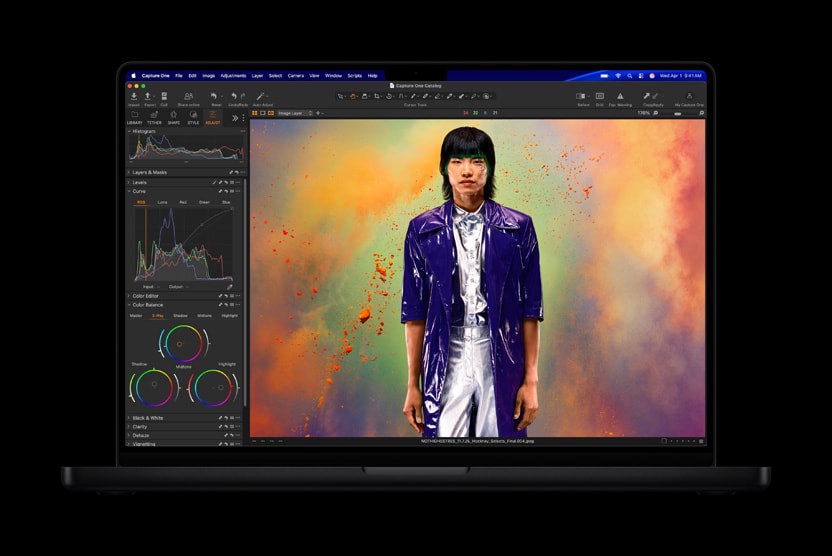
The 14-inch MacBook Pro features a 14.2-inch Liquid Retina XDR display at 3024-by-1964 native resolution and 254 pixels per inch. The 16-inch has a 16.2-inch Liquid Retina XDR display at 3456-by-2234 at the same 254 ppi density.
Both displays use mini-LED backlighting. XDR brightness reaches up to 1000 nits sustained full-screen and 1600 nits peak HDR in temperatures less than 25°C. SDR brightness can hit up to 1000 nits outdoor. The contrast ratio is 1,000,000:1.
Color reproduction covers 1 billion colors with the P3 wide color gamut, plus True Tone for matching the display’s white balance to the ambient light in the room.
ProMotion supports adaptive refresh rates up to 120Hz, scaling down during static content to save battery. Fixed refresh rates of 47.95Hz, 48.00Hz, 50.00Hz, 59.94Hz, and 60.00Hz are also selectable for video editing workflows.
A nano-texture display is offered as a configure-to-order option on both screen sizes. The treatment reduces glare on the glossy mini-LED panel.
M5 Chip
The base 14-inch MacBook Pro runs the M5 chip, built on Apple’s third-generation 3-nanometer process. The M5 has a 10-core CPU with 4 super cores and 6 efficiency cores, a 10-core GPU with hardware-accelerated ray tracing, and a 16-core Neural Engine. Memory bandwidth is 153GB/s. A Neural Accelerator sits in each GPU core and improves on-chip AI performance.
RAM and Storage
The M5 14-inch starts at 16GB unified memory and a 1TB SSD. Memory configurations scale to 24GB or 32GB. Storage tops out at 4TB.
In March 2026, Apple removed the 512GB SSD option from the base M5 MacBook Pro. According to MacRumors, the change brought the starting price from $1,599 to $1,699 while doubling the standard storage to 1TB. The change also adjusted the upgrade pricing for higher tiers.
Performance vs. M4
Apple’s claims for the M5 frame the chip in multipliers over M4. The 10-core CPU is up to 20 percent faster on multithreaded workloads, the GPU is up to 1.6x faster on graphics tests, and AI performance lands at up to 3.5x M4. Each of those numbers is Apple’s own benchmark, with the usual “up to” qualifier.
According to Engadget‘s review, the GPU and AI improvement is the standout change in the M5; CPU and other gains are incremental.
M5 Pro and M5 Max Chips
The higher-end MacBook Pro models use the M5 Pro or M5 Max, both built using a new Apple-designed Fusion Architecture that combines two third-generation 3-nanometer dies into a single system on a chip.
Apple’s John Ternus, senior vice president of Hardware Engineering, said in the launch press release that the new MacBook Pro is “up to 4x faster than the previous generation.”
The M5 Pro is offered in two configurations: 15-core CPU (5 super cores and 10 performance cores) with a 16-core GPU, or 18-core CPU (6 super cores and 12 performance cores) with a 20-core GPU. The M5 Max ships only at 18 CPU cores, paired with either a 32-core GPU or a 40-core GPU. Each GPU core includes a Neural Accelerator.
Apple says M5 Pro and M5 Max are up to 30 percent faster than M4 Pro and M4 Max on CPU workloads, with up to 4x AI performance versus the previous generation, up to 8x AI performance versus M1, and a graphics performance increase of up to 50 percent over M4 Pro and M4 Max.
The chips also include a third-generation Apple ray-tracing engine and a 16-core Neural Engine carried across the M5 family. Apple’s Johny Srouji, senior vice president of Hardware Technologies, described the chip family as a major advance for Apple silicon, with the Fusion Architecture preserving the unified memory architecture and power efficiency principles of Apple silicon.
A new Memory Integrity Enforcement feature debuts on M5 Pro and M5 Max. Apple describes it as an industry-first, always-on memory safety protection.
RAM and Storage
The 14-inch M5 Pro starts at 24GB unified memory and a 1TB SSD. Memory tops out at 48GB or 64GB depending on chip variant. The 14-inch M5 Max starts at 36GB and 2TB and scales to 128GB of memory and an 8TB SSD at the highest configuration.
The 16-inch M5 Pro opens at 24GB and 1TB and runs up to 128GB of memory. The 16-inch M5 Max starts at 36GB and 2TB, with the same 128GB / 8TB ceiling.
Apple says memory bandwidth scales with the chip: 307GB/s on M5 Pro, 460GB/s on the 32-core M5 Max, and up to 614GB/s on the 40-core M5 Max.
GPU and AI Performance
The Fusion Architecture’s per-GPU-core Neural Accelerators drive most of the AI gains. Apple’s framing is up to 4x AI performance versus the previous generation and up to 8x versus M1.
Independent benchmarks back the upgrade. Tom’s Hardware reviewer Andrew E. Freedman ran Cinebench 2026 on the 14-inch M5 Max and recorded sustained scores between 7,990 and 8,058 across a 10-run stress test, with Cinebench’s clock estimates reaching up to 4.6 GHz on a single core and up to 4.3 GHz multi-core. Macworld‘s Roman Loyola benchmarked the 16-inch M5 Max at a Cinebench 2026 GPU score of 94,035, a multi-CPU score of 9,426, and a single-CPU score of 722.
The M3 Ultra in the Mac Studio still leads in raw GPU performance because it has 60 GPU cores to the M5 Max’s 40. For mobile workloads, the M5 Max is the fastest Apple silicon laptop chip Apple has shipped.
Storage Speed
Apple says the new MacBook Pro reaches SSD speeds of up to 14.5GB/s, with up to 2x faster read/write performance versus the previous generation, tested on a 16-inch M5 Max with an 8TB SSD.
Independent testing confirmed the gain. According to The Verge, a 4TB M5 Max measured 13.6 GB/s sustained read and 17.8 GB/s sustained write, an 86 percent and 123 percent improvement over the M4 Max equivalent.
Battery Life
The 14-inch MacBook Pro has a 72.4-watt-hour lithium-polymer battery. Apple cites up to 24 hours of video streaming and up to 16 hours of wireless web browsing on the M5, up to 22 hours / 14 hours on the M5 Pro, and up to 20 hours / 13 hours on the M5 Max.
The 16-inch uses a 100-watt-hour lithium-polymer battery (actual rating 99.6 watt-hours per Apple’s footnote). Apple’s claims are up to 24 hours / 17 hours on M5 Pro and up to 22 hours / 16 hours on M5 Max.
According to Tom’s Guide reviewer Tony Polanco, the 16-inch M5 Pro lasted 21 hours and 10 minutes in a continuous web-surfing test with the display set to 150 nits.
iFixit‘s teardown of the M5 14-inch reported the battery capacity at 72.6 watt-hours, a small variance from Apple’s 72.4-watt-hour spec that does not translate into real-world differences.
Charging
The MacBook Pro supports MagSafe 3 charging and fast-charges to 50 percent in 30 minutes with a 96W or higher USB-C power adapter (140W on the 16-inch).
In-box adapters vary by configuration. The base 14-inch M5 and the entry 15-core M5 Pro ship with a 70W adapter. The 18-core M5 Pro and M5 Max 14-inch models include a 96W adapter. All 16-inch models come with a 140W adapter.
Connectivity
All current MacBook Pro models include three USB-C/Thunderbolt ports, an HDMI port, an SDXC card slot, a 3.5 mm headphone jack with high-impedance support, and a MagSafe 3 port. The Thunderbolt generation depends on the chip: the base 14-inch M5 uses three Thunderbolt 4 ports (up to 40Gb/s), while the M5 Pro and M5 Max models include three Thunderbolt 5 ports (up to 120Gb/s).
Wireless
The base M5 14-inch ships with Wi-Fi 6E (802.11ax) and Bluetooth 5.3. The M5 Pro and M5 Max models include Apple’s new N1 wireless networking chip, which adds Wi-Fi 7 (802.11be), Bluetooth 6, and Thread networking.
The split caused some confusion at the M5 launch. According to John Gruber at Daring Fireball, the M5 14-inch arrived with Wi-Fi 6E despite the simultaneously announced M5 iPad Pro shipping with the N1 and Wi-Fi 7. Gruber predicted the upcoming M5 Pro and M5 Max MacBook Pro models would gain Wi-Fi 7 when they launched, and Apple confirmed his read in March 2026.
External Display Support
Display capacity scales with the chip. The M5 drives up to two external displays. The M5 Pro drives up to three. The M5 Max drives up to four. Resolutions per Thunderbolt port go as high as 8K at 60Hz, 5K at 120Hz, or 4K at 240Hz.
Camera, Audio, and Microphones
All current MacBook Pro models include a 12MP Center Stage camera with Desk View support and 1080p HD video recording.
Audio runs through a high-fidelity six-speaker sound system with force-cancelling woofers, plus Spatial Audio with Dolby Atmos. A studio-quality three-mic array with directional beamforming and Voice Isolation modes handles audio capture.
Keyboard, Trackpad, and Touch ID
The MacBook Pro features a backlit Magic Keyboard with 78 keys (ANSI) or 79 keys (ISO), including 12 full-height function keys. Touch ID is built into the power key for unlocking, authenticating purchases, and replacing passwords. An ambient light sensor adjusts the keyboard backlight to room conditions.
Below the keyboard is a large Force Touch trackpad, which uses haptic feedback rather than a physical click mechanism.
Accessibility
Built-in accessibility features include VoiceOver, Zoom, Voice Control, Switch Control, Closed Captions, Live Captions, Personal Voice, and Live Speech. macOS Tahoe also adds the Accessibility Reader, a system-wide tool for adjusting text contrast and reading flow on any displayed content.
Repairability and Sustainability
According to iFixit‘s teardown, the M5 14-inch MacBook Pro earns a provisional 4 out of 10 repairability score. The battery procedure still requires nearly complete disassembly because Apple sells the battery only as part of the top-case-with-keyboard assembly. iFixit did note one small improvement: the trackpad no longer needs to be removed to access the central battery pull tabs.
On the environmental side, Apple says the MacBook Pro is made with 45 percent recycled content by mass. That includes 100 percent recycled aluminum in the enclosure, 100 percent recycled cobalt and 95 percent recycled lithium in the battery, 100 percent recycled rare earth elements in all magnets, and 100 percent recycled gold plating in all Apple-designed printed circuit boards.
The product is ENERGY STAR certified, ships in 100 percent fiber-based packaging, and is part of Apple’s broader Apple 2030 carbon-neutral plan. Apple also notes that 50 percent of the manufacturing electricity for the 14- and 16-inch MacBook Pro is sourced from low-carbon electricity.
The Other Macs in the Lineup
The MacBook Pro sits at the top of Apple’s laptop range. The MacBook Air, refreshed in March 2026 with the M5 chip, starts at $1,099 for the 13-inch model with 16GB memory and a 512GB SSD. The Air also includes the N1 chip with Wi-Fi 7 and Bluetooth 6, but uses a non-mini-LED display and offers fewer ports.
Below the Air, the new MacBook Neo launched March 11, 2026 at $599 ($499 with education savings). It is the first Mac to use an A-series chip, the A18 Pro, instead of an M-series chip. The Neo has a 13-inch Liquid Retina display at 2408-by-1506 and is sold in Silver, Blush, Citrus, and Indigo.
On the desktop side, the Mac mini is current with M5 and M5 Pro chips, while the Mac Studio remains on the M4 Max and M3 Ultra as of April 2026. The iMac is also still on the M4 chip. An M5 Max and M5 Ultra Mac Studio refresh is expected later in 2026, although Bloomberg‘s Mark Gurman has reported that the timing may slip due to the same memory chip shortage affecting the next MacBook Pro.
macOS Tahoe and Apple Intelligence
All current MacBook Pro models ship with macOS Tahoe 26. The OS introduces a new Liquid Glass design language across the system, plus an updated Spotlight, an integrated Phone app on Mac with cellular call relay from iPhone, Live Activities from iPhone, and Live Translation across Messages, FaceTime, and the Phone app.
Apple Intelligence is available in beta and supports English, Danish, Dutch, French, German, Italian, Norwegian, Portuguese, Spanish, Swedish, Turkish, Vietnamese, simplified and traditional Chinese, Japanese, and Korean. Developers can also work with the Foundation Models framework to build features on top of Apple’s on-device language models.
What’s Next for the MacBook Pro
Apple is preparing the largest MacBook Pro overhaul since 2021. According to Bloomberg‘s Mark Gurman, the next-generation MacBook Pro will move to OLED display technology, add a touchscreen, gain a Dynamic Island-style camera cutout in place of the current notch, and ship in a thinner enclosure. The new chip is expected to be the M6, built on a 2-nanometer process, with M6 Pro and M6 Max variants.
Earlier Gurman pieces pointed to a late 2026 launch, and analyst Ming-Chi Kuo predicted late Q4 2026 or early Q1 2027 in a Medium post in March 2026. Gurman’s Power On newsletter on April 19, 2026 then reported that the MacBook Pro and Mac Studio refreshes are likely to slip later than expected, citing a global memory chip shortage. The early 2027 window now looks more probable than late 2026.
Gurman has reported that Apple may launch the redesigned high-end model as a new MacBook Ultra sitting above the existing M5 Pro and M5 Max MacBook Pro, which could remain on sale. Gurman cautioned that Apple could keep the traditional MacBook Pro name. The product name is not yet confirmed.
The redesign may not span the lineup. According to Gurman’s most recent reporting, only the higher-end M6 Pro and M6 Max models will get the OLED display, the touchscreen, and the thinner enclosure. The entry-level M6 MacBook Pro is expected to keep the existing chassis with a mini-LED display.
A future MacBook Pro could also gain 5G cellular connectivity. Gurman has reported that Apple is investigating a cellular Mac, although such a product is not expected before late 2026 at the earliest.
MacBook Pro Timeline
April 23, 2026 — 9to5Mac aggregates rumored M6 MacBook Pro features, including a touchscreen, OLED display, thinner design, Dynamic Island, M6 Pro and M6 Max variants, and possible cellular support.
April 19, 2026 — Bloomberg‘s Mark Gurman reports in Power On that the M6 MacBook Pro and Mac Studio refreshes are likely to slip into early 2027 due to a global memory chip shortage.
March 16, 2026 — Engadget publishes its review of the 16-inch M5 Max MacBook Pro, calling it the pinnacle of professional laptops.
March 12, 2026 — BGR publishes its M5 Max MacBook Pro review.
March 11, 2026 — Apple begins shipping the 14- and 16-inch MacBook Pro with M5 Pro and M5 Max in 33 countries and regions.
March 11, 2026 — Ming-Chi Kuo posts on Medium predicting an OLED touch MacBook Pro in late Q4 2026 or early Q1 2027.
March 9, 2026 — Tom’s Hardware and Macworld publish reviews of the 14- and 16-inch M5 Max MacBook Pro.
March 8, 2026 — Bloomberg‘s Mark Gurman reports possible MacBook Ultra branding for the redesigned high-end MacBook Pro.
March 4, 2026 — Pre-orders open for the new MacBook Pro with M5 Pro and M5 Max in 33 countries and regions. Apple also announces the MacBook Air with M5 and the MacBook Neo on the same day.
March 3, 2026 — Apple announces the MacBook Pro with M5 Pro and M5 Max, the M5 Pro and M5 Max chips, and updated storage tiers for the M5 14-inch MacBook Pro (1TB standard, $1,699 starting price).
February 24, 2026 — Bloomberg‘s Mark Gurman publishes a detailed Power On report on the redesigned MacBook Pro with OLED, touchscreen, and Dynamic Island.
December 21, 2025 — 9to5Mac publishes an overview of rumored M6 MacBook Pro features pointing to a late 2026 or early 2027 launch.
October 27, 2025 — iFixit publishes its teardown of the M5 14-inch MacBook Pro with a 4 out of 10 repairability score.
October 22, 2025 — The 14-inch MacBook Pro with M5, the iPad Pro with M5, and the Apple Vision Pro with M5 begin shipping.
October 21, 2025 — Engadget and The Verge publish reviews of the M5 14-inch MacBook Pro.
October 15, 2025 — Apple unveils the 14-inch MacBook Pro with M5 alongside the M5 chip, the M5 iPad Pro, and the M5 Apple Vision Pro. Pre-orders open the same day.
Changelog
May 3, 2026 — Initial publication.
Note: See an error in this roundup or want to offer feedback? Send us an email here.