




iPad
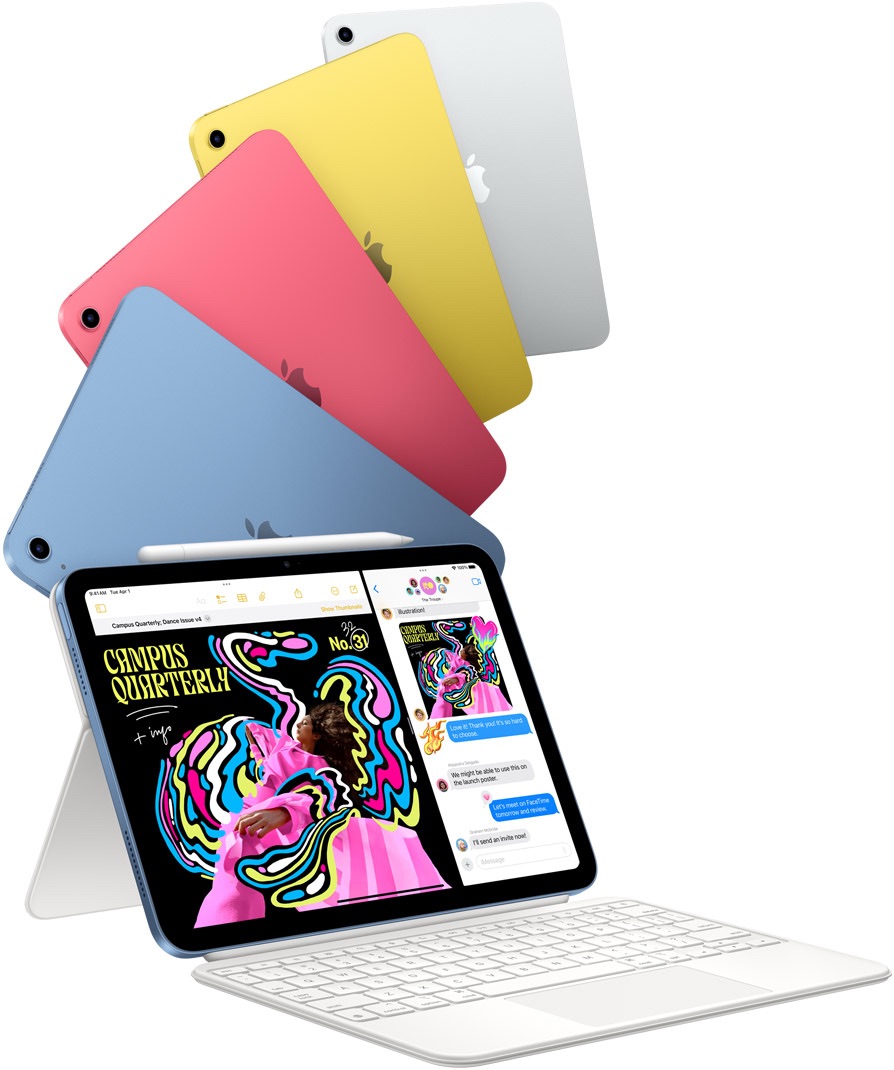
Apple's 11-inch iPad with Apple Pencil and Magic Keyboard Folio support, starting at $349.
Should You Buy the iPad?
The iPad (A16) is Apple’s most affordable iPad, and the model most people will gravitate toward when they want a tablet on a budget. The Wi-Fi configuration starts at $349, and the Wi-Fi + Cellular configuration starts at $499. Apple also offers education pricing of $329 and $479.
This is the only current-generation iPad that does not support Apple Intelligence, according to Macworld. Apple Intelligence requires at least an A17 Pro chip and 8GB of memory, and the A16 falls short on both counts. If features such as Genmoji, Image Playground, Writing Tools, and Live Translation matter to you, this is the wrong iPad.
For a small tablet with Apple Intelligence support, the iPad mini (A17 Pro) starts at $499 and uses the faster A17 Pro chip. For a more capable iPad with a better display, the iPad Air (M4) starts at $599 for the 11-inch model, with M4 silicon and Apple Pencil Pro support. At the top, the iPad Pro (M5) starts at $999 with a tandem OLED Ultra Retina XDR display, ProMotion, and Wi-Fi 7.
A successor is on the horizon. According to Bloomberg‘s Mark Gurman, Apple has a new entry-level iPad with the A18 chip “ready to go” and still coming this year. Macworld also notes a December 2025 code leak that pointed to iPad codenames J581 and J582 paired with an A19 chip, so the exact silicon for the successor remains unsettled. If Apple Intelligence is non-negotiable, waiting may pay off.
If it isn’t, the iPad (A16) is still a strong value buy. Engadget‘s review describes the iPad (A16) as a refresh that “refuses to rock the boat,” with welcome chip and storage gains and few other meaningful changes. The lack of Apple Intelligence is the most significant software trade-off, and the older display technology is the most significant hardware trade-off.
How to Buy
The iPad (A16) is sold through Apple’s online store, Apple retail stores, authorized resellers, and major carriers. Apple opened pre-orders on March 4, 2025, and the iPad began arriving with customers on March 12, 2025, in 29 countries and regions, including the U.S.
The Wi-Fi model is priced at $349 for 128GB, with 256GB and 512GB tiers available at higher prices. The Wi-Fi + Cellular model starts at $499 for 128GB and uses Model A3355. Apple’s education pricing reduces the Wi-Fi tier to $329 and the Wi-Fi + Cellular tier to $479.
The iPad (A16) comes in 4 finishes: Silver, Blue, Pink, and Yellow. Apple sells two compatible accessories separately: the Apple Pencil (USB-C) at $79 ($69 education) and the Magic Keyboard Folio at $249 ($229 education).
Reviews
Reviewers landed on a mostly consistent verdict. The iPad (A16) is a strong value buy held back by an aging display and the absence of Apple Intelligence, with verdicts ranging from “shockingly good” to “still one of the best.”
According to Cult of Mac‘s Ed Hardy, the iPad (A16) is “an almost shockingly good computer” for $349 and a worthy primary device for most users, with the lack of Apple Intelligence flagged as a notable drawback rather than a deal-breaker. TechRadar‘s review concludes the iPad (A16) is still one of the best entry-level tablets available, with the A16 keeping things responsive in iPadOS and the price competitive against everything else in its class.
Tech Advisor‘s review describes the iPad (A16) as “more than enough” for most buyers at half the price of the iPad Air, citing an excellent design and a screen that handles content well. The reviewer flags the lack of an anti-reflective coating as a caveat. Engadget frames the refresh as a “tock” update with welcome chip and memory improvements but otherwise a continuation of the previous model.
According to Laptop Mag‘s review, the iPad (A16) is the best iPad for most people because of the doubled base storage, newer chip, solid battery life, and reasonable price. The reviewer criticizes Apple for continuing to promote the discontinued first-generation Apple Pencil. Creative Bloq‘s review labels the iPad (A16) “low-end, high value” and a solid pick for drawing, note-taking, browsing, and streaming, with the absence of Apple Intelligence and M-series-only app gating noted as trade-offs.
According to Consumer Reports‘ tablet evaluation of the Wi-Fi model, the iPad (A16) rates very good for everyday speed, very good on screen brightness with reduced glare, and excellent on common tasks.
Design
The iPad (A16) inherits the same all-aluminum, flat-edge enclosure that Apple introduced with the iPad (10th generation) in 2022. Apple did not announce any external design changes for this refresh.
The Wi-Fi model has dimensions of 9.79 inches (248.6 mm) by 7.07 inches (179.5 mm), with a thickness of 7 mm (0.28 inches), and weighs 1.05 pounds (477 grams). The Wi-Fi + Cellular model is identical in footprint and depth but weighs 1.06 pounds (481 grams).
The iPad (A16) is offered in 4 finishes: Silver, Blue, Pink, and Yellow. Note that Apple’s color palette is unchanged from the previous generation. The front camera sits along the long edge of the device for landscape video calls, and the USB-C port and Smart Connector remain in place from the prior model.
According to Engadget‘s review, the iPad (A16) looks indistinguishable from the iPad (10th generation) at a glance. Tech Advisor‘s review reaches the same conclusion, noting both models share the aluminum chassis and flat-edge form factor.
Touch ID
Touch ID is housed in the top button rather than under the display. Place a finger on it to unlock the iPad, secure personal data within apps, and authorize purchases through the iTunes Store, App Store, and Apple Books. Touch ID also handles Apple Pay authentication within apps and on the web. The iPad (A16) does not support Face ID, which remains exclusive to the iPad Pro in Apple’s tablet lineup.
Display
The iPad (A16) has an 11-inch Liquid Retina display, which Apple measures at 10.86 inches diagonally as a rectangle. It is an LED-backlit IPS panel with a resolution of 2360 by 1640 at 264 ppi, 500 nits of brightness, True Tone, and a fingerprint-resistant oleophobic coating.
True Tone shifts the white point of the display to match the ambient lighting in the room, so colors look natural rather than blue-shifted in warm light. The panel refreshes at 60Hz; the iPad (A16) does not have ProMotion or any high-refresh-rate option, which remain reserved for the iPad Pro across the iPad line.
A touch sensor on the display allows it to work with the Apple Pencil (USB-C) and the first-generation Apple Pencil. There is no hover support.
Display Limitations
The display is non-laminated, with a visible air gap between the LCD panel and the front glass, and lacks an anti-reflective coating. According to Engadget‘s review, this is the most significant hardware shortcoming on the iPad (A16) and the same screen continues from the prior model. Tech Advisor‘s review confirms the iPad (A16) lacks the anti-reflective coating found on the iPad Air.
The display is also not tuned for the wider P3 color space, according to Engadget; it is sRGB only, in contrast to the iPad Air and iPad Pro. Apple advertises 500 nits of peak brightness, but according to GSMArena‘s lab measurements, the iPad (A16) reached 466 nits in both manual and automatic modes.
A16 Chip
The iPad (A16) is powered by the A16 chip. In this iPad, the A16 has a 5-core CPU and 4-core GPU, plus a Neural Engine with 16 cores.
Apple says the A16 makes the iPad nearly 30 percent faster than the iPad (10th generation), and delivers up to a 50 percent improvement in overall performance compared to the iPad with the A13 Bionic chip. Apple’s testing also claims the A16 is up to 6x faster than what the company describes as “the best-selling Android tablet.”
Apple’s testing conditions appear in the press release fine print. Comparisons were performed in January and February 2025 using preproduction iPad (A16) units against production iPad (10th generation) units, with Microsoft Excel for iPad version 2.93 used as the task suite for the 30 percent and 50 percent claims, and a Qualcomm SM6375-based Android tablet for the 6x claim.
Independent benchmarks line up roughly with Apple’s framing. According to Cult of Mac‘s review, the iPad (A16) recorded a Geekbench 6 multi-core score of 5,493. Creative Bloq‘s review reported a higher Geekbench 6 multi-core score of 6,338, with a single-core score of 2,598 and a 3DMark Solar Bay score of 3,623. Multi-core results in the range of roughly 5,500 to 6,300 are consistent with the device’s positioning.
The A16 does not support Apple Intelligence. Apple Intelligence is available on the iPad mini (A17 Pro) and iPad models with M1 or later silicon; the A16 falls outside that compatibility list.
RAM
The iPad (A16) has 6GB of RAM, up from 4GB on the iPad (10th generation). Apple does not list memory on its consumer-facing iPad spec pages, but according to Cult of Mac, the iPad (A16) ships with 6GB. Consumer Reports‘ lab profile of the Wi-Fi model independently records 6GB of memory.
The 6GB figure is below the 8GB minimum required for Apple Intelligence, so even if Apple wanted to bring its on-device generative features to this iPad, the memory would not support them.
Storage
The iPad (A16) is offered in three storage tiers: 128GB, 256GB, and 512GB. The iPad (10th generation) shipped only in 64GB and 256GB, so this refresh doubles the starting capacity and adds a new 512GB tier at the top.
Camera
The iPad (A16) has a single 12MP Wide rear camera with an ƒ/1.8 aperture, a five-element lens, autofocus with Focus Pixels, digital zoom up to 5x, panorama up to 63MP, and Smart HDR 4. Photos save as HEIF or JPEG.
The front camera is a 12MP landscape Center Stage camera at ƒ/2.4 with Smart HDR 4. Because the camera sits on the long edge of the iPad, the framing stays upright when the iPad is in landscape orientation.
According to PhoneArena‘s review, the camera hardware itself is unchanged from the iPad (10th generation); the meaningful change is the move from Smart HDR 3 to Smart HDR 4.
Video Capabilities
The rear camera records 4K video at 24, 25, 30, or 60 fps, with 1080p available at 25, 30, or 60 fps and 720p at 30 or 60 fps. Slo-mo recording reaches 1080p at 120 or 240 fps, and the camera supports time-lapse, extended dynamic range up to 30 fps, video image stabilization, cinematic stabilization at 1080p and 720p, and continuous autofocus. Video formats are HEVC and H.264.
The front camera records 1080p at 25, 30, or 60 fps, with time-lapse, extended dynamic range up to 30 fps, cinematic stabilization, lens correction, and Retina Flash.
Battery Life
The iPad (A16) has a 28.93-watt-hour rechargeable lithium-polymer battery. Apple rates it at up to 10 hours of web browsing on Wi-Fi or video playback on all models, and up to 9 hours of web browsing over a cellular network on Wi-Fi + Cellular models.
Charging
The iPad (A16) charges through its USB-C port with the bundled 20W USB-C Power Adapter and 1-meter USB-C charge cable. There is no MagSafe and no wireless charging on this iPad.
According to GSMArena‘s lab testing, the iPad (A16) drew up to 45W from a USB-PD adapter, well above the rated output of Apple’s bundled 20W charger. Apple does not advertise a 45W charging tier for the iPad (A16).
Connectivity
All iPad (A16) models include Wi-Fi 6 (802.11ax) with 2×2 MIMO and simultaneous dual-band support, plus Bluetooth 5.3. There is no Wi-Fi 6E or Wi-Fi 7.
The USB-C port supports charging, DisplayPort output, and data transfer at USB 2.0 speeds of up to 480Mb/s.
The iPad (A16) drives one external display at up to 4K resolution at 60Hz over USB-C, with native DisplayPort output and adapter support for VGA, HDMI, and DVI. Up to 4K AirPlay mirroring is supported to an Apple TV (2nd generation or later) or an AirPlay-compatible smart TV.
According to Cult of Mac‘s review, the iPad (A16) cannot use a connected display as a workspace extension; it can only mirror its screen. Workspace extension on iPadOS requires an iPad Air or iPad Pro with M-series silicon.
For positioning, the iPad (A16) includes a digital compass, Wi-Fi positioning, and iBeacon microlocation on all models. GPS and GNSS are exclusive to Wi-Fi + Cellular models.
Cellular
Wi-Fi + Cellular models add 5G NR (sub-6 GHz) with 4×4 MIMO and Gigabit LTE with 4×4 MIMO. The cellular model identifier is A3355. There is no mmWave 5G support on the iPad (A16).
Apple has dropped the physical SIM card slot from this generation. The iPad (A16) is data-only and uses eSIM exclusively for cellular activation. Apple notes that eSIM activation on Model A3355 is not available in mainland China.
5G Bands
The iPad (A16) supports 26 5G NR bands on Model A3355: n1, n2, n3, n5, n7, n8, n12, n14, n20, n25, n26, n28, n29, n30, n38, n40, n41, n48, n66, n70, n71, n75, n76, n77, n78, and n79.
LTE Bands
FDD-LTE band support covers bands 1, 2, 3, 4, 5, 7, 8, 11, 12, 13, 14, 17, 18, 19, 20, 21, 25, 26, 28, 29, 30, 32, 66, and 71. TD-LTE bands include 34, 38, 39, 40, 41, 42, and 48. The cellular model also supports UMTS/HSPA/HSPA+/DC-HSDPA at 850, 900, 1700, 2100, 1900, and 2100 MHz.
Apple Pencil and Magic Keyboard Folio
The iPad (A16) is compatible with the Apple Pencil (USB-C) and the first-generation Apple Pencil. Apple Pencil Pro is not supported, and there is no hover. The Apple Pencil (USB-C) sells for $79 ($69 education).
Pairing and charging the first-generation Apple Pencil on the iPad (A16) requires a USB-C to Apple Pencil Adapter, because the first-generation Pencil charges over Lightning while the iPad (A16) only has a USB-C port. According to Laptop Mag‘s review, this is an awkward holdover and the iPad (A16) should support the newer Apple Pencil Pro instead.
The recommended keyboard accessory is the Magic Keyboard Folio, which Apple sells for $249 ($229 education). The newer Magic Keyboard for iPad Air, with its cantilever floating-display design, is not compatible with the iPad (A16).
Audio
The iPad (A16) has landscape stereo speakers and dual microphones for calls, video recording, and audio recording. Audio playback supports AAC, MP3, Apple Lossless, FLAC, Dolby Digital, Dolby Digital Plus, and Dolby Atmos. Video playback supports HEVC and H.264, with content support for Dolby Vision and HDR10.
The speaker placement keeps stereo separation when the iPad is held in landscape.
iPadOS 26 on iPad (A16)
The iPad (A16) ships with iPadOS 26, which Apple released on September 15, 2025. The update brings the new Liquid Glass design language, a desktop-style windowing system, folders in the Dock, and a new Preview app for PDFs to the iPad (A16).
According to 9to5Mac, iPadOS 26 turned the entry-level iPad into the best value in the iPad lineup because the new windowing system was previously gated behind Stage Manager and required M-series silicon. Bringing real multitasking to the iPad (A16) closed one of the biggest software gaps between this device and the iPad Air or iPad Pro.
The iPad (A16) also gains the iPadOS 26 3D Effect Lock Screen, alongside the broader iPadOS 26 feature set.
Apple Intelligence Note
Apple Intelligence is not available on the iPad (A16) under iPadOS 26 and will not become available in any future iPadOS release. Apple Intelligence requires at least an A17 Pro or M-series chip and 8GB of RAM, and the A16 chip with 6GB of memory falls short on both. According to Macworld, this is the only current-generation iPad without Apple Intelligence.
The practical effect is that features such as Genmoji, Image Playground, Writing Tools, Clean Up in Photos, and Apple Intelligence-driven Live Translation are unavailable on this iPad.
Accessibility
The iPad (A16) supports the standard iPadOS accessibility feature set: VoiceOver, Zoom, Magnifier, Spoken Content, Voice Control, Switch Control, AssistiveTouch, Siri and Dictation, Type to Siri, Real-Time Text, Audio Descriptions, Subtitles and Closed Captioning, and Live Captions.
iPadOS 26 added new Braille experiences and additional Vehicle Motion Cues options to the platform; both are available on the iPad (A16) within iPadOS 26’s compatibility constraints.
Environmental Claims
Apple says the iPad (A16) achieves 40 percent recycled content overall, with over 30 percent of manufacturing electricity sourced from renewable electricity, and over 40 percent emissions reduction against Apple’s modeled business-as-usual scenario.
By material, the iPad (A16) uses 100 percent recycled aluminum in the enclosure and metal chassis, 100 percent recycled cobalt and over 95 percent recycled lithium in the battery (a first for the iPad on the lithium claim), 100 percent recycled rare earth elements across all magnets, 100 percent recycled gold wire in all cameras, and 100 percent recycled gold plating in all Apple-designed printed circuit boards and connectors. Solder on multiple PCBs uses 100 percent recycled tin, the logo uses 80 percent recycled steel, the cover glass contains 15 percent recycled glass, and at least 11 components are made with at least 50 percent recycled plastic. Packaging is 100 percent fiber-based with 41 percent recycled content.
The iPad (A16) is ENERGY STAR certified, free of mercury, brominated flame retardants, and PVC, and uses arsenic-free glass.
In the Box
Apple includes the iPad, a 1-meter USB-C charge cable, and a 20W USB-C Power Adapter. There is no Apple Pencil and no Smart Folio in the box. Both the keyboard and stylus accessories are sold separately.
What’s Next for iPad
Apple has a refreshed entry-level iPad on its product roadmap. According to Bloomberg‘s Mark Gurman, this next iPad is built around the A18 chip and is still expected to ship in 2026.
Macworld notes a December 2025 code leak that referenced iPad codenames J581 and J582 paired with an A19 chip, raising the possibility that Apple’s next entry-level iPad could ship with A19 silicon instead of the A18. Apple has not officially announced any successor as of this writing.
iPad Timeline
April 2026 — Macworld updates its 2026 iPad guide, noting the iPad (A16) is the only current-generation iPad without Apple Intelligence and reaffirming that an A18 successor is expected in 2026.
March 29, 2026 — MacRumors aggregates Mark Gurman’s report that Apple has next-generation iPad, HomePod mini, and Apple TV updates ready to go.
March 22, 2026 — Bloomberg‘s Mark Gurman reports that the next entry-level iPad with the A18 chip is set to launch this year. 9to5Mac covers.
March 11, 2026 — iPad Air (M4) ships in a sibling product launch.
March 2, 2026 — Apple announces the iPad Air (M4); the iPad (A16) is not refreshed at the same time.
December 2025 — A code leak references iPad models codenamed J581 and J582 with an A19 chip, per Macworld‘s reporting.
October 22, 2025 — iPad Pro (M5) ships in a sibling product launch.
October 15, 2025 — Apple announces the iPad Pro (M5).
September 15, 2025 — Apple releases iPadOS 26; the iPad (A16) is among the supported devices.
July 24, 2025 — iPadOS 26 enters public beta.
June 13, 2025 — 9to5Mac argues iPadOS 26 makes the iPad (A16) the best value in the iPad lineup by adding the windowing system.
June 9, 2025 — Apple announces iPadOS 26 at WWDC 2025; the iPad (A16) is confirmed compatible.
March 26, 2025 — Engadget publishes its iPad (A16) review.
March 14, 2025 — Cult of Mac publishes its iPad (A16) review.
March 12, 2025 — The iPad (A16) begins arriving with customers in 29 countries and regions, including the U.S.
March 4, 2025 — Apple announces the iPad (A16) alongside the iPad Air (M3); pre-orders open.
Changelog
May 3, 2026 — Initial publication.
Note: See an error in this roundup or want to offer feedback? Send us an email here.