




iPhone Air
Apple's new super-thin iPhone, available now.
Should You Buy the iPhone Air?
Priced from $999, the iPhone Air sits between the $799 iPhone 17 and the $1,099 iPhone 17 Pro in Apple’s fall 2025 lineup, replacing the Plus-sized iPhone. If thinness and light weight are the priorities, the Air is the only iPhone Apple sells that meets both.
Buying today comes with a clearer picture of what the Air is and what it isn’t. Apple anticipated iPhone Air would account for 6 to 8 percent of new iPhone sales, roughly matching the iPhone 16 Plus it replaced, according to Bloomberg‘s reporting relayed by Fortune. Demand came in weaker than Apple had planned for. Nikkei Asia reported in October 2025 that Apple had cut iPhone Air production orders nearly to “end of production” levels while raising orders for the iPhone 17 and iPhone 17 Pro.
Analyst Ming-Chi Kuo added that most iPhone Air suppliers would reduce capacity by more than 80 percent by Q1 2026, with some long-lead components discontinued by the end of 2025. A KeyBanc Capital Markets investor survey found “virtually no demand” for the model. Japan’s Mizuho Securities, as reported by Nikkei Asia, cut its iPhone Air production forecast by approximately 1 million units.
The Air is the thinnest iPhone Apple has shipped, with a ProMotion OLED and an A19 Pro chip, though its 5-core GPU sits below the iPhone 17 Pro’s 6-core version. Compared to the iPhone 17, the Air has a single rear lens instead of a dual-lens system, and compared to the iPhone 17 Pro, it lacks the Telephoto lens and has the smallest battery in the iPhone 17-generation lineup. The Air is also eSIM-only worldwide, with no physical SIM slot in any region.
iPhone Air is sold alongside the $799 iPhone 17, the $1,099 iPhone 17 Pro, and the $1,199 iPhone 17 Pro Max, plus the newer $599 iPhone 17e that Apple introduced in March 2026. A second-generation iPhone Air is not expected until the spring of 2027, so there is no near-term successor to wait for.
Design
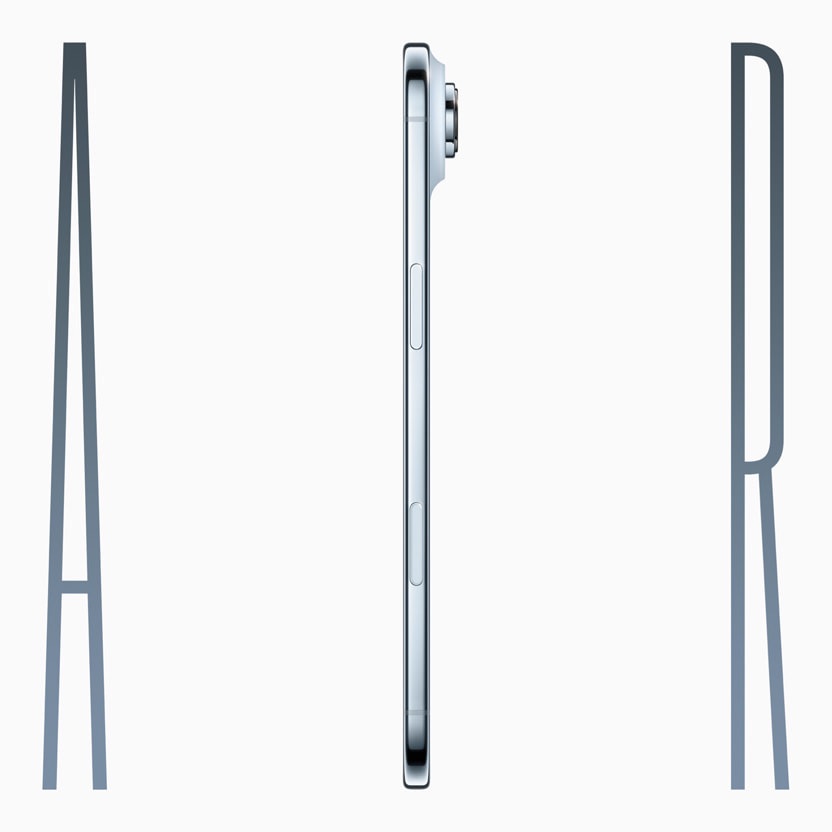
iPhone Air measures 2.94 inches wide, 6.15 inches tall, and 0.22 inch deep, or 5.64mm at its slimmest. It weighs 5.82 ounces (165 grams). Apple describes the phone as “the thinnest iPhone ever made at 5.6mm.”
The chassis uses a grade 5 titanium frame with a polished mirror finish. 4 finishes are offered at launch: space black, cloud white, light gold, and sky blue.
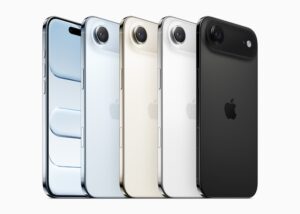
A precision-milled rear plateau houses the cameras, speaker, and Apple silicon. By pulling those components into the plateau, Apple freed interior space for the battery.
The front cover glass is Ceramic Shield 2, which Apple says offers 3x more scratch resistance than prior generations and carries an Apple-designed anti-reflection coating. The rear is protected by Ceramic Shield, with up to 4x better crack resistance than the back glass on previous iPhones.
iPhone Air features an IP68 rating under IEC standard 60529, tested to a maximum depth of 6 meters for up to 30 minutes.
The hardware layout keeps the Action button, Camera Control, side button, and volume controls. The USB-C port at the bottom is itself 3D-printed from titanium, a manufacturing choice Apple says uses 33 percent less material than a conventional forging process.
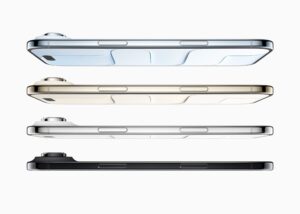
As for real-world durability, Apple says iPhone Air is more durable than any previous iPhone. iFixit‘s teardown added a caveat: the empty titanium frame bent more easily than the fully assembled phone, with weak points at the plastic antenna passthroughs. Once populated with internals, the Air held up in widely shared stress tests.
In its teardown, iFixit awarded iPhone Air a provisional 7 out of 10 repairability score, citing a flat disassembly tree, the logic board’s relocation into the plateau, battery access through the back glass without removing the OLED, and Apple’s continued use of electrically debonding battery adhesive.
Apple builds iPhone Air with 35 percent recycled content overall, including 80 percent recycled titanium (the highest recycled-titanium percentage ever for an iPhone), 100 percent recycled cobalt plus 95 percent recycled lithium in the battery, 100 percent recycled rare earth elements in the magnets, and 80 percent recycled steel in the battery enclosure. Apple assembles the phone using 45 percent renewable electricity across the supply chain, and ships it in 100 percent fiber-based packaging that the company says allows 10 percent more units to fit per shipping trip.
Display
iPhone Air has a 6.5-inch all-screen OLED Super Retina XDR display at 2,736 by 1,260 pixels and 460 ppi. When measured as a rectangle, the diagonal is 6.55 inches.
The panel supports ProMotion with adaptive refresh rates up to 120Hz, plus an Always-On display that adjusts down to 1Hz when idle.
Apple rates typical brightness at 1,000 nits, with HDR peak at 1,600 nits and outdoor peak at 3,000 nits, which is the highest ever on iPhone and which Apple credits with 2x better outdoor contrast. Minimum brightness is 1 nit.
The contrast ratio is 2,000,000:1 typical. The display also carries Dynamic Island, True Tone, Wide color (P3), Haptic Touch, HDR, a fingerprint-resistant oleophobic coating, and an anti-reflective coating.
A19 Pro Chip
iPhone Air ships with the A19 Pro chip, the same base silicon used in the iPhone 17 Pro, though the Air’s variant carries a 5-core GPU instead of the Pro’s 6-core configuration.
The chip pairs a 6-core CPU (2 performance, 4 efficiency) with that 5-core GPU, a 16-core Neural Engine, and hardware-accelerated ray tracing. Apple has built Neural Accelerators into each GPU core. The company says they bring up to 3x the peak GPU compute of the previous generation. Apple also positions A19 Pro as delivering the fastest CPU available in any smartphone.
Memory Integrity Enforcement
A19 Pro and A19 also introduce Memory Integrity Enforcement, which Apple describes as an always-on memory-safety defense built into the chip and into iOS. MIE combines secure memory allocators, Enhanced Memory Tagging Extension in synchronous mode, and Tag Confidentiality Enforcement policies, hardening the iOS kernel plus more than 70 userland processes.
Apple positions MIE as an answer to mercenary spyware, saying it will make exploit chains significantly more expensive and difficult to develop and maintain. The company calls it “the most significant upgrade to memory safety in the history of consumer operating systems.”
Camera
iPhone Air has a single rear camera.
The 48MP Fusion Main uses a 26mm focal length, an f/1.6 aperture, sensor-shift optical image stabilization, and 100% Focus Pixels, built around what Apple describes as a 2.0 um quad-pixel sensor.
From that single sensor, the Air crops to a 12MP 2x Telephoto at a 52mm equivalent focal length with the same f/1.6 aperture and sensor-shift OIS. Apple frames the result as 4 effective focal lengths from a single lens, adding 28mm and 35mm framing alongside 1x and 2x. Digital zoom reaches up to 10x.
The camera captures 24-megapixel or 48-megapixel super-high-resolution stills. Imaging features include Deep Fusion, Smart HDR 5, Photonic Engine, next-generation portraits with Focus and Depth Control, Portrait Lighting with 6 effects, Night mode, and the latest Photographic Styles, including a new Bright style.
What the Air does not have is an ultra-wide lens or a dedicated telephoto lens. The 2x Telephoto is a sensor crop of the Fusion Main rather than a discrete optic, which is the principal camera tradeoff versus the iPhone 17’s dual-lens system and the iPhone 17 Pro’s triple-lens system.
Video
Video recording supports 4K Dolby Vision at 24, 25, 30, and 60 fps, Action mode up to 2.8K Dolby Vision at 60 fps, 1080p slo-mo at 120 or 240 fps, and Dual Capture at up to 4K Dolby Vision at 30 fps.
Center Stage Front Camera
On the front, the new 18MP Center Stage camera uses Apple’s first square front camera sensor on iPhone, with an f/1.9 aperture and autofocus. The square sensor lets you shoot in portrait or landscape while holding the phone vertically, and the camera automatically expands the field of view for group shots.
The front camera supports ultra-stabilized 4K HDR video, Dual Capture with the rear camera simultaneously, and Center Stage framing during video calls.
Battery Life
Apple rates iPhone Air at up to 27 hours of video playback and up to 22 hours of streamed video playback. With the iPhone Air MagSafe Battery accessory attached, those figures climb to up to 40 hours and up to 35 hours, respectively.
Apple does not publish iPhone Air’s mAh capacity. According to iFixit‘s teardown, the internal cell measures 3,149 mAh. For context, iFixit measured 3,692 mAh on iPhone 17, 4,252 mAh on iPhone 17 Pro, and 5,088 mAh on iPhone 17 Pro Max, making the Air’s cell the smallest in the iPhone 17 generation.
Per iFixit‘s teardown, the iPhone Air MagSafe Battery accessory contains a 12.26 Wh cell that appears to match the internal iPhone Air battery. iFixit confirmed the two are physically interchangeable.
Charging
iPhone Air fast-charges up to 50 percent in 30 minutes with a 20W wired adapter or higher, or with a 30W adapter or higher paired with MagSafe. MagSafe wireless charging is rated up to 20W, and Qi2 wireless charging is also rated up to 20W.
Adaptive Power Mode
iOS 26 introduces Adaptive Power Mode, which is designed to stretch daily battery life. On a phone with the Air’s capacity, that headroom is more consequential than it is on the Pro Max.
5G Connectivity
iPhone Air is the first shipping iPhone built around Apple’s C1X cellular modem. Apple says C1X is up to 2x faster than the first-generation C1 at the same cellular technologies, faster than the modem in iPhone 16 Pro, and approximately 30 percent more energy-efficient. It is the most power-efficient modem Apple has shipped in an iPhone.
On the air side, iPhone Air supports 5G sub-6 GHz with 4×4 MIMO and Gigabit LTE with 4×4 MIMO. mmWave 5G is not supported.
eSIM
iPhone Air is eSIM-only worldwide. It supports dual active eSIMs and can store 8 or more eSIMs, and it does not accept a physical SIM card in any region.
Satellite Features
iPhone Air carries Apple’s full satellite feature set: Emergency SOS via satellite, Roadside Assistance via satellite, Messages via satellite, and Find My via satellite.
Apple’s Crash Detection feature is also supported.
Wi-Fi, Bluetooth, and More
Apple’s N1 wireless chip supplies Wi-Fi 7 (802.11be) with 2×2 MIMO, Bluetooth 6, and Thread networking.
iPhone Air also includes Apple’s second-generation Ultra Wideband chip, NFC with reader mode, and Express Cards with power reserve. The USB-C port runs at USB 2 speeds up to 480 Mb/s for data.
Accessibility
iPhone Air includes Apple’s standard iOS accessibility feature set: VoiceOver, Zoom, Magnifier, Voice Control, Switch Control, AssistiveTouch, Eye Tracking, RTT/TTY, Closed Captions, Live Captions, Personal Voice, Live Speech, Type to Siri, Vocal Shortcuts, and Spoken Content.
Accessories
Apple introduced 4 dedicated accessories alongside the phone at launch. The iPhone Air Case with MagSafe sells for $49 in frost and shadow translucent polycarbonate with a reinforced frame. The iPhone Air Bumper is $39 and comes in 4 colors that match the phone. The Crossbody Strap is $59, woven from 100 percent recycled yarns with flexible magnets and stainless-steel sliders, in 10 colors. And the iPhone Air MagSafe Battery is $99.
On the charging side, Apple also debuted a 40W Dynamic Power Adapter with 60W Max at $39, plus a pair of Qi2 25W-certified MagSafe Chargers at $39 (1 m) and $49 (2 m).
How to Buy
iPhone Air is sold through Apple’s online store, Apple retail locations, carrier storefronts, and third-party retailers. Pricing starts at $999 for 256GB, or $41.62 per month under Apple Card Monthly Installments, with 512GB and 1TB storage tiers available at higher price points.
Availability opened in more than 63 countries and regions on September 19, 2025, including the U.S., UK, China, Japan, Canada, Germany, France, and India. A second wave reached 22 additional countries and regions on September 26, 2025.
What’s Next for iPhone Air
Reports point to a second-generation iPhone Air in spring 2027 rather than a fall 2026 refresh. Bloomberg‘s Mark Gurman has written in his Power On newsletter that iPhone Air 2 was never targeted for fall 2026 in the first place, and that the update centers on a switch to a 2-nanometer processor alongside battery improvements and possibly a second rear lens.
The Information has framed the same gap differently, reporting that Apple delayed iPhone Air 2 primarily to give engineering more time to add a second rear camera. Gurman’s read pushes back on the “delay” framing, arguing this is Apple’s planned cadence rather than a schedule slip.
Either way, suppliers have been winding down. By late October 2025, most Air suppliers were expected to reduce capacity more than 80 percent by the first quarter of 2026, according to analyst Ming-Chi Kuo. Foxconn reportedly had all but 1.5 production lines idle by November 10, 2025.
The designer who narrated the iPhone Air video at Apple’s September event, Abidur Chowdhury, left Apple for an AI startup in November 2025. Per Fortune‘s reporting on Bloomberg‘s reporting, the move was unrelated to iPhone Air’s sales performance.
iPhone Air Timeline
April 9, 2026 — Apple offers up to a 30 percent discount on iPhone Air through its UK Amazon storefront.
March 2026 — Apple introduces the $599 iPhone 17e and a new MacBook, broadening the entry-level lineup alongside iPhone Air.
November 18, 2025 — Apple designer Abidur Chowdhury, who presented iPhone Air’s September video, leaves Apple for an unnamed AI startup. Bloomberg‘s Mark Gurman reports the move is unrelated to iPhone Air sales, via Fortune.
November 16, 2025 — Bloomberg‘s Mark Gurman reports in Power On that iPhone Air 2 remains on track for a spring 2027 window, focused on a 2nm processor and battery improvements, with a possible second camera under consideration.
November 10, 2025 — Foxconn is reported to have wound down all but 1.5 iPhone Air production lines, with Luxshare stopping production at the end of October.
October 22, 2025 — Analyst Ming-Chi Kuo posts on X that iPhone Air supplier capacity will be cut more than 80 percent by Q1 2026 and some long-lead components will be discontinued by the end of 2025.
October 22, 2025 — Nikkei Asia reports that Apple has cut iPhone Air production orders nearly to “end of production” levels and increased iPhone 17 and iPhone 17 Pro orders. A KeyBanc Capital Markets investor survey finds “virtually no demand” for iPhone Air, and Mizuho Securities cuts its production forecast by approximately 1 million units.
September 26, 2025 — iPhone Air launches in a second wave of 22 additional countries and regions.
September 20, 2025 — iFixit publishes its iPhone Air teardown, assigning a provisional 7 out of 10 repairability score and measuring a 3,149 mAh battery.
September 19, 2025 — iPhone Air goes on sale globally in more than 63 countries and regions.
September 17, 2025 — The Verge publishes Allison Johnson’s iPhone Air review under the headline “statement piece”; the Vergecast covers iPhone Air, iPhone 17, and iPhone 17 Pro reviews.
September 15, 2025 — iOS 26 is released as a free software update.
September 12, 2025 — iPhone Air pre-orders open at 5 a.m. PDT in more than 63 countries and regions.
September 9, 2025 — Apple announces iPhone Air at the “Awe Dropping” event at Apple Park and publishes the Memory Integrity Enforcement security blog post the same day.
Changelog
May 3, 2026 — Initial publication.
Note: See an error in this roundup or want to offer feedback? Send us an email here.