




MacBook Air
Apple's mid-range MacBook Air starts at $1099 and is available in 13-inch and 15-inch sizes.
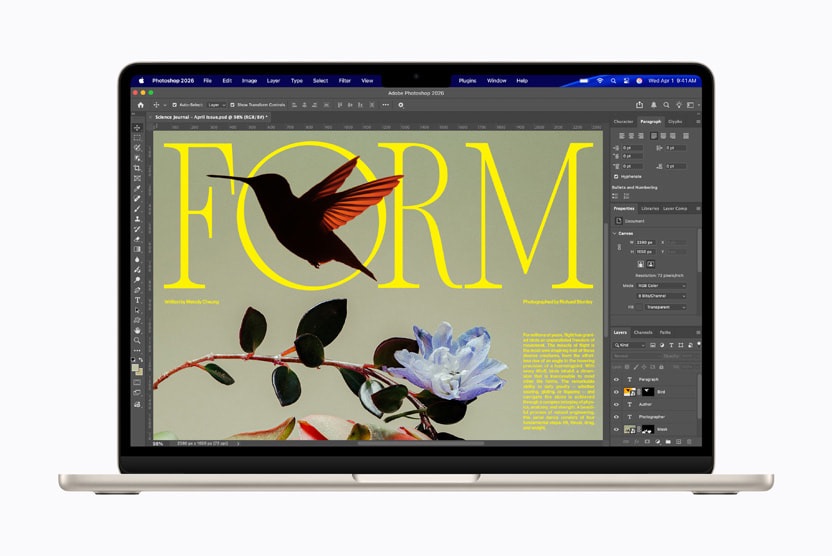
Should You Buy the MacBook Air?
The M5 MacBook Air is at the start of its product cycle. Apple announced it on March 3, 2026, opened pre-orders on March 4, and began shipping units to customers on Wednesday, March 11.
Pricing starts at $1,099 for the 13-inch model and $1,299 for the 15-inch model. Both sizes are $100 more than the M4 generation. According to AppleInsider‘s review roundup, Apple offset the price hike by doubling base storage from 256GB to 512GB.

If portability is the priority, the 13-inch model is the better choice at 2.7 pounds. If screen real estate and louder audio matter more, the 15-inch model adds two extra speakers and a larger panel at 3.3 pounds.
Below the Air, the new MacBook Neo starts at $599 and uses an A18 Pro chip aimed at students and light workloads. Above it, the 14-inch MacBook Pro with M5 starts at $1,599 and adds ProMotion and fan-cooled sustained performance. Stepping further into the Pro line, the M5 Pro 14-inch starts at $2,199, the 16-inch M5 Pro starts at $2,699, and M5 Max configurations top out at $3,899.
According to a synthesis of major reviews compiled by 9to5Mac, M4 owners have no compelling reason to upgrade, but anyone on an M2 or older Mac will see substantial gains.
How to Buy
The MacBook Air with M5 is sold through apple.com/store, the Apple Store app, and Apple authorized resellers in 33 countries and regions. Pre-orders opened at 6:15 a.m. PST on March 4, 2026. General availability began Wednesday, March 11.
The 13-inch model starts at $1,099 with a 10-core CPU, 8-core GPU, 16GB RAM, and 512GB SSD. Education pricing brings it down to $999. The 15-inch model starts at $1,299 ($1,199 with education savings) and ships with a 10-core GPU as standard.

Configure-to-order options include 24GB or 32GB memory, plus storage tiers up to 4TB. The 4TB tier is new for this generation, the highest capacity Apple has ever offered on MacBook Air.
U.S. buyers receive a 40W Dynamic Power Adapter with 60W Max in the box, alongside a 2-meter USB-C to MagSafe 3 cable. Configure-to-order options swap that for the 35W Dual USB-C Port Compact Power Adapter or the 70W USB-C Power Adapter, the latter required for the fastest charging speeds.
According to Macworld, no power adapter ships in the United Kingdom or EU in line with regional regulations giving consumers the ability to buy products without a charger. The 40W adapter is sold separately for £39, the 35W Dual USB-C for £59, or the 70W USB-C adapter for £59.
Reviews
Reviewer reactions to the M5 MacBook Air landed in “best for most” territory, with the $100 price increase as the consistent caveat.
According to Tom’s Hardware, the laptop is “the best Mac around” for many users, with the verdict “Steady as it goes.”

In Tom’s Guide‘s review by Tony Polanco, the 15-inch model earned an “almost perfect” verdict and was called a stellar notebook for most people, even at $100 more.
According to The Verge‘s Antonio G. Di Benedetto, as quoted by 9to5Mac, the MacBook Air remains Apple’s “Goldilocks” laptop. He wrote: “It’s just as outstanding a computer as last year’s model, even if it’s a shame it’s $100 more expensive.”
TechRadar‘s Lance Ulanoff described the 13-inch M5 MacBook Air as Apple’s best mix of winning design, near-pro-level performance, and battery life in an ultraportable.
Over at CNN Underscored, Henry T. Casey called the laptop “pretty much the perfect laptop for most people” despite the price hike.
Notebookcheck rated the 13-inch model a “very good” 92 percent, with concerns over unchanged battery life relative to the M4.
According to AppleInsider‘s review roundup, reviewers broadly criticized the absence of a touchscreen, observing that comparable Windows laptops at similar price points include touch.
Design
Apple kept the M5 MacBook Air’s external design unchanged from the M4 generation. The aluminum chassis, squared-off and flat-edged, dates back to the 2022 redesign that retired the tapered wedge of pre-Apple-silicon models. According to iFixit, the new generation is almost identical to its predecessor.
The 13-inch model measures 0.44 inch (1.13 cm) tall, 11.97 inches (30.41 cm) wide, and 8.46 inches (21.5 cm) deep, weighing 2.7 pounds (1.23 kg). The 15-inch model is 0.45 inch (1.15 cm) tall, 13.40 inches (34.04 cm) wide, and 9.35 inches (23.76 cm) deep, weighing 3.3 pounds (1.51 kg).
According to Trusted Reviews, the M5 weighs one gram less than the M4, but is otherwise externally identical.
The MacBook Air ships in four finishes: Sky Blue, Silver, Starlight, and Midnight, the same lineup carried over from the M4. The fanless silent design remains, with no vents and no moving parts inside the chassis.
Repairability
According to iFixit, repairs on the M5 MacBook Air remain challenging. Pentalobe screws guard the exterior, the battery is secured with stretch-release adhesives and screws and requires removing the logic board for access, and both memory and storage are non-serviceable and non-upgradeable.
iFixit highlights one positive. The MagSafe, Thunderbolt, and headphone ports are all highly modular. Apple has also published a MacBook Air (13-inch, M5) Repair Manual on its support site, dated March 12, 2026.
Display
Both MacBook Air sizes use Liquid Retina displays at 500 nits brightness, with support for 1 billion colors, P3 wide color, and True Tone. The 13-inch model is a 13.6-inch LED-backlit IPS panel at 2560-by-1664 native resolution, 224 pixels per inch. The 15-inch model uses a 15.3-inch panel at 2880-by-1864 native resolution, also at 224 pixels per inch.
As Macworld notes, the MacBook Air does not include ProMotion, the variable refresh-rate technology Apple reserves for the MacBook Pro lineup. Display panel and brightness specs are unchanged from the M4 generation.
In Tom’s Guide testing, the M5 MacBook Air came close to but did not quite hit Apple’s claimed 500 nits, with overall good color reproduction across sRGB and DCI-P3 plus good color accuracy on Delta-E.
M5 Chip
The MacBook Air uses Apple’s M5 chip, manufactured on TSMC’s third-generation 3-nanometer (N3P) process. The CPU has 10 cores, made up of 4 super cores plus 6 efficiency cores. The base 13-inch ships with an 8-core GPU; the 15-inch and the configure-to-order 13-inch ship with a 10-core GPU. Each GPU core contains a Neural Accelerator.
The M5 also includes a 16-core Neural Engine, third-generation hardware-accelerated ray tracing, and unified memory bandwidth of 153GB/s, up 28 percent from the M4.
Web browsing is up to 50 percent faster and demanding tasks up to 2x faster on the M5 MacBook Air than the Intel reference, plus up to 3.8x faster time-to-first-token performance for AI workloads.
RAM
The MacBook Air ships with 16GB of unified memory standard, configurable to 24GB or 32GB. The faster 153GB/s memory bandwidth applies to all configurations.
Storage
Base storage doubled from the previous generation to 512GB, with configure-to-order options at 1TB, 2TB, and 4TB. The 4TB tier is new for this generation. Apple claims up to 2x faster read/write performance versus the previous SSD.
According to Six Colors‘ tests by Dan Moren, the M5 measured a 125 percent read speed improvement and a 219 percent write speed improvement over the M4 in Blackmagic disk tests, with AmorphousDiskMark showing at least a 250 percent improvement. In Tom’s Hardware testing, the 13-inch M5 MacBook Air copied 25GB of files at 1,924.84 MBps, slightly ahead of the M5 MacBook Pro and faster than both Intel-based laptops in their comparison.
Performance
Apple’s main claim for the M5 MacBook Air is up to 4x faster AI performance than the M4 MacBook Air, plus up to 9.5x faster than the M1, with the comparisons defined against specific 32GB/4TB and 16GB/2TB configurations. Apple also lists up to 6.9x faster AI video enhancement in Topaz Video versus the M1 (and up to 1.9x versus the M4), up to 6.5x faster 3D rendering with ray tracing in Blender versus the M1 (and up to 1.5x versus the M4), and up to 2.7x faster image processing in Affinity versus the M1 (and up to 1.5x versus the M4).
According to Six Colors‘ Dan Moren, the M5 MacBook Air saw an approximately 11 percent increase in single-core and multi-core performance over the M4, plus a 31 percent average GPU performance gain. The 15-inch unit posted a Geekbench 6 single-core score of 4,167 and multi-core of 16,979 in Six Colors‘ testing.
In Tom’s Guide testing by Tony Polanco, the 15-inch M5 MacBook Air scored 17,276 multi-core on Geekbench 6, up from 14,921 on the M4, plus a Handbrake 4K-to-1080p transcode in 4 minutes 34 seconds, more than 20 seconds faster than the M4. In Tom’s Hardware testing, the 13-inch model scored 4,168 single-core and 17,067 multi-core on Geekbench 6, with a Handbrake transcode time of 4 minutes 41 seconds.
According to Six Colors‘ Dan Moren, single-core performance jumps approximately 38 percent over M3, 57 percent over M2, and 75 percent over M1.
According to Tom’s Hardware, the M5 thermally throttles in a Cinebench 2026 stress test, starting at a score of 3,415 and settling in the low 2,300s after several runs. According to The Verge‘s Antonio G. Di Benedetto, the M5 MacBook Air’s benchmark scores fell just slightly below the 14-inch M5 MacBook Pro across the board, attributable to the Air’s fanless cooling.
AI Performance
Each of the M5’s GPU cores has a Neural Accelerator, which Apple credits for the up-to-4x AI performance jump over the M4. The 16-core Neural Engine handles on-device Apple Intelligence and machine learning workloads. Apple cites large language model time-to-first-token performance up to 3.8x faster than an Intel Core Ultra X7 PC laptop reference.
Gaming
According to CNN Underscored, the M5 MacBook Air ran Shadow of the Tomb Raider at 43 fps, up from 36 fps on the M4 and far above the 13 fps measured on the new MacBook Neo.
According to Tom’s Guide testing summarized by AppleInsider, Cyberpunk 2077 ran at under 30 fps at 1200p resolution with medium settings, slightly slower than the M4’s 34 fps in the same test. Both findings co-exist; gaming performance varies by title and engine optimization.
Battery Life
The 13-inch MacBook Air contains a 53.8 watt-hour lithium-polymer battery; the 15-inch contains a 66.5 watt-hour battery. Apple rates both for up to 18 hours of video streaming and up to 15 hours of wireless web browsing, the same ratings as the M4 generation since both models use identical battery capacities.
Real-world reviewer testing came in below Apple’s 18-hour streaming maximum but still extensive. Tom’s Guide measured 15 hours 37 minutes in continuous web surfing at 150 nits. Notebookcheck measured 16 hours 11 minutes WLAN at 150 nits. TechRadar reported 15.5 hours web surfing. CNN Underscored measured 16 hours 38 minutes on a 4K looping video test, a 14 percent increase over the M4 in that specific test.
According to Notebookcheck testing, the M5’s full-brightness battery life is roughly 6 percent shorter than the M4 (6 hours 39 minutes vs 7 hours 5 minutes), since both models use the same 53.8 Wh cell and the M5 draws slightly more power at peak brightness.
Charging
The MacBook Air ships with a 40W Dynamic Power Adapter with 60W Max plus a 2-meter USB-C to MagSafe 3 cable. The 70W USB-C Power Adapter (Model A2743) or higher is required for fast charge: Apple says approximately 50 percent in about 30 minutes from a drained MacBook Air.
Buyers in the United Kingdom and EU receive no power adapter in the box, in line with regional regulations.
Connectivity
For the first time, the MacBook Air uses Apple’s N1 wireless networking chip. The N1 brings Wi-Fi 7 (802.11be) to MacBook Air, alongside Bluetooth 6 and Thread networking.
The MacBook Air has two Thunderbolt 4 (USB-C) ports supporting up to 40Gb/s, the MagSafe 3 charging port, plus a 3.5mm headphone jack with high-impedance headphone support. According to Macworld, Thunderbolt 5 remains exclusive to the M5 Pro and M5 Max MacBook Pros; the Air retains Thunderbolt 4. As Trusted Reviews observes, both Thunderbolt 4 ports remain on the left side of the chassis, an ergonomic complaint preserved from prior generations.
External Display Support
The MacBook Air supports up to two external displays simultaneously with the built-in display at full native resolution. Combinations include two displays at 6K@60Hz or 4K@144Hz, or a single display at 8K@60Hz, 5K@120Hz, or 4K@240Hz.
Camera and Audio
The MacBook Air uses a 12MP Center Stage camera at the top of the display, with support for Desk View and 1080p HD video recording. An advanced image signal processor in the M5 chip handles computational video.
The 13-inch model uses a four-speaker sound system. The 15-inch model uses six speakers, including force-cancelling woofers Apple reserves for the larger size. Both sizes share a three-mic array with directional beamforming, plus support for Voice Isolation and Wide Spectrum microphone modes. Both also support Spatial Audio with dynamic head tracking using compatible AirPods.
A new Edge Light effect, added in macOS Tahoe, provides a fill light to evenly illuminate a user’s face during video calls.
macOS Tahoe
The M5 MacBook Air ships with macOS Tahoe, which introduced the Liquid Glass design language across Apple’s platforms. Tahoe adds customizable colors for folders, app icons, and widgets, plus Live Translation in Messages, updates in Reminders, and Shortcuts actions that tap into Apple Intelligence models.
The Phone app on Mac relays cellular calls from a nearby iPhone, and Live Activities now open in iPhone Mirroring.
Apple Intelligence
On-device Apple Intelligence features rely on the M5’s 16-core Neural Engine plus the new GPU Neural Accelerators. Apple highlights faster AI inference for image generation, video enhancement, and text generation tasks.
Accessibility
Apple lists VoiceOver, Zoom, motion/display/text settings, Accessibility Reader, Voice Control, Switch Control, Closed Captions, Live Captions, and Personal Voice and Live Speech as built-in accessibility features for the MacBook Air with M5.
Environment
The MacBook Air with M5 is made with 55 percent recycled content by mass. The enclosure and trackpad gel plate use 100 percent recycled aluminum. The battery uses 100 percent recycled cobalt and 95 percent recycled lithium. All Apple-designed printed circuit boards use 100 percent recycled gold plating, all magnets use 100 percent recycled rare earth elements, all solder uses 100 percent recycled tin, and the keyboard feature plate and trackpad beam use 90 percent recycled steel.
Apple states 50 percent of manufacturing electricity for MacBook Air comes from low-carbon electricity. The laptop ships in 100 percent fiber-based packaging and is ENERGY STAR certified.
Other MacBooks in the Lineup
The MacBook Air sits in the middle of Apple’s spring 2026 Mac lineup. Below it, the new MacBook Neo starts at $599 ($499 with education savings) and uses an A18 Pro chip rather than M-series silicon. The Neo has a 13-inch Liquid Retina display and ships in Silver, Blush, Citrus, and Indigo.
Above the Air, the 14-inch MacBook Pro with M5 starts at $1,599 with 1TB base storage. The M5 Pro variants begin at $2,199 (14-inch) and $2,699 (16-inch), each with 18-core CPUs, up to 20-core GPUs, 1TB base storage, and Thunderbolt 5. M5 Max models begin at $3,599 (14-inch) and $3,899 (16-inch), with 18-core CPUs, up to 40-core GPUs, and 2TB base storage. The 16-inch M5 Max is offered in Space Black and Silver.
What’s Next for MacBook Air
The most-watched forward-looking change is OLED display technology, but it remains years away. According to analyst Ming-Chi Kuo via X on March 11, 2026, an OLED MacBook Air is expected around 2028 or 2029.
Bloomberg‘s Mark Gurman has reported a 2028 window in his “Power On” newsletter, though the specific newsletter is paywalled. Gurman’s broader Mac roadmap for 2026 covered the M5 MacBook Air, MacBook Neo, M5 Pro/Max MacBook Pros, M5 and M5 Pro Mac mini, plus M6 MacBook Pro updates further out.
Touch-screen MacBook timing is also unsettled. According to Macworld, citing Bloomberg, the MacBook Pro touch-screen models may slip from late 2026 toward early 2027 due to memory chip supply constraints.
MacBook Air Timeline
April 19, 2026 — Bloomberg‘s Mark Gurman reports that MacBook Pro touch-screen models may slip from late 2026 toward early 2027 due to a memory chip shortage. Macworld.
March 23, 2026 — Tom’s Hardware publishes its 13-inch MacBook Air M5 review, with the verdict “Steady as it goes.”
March 17, 2026 — CNN Underscored publishes its M5 MacBook Air review, calling it “pretty much the perfect laptop for most people.”
March 14, 2026 — The Verge publishes Antonio G. Di Benedetto’s M5 MacBook Air review, framing it as Apple’s “Goldilocks” laptop.
March 12, 2026 — Apple publishes the MacBook Air (13-inch, M5) Repair Manual on its support site.
March 11, 2026 — MacBook Air with M5 (alongside MacBook Neo and the M5 Pro/Max MacBook Pros) becomes available worldwide; Six Colors‘ Dan Moren publishes a same-day review.
March 11, 2026 — Analyst Ming-Chi Kuo via X revises the OLED MacBook Air estimate to 2028 or 2029, with OLED MacBook Pro to late 2026 or early 2027.
March 10, 2026 — 9to5Mac, AppleInsider, and other outlets publish review roundups for the M5 MacBook Air.
March 9, 2026 — Tom’s Guide, TechRadar, and Notebookcheck publish full M5 MacBook Air reviews.
March 4, 2026 — Pre-orders open at 6:15 a.m. PST; Apple’s “Apple Experience” event takes place in New York, London, and Shanghai. MacBook Neo is officially unveiled.
March 3, 2026 — Apple announces the M5 MacBook Air, M5 Pro/Max MacBook Pros, and a new Studio Display via simultaneous press releases.
March 2, 2026 — Coverage indicates Apple will retain LCD on the imminent M5 MacBook Air, with OLED postponed to 2028 or later.
October 22, 2025 — 14-inch MacBook Pro with base M5 becomes available, the first M5 product to ship.
October 15, 2025 — Apple announces the M5 chip alongside the 14-inch MacBook Pro M5, iPad Pro M5, and Apple Vision Pro M5.
March 12, 2025 — MacBook Air M4 (predecessor) is released, introducing 16GB base RAM, the Sky Blue color, and the 12MP Center Stage camera.
March 8, 2024 — MacBook Air M3 is released.
June 13, 2023 — MacBook Air 15-inch M2 is released, introducing the larger size to the MacBook Air line.
July 15, 2022 — MacBook Air M2 is released, introducing the current squared-off, flat-edged chassis design.
November 17, 2020 — MacBook Air M1 is released, the first Apple silicon MacBook Air.
Changelog
May 3, 2026 — Initial publication.
Note: See an error in this roundup or want to offer feedback? Send us an email here.