






iPad Pro
Updated with M5 chip in October 2025.
Should You Buy the iPad Pro?
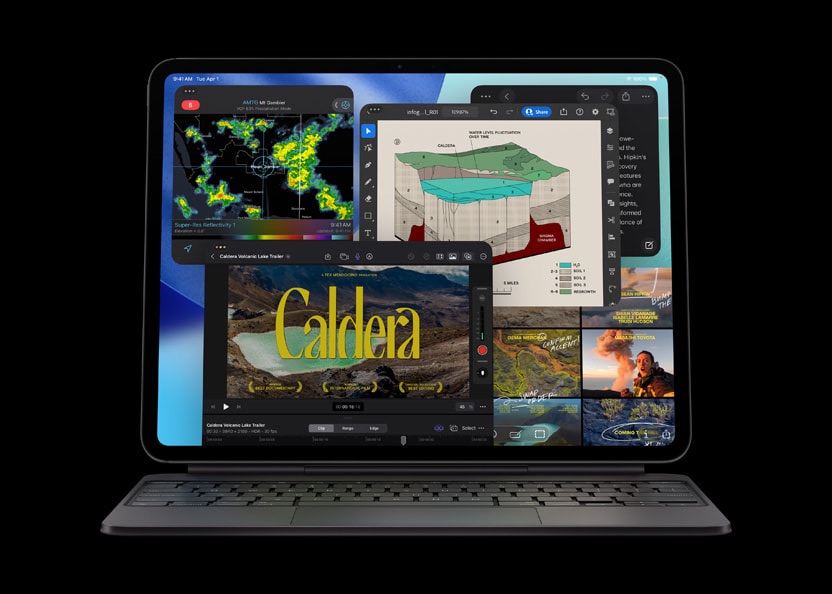
The iPad Pro is Apple’s flagship tablet. It uses the same M-series silicon as Apple’s Mac lineup, has a Tandem OLED display, and supports the full Magic Keyboard with a glass trackpad and aluminum palm rest. Apple announced the M5 iPad Pro on October 15, 2025, with pre-orders opening that day in 31 countries and regions and retail availability beginning Wednesday, October 22, 2025.
Pricing on the 11-inch model starts at $999 for Wi-Fi and $1,199 for Wi-Fi + Cellular, while the 13-inch model starts at $1,299 for Wi-Fi and $1,499 for Wi-Fi + Cellular. Education savings bring the starting prices down to $899 and $1,199. Storage options run from 256GB to 2TB, in silver and space black.
If the price is steep, the iPad Air offers a more affordable path. It uses the M4 chip, has the same N1 wireless networking chip and C1X modem, and comes in matching 11-inch and 13-inch sizes starting at $599 and $799, but it has an LCD Liquid Retina display rather than Tandem OLED and is a thicker design. Below the Air sit the iPad mini with the A17 Pro chip and the entry-level iPad with the A16 chip.
The M5 iPad Pro shipped on the same day as the 14-inch MacBook Pro with M5 and the upgraded Apple Vision Pro with M5, all on October 22, 2025. According to Bloomberg‘s Mark Gurman in his Power On newsletter, the next iPad Pro is not expected until spring 2027 with an M6 chip and vapor chamber cooling, so this generation is the current option for buyers.

John Ternus, Apple’s senior vice president of Hardware Engineering, summed up the launch in Apple’s announcement:
iPad Pro with M5 unlocks endless possibilities for creativity and productivity — with a huge leap in AI performance and a big boost in graphics, superfast wireless connectivity, and game-changing iPadOS 26 features, it pushes the boundaries of what iPad can do yet again.
Design
Externally, the 2025 iPad Pro is mechanically identical to the 2024 model, with no exterior redesign. The 11-inch model measures 9.83 by 6.99 by 0.21 inches (5.3mm thick) and weighs 444 grams for Wi-Fi or 446 grams for Wi-Fi + Cellular. The 13-inch model measures 11.09 by 8.48 by 0.20 inches (5.1mm thick) and weighs 579 grams for Wi-Fi or 582 grams for Wi-Fi + Cellular.
Apple calls iPad Pro its thinnest device. The aluminum enclosure has flat sides, slim bezels around the OLED panel, and a landscape-oriented camera at the top of the device. There are 2 finishes available: silver and space black.
According to iFixit‘s teardown, as covered by AppleInsider, the M5 iPad Pro has no significant internal redesign over the M4 model, with the same body, display, speakers, microphones, and battery. iFixit awarded the new model a provisional repairability score of 5 out of 10, the highest score the site has given an iPad Pro to date, attributing the gain to Apple’s expansion of its Self Service Repair program to iPads in 2025 rather than to changes in the hardware itself.
Display
The display is unchanged from the M4 generation. Both sizes have an Ultra Retina XDR Tandem OLED panel. The 13-inch model has a resolution of 2,752 by 2,064 pixels at 264 ppi, and the 11-inch is 2,420 by 1,668 pixels, also at 264 ppi.
Both models hit 1,000 nits full-screen brightness for SDR and HDR content, with 1,600 nits peak brightness for HDR content only, 1 nit minimum brightness, and a 2,000,000:1 contrast ratio. Other supported features include ProMotion with adaptive refresh rates from 10Hz to 120Hz, P3 wide color, True Tone, full lamination, and an antireflective coating.
Nano-texture glass is offered as a build-to-order option on the 1TB and 2TB models. The glass is etched at the nanometer scale to reduce glare in challenging lighting conditions while preserving image quality, and it is intended for color-managed creative workflows. The display also supports Apple Pencil Pro, Apple Pencil (USB-C), and Apple Pencil hover.
M5 Chip
Apple’s M5 is built using its third-generation 3-nanometer process, with a next-generation 10-core GPU architecture that has a Neural Accelerator in each core. There is also a 16-core Neural Engine, a third-generation ray-tracing engine, and a media engine with hardware-accelerated 8K H.264, HEVC, ProRes, ProRes RAW, and AV1 decode, plus ProRes encode and decode.
In iPad Pro, the chip is configured with a 9-core CPU on 256GB and 512GB models and a 10-core CPU on 1TB and 2TB models. The 10-core CPU has 4 performance cores and 6 efficiency cores. All configurations have the same 10-core GPU and 16-core Neural Engine.
Unified memory scales with storage. The 256GB and 512GB models start with 12GB of unified memory, which Apple says is 50 percent more than the M4 starting point. The 1TB and 2TB models have 16GB. Memory bandwidth is 153GB/s, which Apple describes as a nearly 30 percent increase compared to the previous generation.
Apple advertises up to 2x faster storage read and write speeds compared to the M4 iPad Pro, and according to Six Colors‘s Jason Snell, the storage interface has been upgraded to PCIe gen 5 to support the higher throughput.
For AI workloads, Apple cites up to 3.5x faster AI performance than M4 and up to 5.6x faster than the M1 iPad Pro, with the M4 comparison run against a 13-inch M4 unit with a 10-core CPU and 16GB of memory. App-level claims include up to 1.5x faster 3D rendering with ray tracing in Octane X, up to 1.2x faster Final Cut Pro for iPad video transcoding, up to 2x faster AI image generation in Draw Things, and up to 2.3x faster AI video upscaling in DaVinci Resolve for iPad, all measured against the M4 iPad Pro.
Independent reviewers have observed a more uneven picture. According to Engadget‘s Nathan Ingraham, Geekbench AI scores on the CPU and Neural Engine improved only by single-digit percentages over M4, but GPU AI scores rose sharply, with half-precision up about 85 percent and quantized up roughly 101 percent. Snell at Six Colors reports that AI image generation runs in about half the time on M5, lining up with Apple’s 2x Draw Things claim.
Camera
Camera hardware is unchanged from the M4 generation. The rear camera is a 12MP Wide camera with an f/1.8 aperture, a five-element lens with sapphire crystal cover, autofocus with Focus Pixels, Smart HDR 4, panoramas up to 63MP, and an adaptive True Tone flash. A LiDAR Scanner is included alongside the rear camera.
On the front is a landscape-oriented 12MP Center Stage camera with an f/2.0 aperture and the TrueDepth camera system that powers Face ID. According to iFixit‘s teardown, the rumored second front-facing camera did not materialize on the M5 model.
For video, the rear records 4K at 24, 25, 30, or 60 fps. ProRes recording is supported up to 4K at 30 fps on the 512GB and larger models, and up to 1080p at 30 fps on the 256GB tier.
Battery Life
The 11-inch iPad Pro has a 31.29-watt-hour battery, and the 13-inch has a 38.99-watt-hour battery. Both deliver up to 10 hours of web browsing on Wi-Fi or video playback, and Wi-Fi + Cellular models deliver up to 9 hours when browsing on cellular. According to iFixit, the battery hardware itself is the same as the M4 model.
With the new 40W Dynamic Power Adapter with 60W Max, or any other USB-C power adapter rated for 60W or higher, iPad Pro charges to about 50 percent in around 30 minutes. Apple sells the 40W Dynamic Power Adapter for $39 in the U.S., Canada, China mainland, Japan, Mexico, Taiwan, and the Philippines.
Apple Intelligence Updates
iPad Pro ships with iPadOS 26 and supports Apple Intelligence. The current shipping point release is iPadOS 26.4. iPadOS 26 introduces a Liquid Glass design, a new windowing system, a menu bar, an updated Files app with folders in the Dock, the new Preview app for PDFs, and Background Tasks.
Apple Intelligence on iPad Pro adds Live Translation in Phone, FaceTime, and Messages; intelligent actions in Shortcuts; and reminder categorization in the Reminders app. These features run on-device.
Built-in accessibility features on iPad Pro include VoiceOver, Zoom, Magnifier, Spoken Content, Voice Control, Switch Control, AssistiveTouch, Siri and Dictation, Type to Siri, Real-Time Text, Audio Descriptions, Subtitles and Closed Captioning, and Live Captions.
Smaller Changes
The N1 chip is new this generation. Apple’s wireless networking chip supports Wi-Fi 7 (802.11be) with 2×2 MIMO and simultaneous dual band, Bluetooth 6, and Thread.
Cellular models also get the new C1X modem. Apple says C1X delivers up to 50 percent faster cellular data performance and, for active cellular users, up to 30 percent less energy use compared to the M4 iPad Pro. The modem supports 5G sub-6 GHz with 4×4 MIMO and Gigabit LTE with 4×4 MIMO. iPad Pro is eSIM only and is not compatible with physical SIM cards.
The Thunderbolt / USB 4 port still tops out at 40 Gb/s, but external display support has been upgraded. The new iPad Pro can drive 1 external display at up to 6K at 60Hz or 4K at 120Hz, and supports Adaptive Sync on 120Hz external displays.
Audio and accessory connectors are unchanged. iPad Pro has a four-speaker audio system, a studio-quality four-microphone array, a Smart Connector on the back, and a magnetic connector for Apple Pencil. The Apple Pencil Pro sells for $129 ($119 with education savings), Apple Pencil (USB-C) sells for $79 ($69 with education savings), the 11-inch Magic Keyboard is $299, and the 13-inch Magic Keyboard is $349. The Smart Folio for iPad Pro is also compatible.
On the environmental side, Apple says iPad Pro is made with 30 percent recycled content by weight, including 100 percent recycled aluminum in the enclosure, 100 percent recycled rare earth elements in all magnets, 100 percent recycled cobalt and 95 percent recycled lithium in the battery, and 100 percent fiber-based packaging. Apple also says 55 percent of the manufacturing electricity for iPad Pro is sourced from renewable electricity, and the device is ENERGY STAR certified.
What’s Next for iPad Pro
The next iPad Pro is not expected until early 2027. According to Bloomberg‘s Mark Gurman, writing in his Power On newsletter as reported by AppleInsider, Apple operates iPad Pro on an upgrade cycle of about 18 months, putting the next refresh in spring 2027.
Gurman has reported that the next chip is expected to be the M6, likely manufactured on TSMC’s 2-nanometer process. He has also reported that the next iPad Pro is expected to gain iPhone 17 Pro-style vapor chamber cooling. The current M5 iPad Pro uses a copper sheet for heat dissipation rather than a vapor chamber, per iFixit‘s teardown. No major design changes are anticipated.
iPad Pro Timeline
March 11, 2026 — Apple begins retail sales of the iPad Air (M4), refreshing the mid-tier iPad with the M4 chip, the N1 wireless chip, the C1X modem, and 12GB of memory at unchanged $599 and $799 starting prices.
March 2, 2026 — Apple announces the new iPad Air with M4, with pre-orders opening March 4.
March 1, 2026 — AppleInsider summarizes Bloomberg‘s Mark Gurman’s Power On newsletter reporting that the next iPad Pro is expected in spring 2027 with the M6 chip and vapor chamber cooling, with no major design overhaul.
October 30, 2025 — iFixit publishes its teardown of the M5 iPad Pro, awarding a provisional 5-out-of-10 repairability score, the highest the site has given an iPad Pro to date, as covered by AppleInsider.
October 26, 2025 — Bloomberg‘s Mark Gurman reports in Power On that Apple is working on iPhone 17 Pro-style vapor chamber cooling for an iPad Pro slated for as early as 2027.
October 22, 2025 — iPad Pro (M5), 14-inch MacBook Pro (M5), and Apple Vision Pro (M5) reach retail.
October 21, 2025 — Review embargo lifts, with the first independent reviews published by Six Colors, Engadget, Gizmodo, and other outlets.
October 15, 2025 — Apple announces the iPad Pro (M5), the M5 chip, the new 14-inch MacBook Pro (M5), and the M5 Apple Vision Pro through simultaneous press releases, with no event.
June 25, 2025 — Reports based on ZDNet Korea and DigiTimes, summarized by AppleInsider, confirm OLED panel mass production for the M5 iPad Pro, with Samsung and LG dual-supplying both 11-inch and 13-inch panels.
December 4, 2024 — Analyst Ming-Chi Kuo forecasts in a Medium post that the M5 iPad Pro will enter mass production in the second half of 2025, with assembly handled by BYD Electronics.
May 15, 2024 — The iPad Pro (M4) reaches retail, introducing the Tandem OLED Ultra Retina XDR display, the M4 chip, and the slim redesign that the M5 model retains.
Changelog
May 3, 2026 — Initial publication.
Note: See an error in this roundup or want to offer feedback? Send us an email here.