






AirTag
Apple's item tracker, updated with greater range and volume
Should You Buy the New AirTag?
If you have lost your keys one too many times, the new AirTag is an easy purchase. Apple sells a single AirTag for $29 and a four-pack for $99, the same prices the original launched at in 2021. Free engraving with text and emoji is offered at checkout when you buy from apple.com or the Apple Store app.
The original AirTag is no longer sold by Apple. Only the second-generation model is available now, so any AirTag bought directly from Apple today is the new one. If you already own a first-generation AirTag and you mostly use it to keep tabs on a backpack near home, the upgrade is harder to justify.
For travelers and anyone who routinely loses items in cluttered spaces, the case for upgrading is stronger. Engadget‘s Mat Smith gave the AirTag 2 a 94 out of 100 in February, and AppleInsider‘s launch-day comparison framed the upgrade as attractive at the price but not essential for everyone with a working first-generation tag. The most useful single addition for existing AirTag households is Precision Finding on Apple Watch, which only works with the second-generation model.
How to Buy
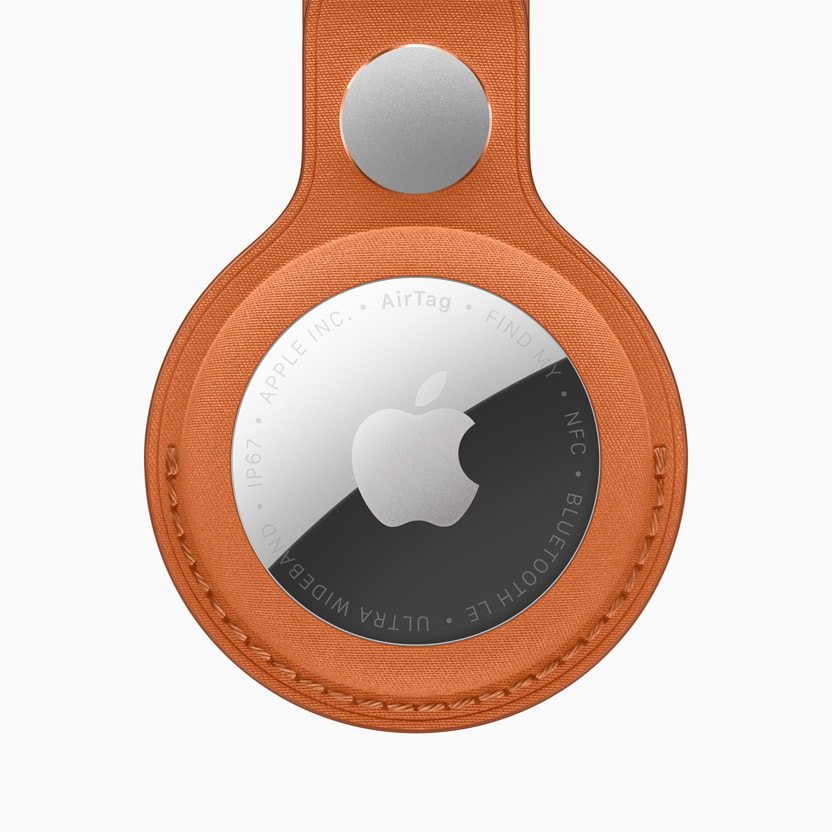
The new AirTag has been available to order on apple.com and through the Apple Store app since the January 26, 2026 launch, with Apple Store retail and Apple Authorized Reseller availability following the same week. A single AirTag is $29 and the four-pack is $99, identical to the 2021 launch pricing. Apple sells the AirTag FineWoven Key Ring separately for $35, available in fox orange, midnight purple, navy, moss, and black; Apple says the FineWoven Key Ring is built from 68 percent recycled content.
A single AirTag can be shared with up to 5 people via Family Sharing, so a household can split tracking duties on shared items like a car, an umbrella, or family keys. Shared users can locate the AirTag without triggering Tracking Notifications.
Engraving
Engraving is free. You can add letters, an emoji, or both at checkout from apple.com or the Apple Store app. Engraved AirTags do not cost extra.
Reviews
Hands-on coverage of the second-generation AirTag was published in late January and early February 2026. The reviews are broadly positive. Across outlets, the longer Precision Finding range and the louder, higher-pitched chime are singled out as the most useful improvements. The missing keyring hole and the cost of Apple’s own accessories are the most common complaints.
Engadget‘s Mat Smith gave the AirTag 2 a 94 out of 100. He measured the directional Precision Finding interface activating at around 80 feet on the new AirTag, versus 30 to 40 feet on the original, exceeding Apple’s stated 1.5x figure in unobstructed-environment testing. Smith also recounted hearing the new chime from across his gym’s locker room while the AirTag was inside a closed locker, where the original had been inaudible until he was within a few feet. His main negatives: the FineWoven Key Ring is too expensive, and AirTag still has no built-in keyring hole.
In a hands-on for 9to5Mac, Benjamin Mayo wrote that Precision Finding on the second-generation AirTag finally feels worthwhile thanks to the increased range, where the original AirTag’s short detection radius made the feature more of a gimmick than a tool. He also noted that the new chime is more piercing and easier to track by ear.
MacRumors‘ February hands-on review found the AirTag 2 clearly superior in side-by-side Precision Finding tests with a backpack obstructing the line of sight, and called Apple Watch Precision Finding the most meaningful addition to the new model. AppleInsider‘s launch-day comparison reached a more reserved verdict, framing the upgrade as worth it for travelers and people who lose items often, but not a must-buy for owners of working first-generation AirTags.
Design
The second-generation AirTag has the same round, coin-shaped form factor as the 2021 original. The front is a glossy white plastic disc with the Apple logo, and the back is polished stainless steel. Apple states the new model uses identical dimensions and is compatible with every existing AirTag accessory, so cases, keyrings, lanyards, and pet collars made for the first generation continue to work without changes.
Dimensions match the 2021 model: 1.26 inches (31.9 mm) in diameter and 0.31 inch (8.0 mm) in height. Weight has crept up. The new AirTag is 0.42 ounce (11.8 grams), about 7 percent heavier than the original’s 0.39-ounce (11-gram) weight.
Updated Back Text
The most reliable way to tell the second-generation AirTag apart from the first is the engraving on the steel back. According to MacRumors, the new model’s text is set in all-capital letters and includes references to IP67, NFC, and Find My, none of which are printed on the original AirTag’s back. AppleInsider‘s coverage of Joseph Taylor’s teardown also notes a new internal marking that resembles a small QR code.
Water and Dust Resistance
AirTag is rated IP67 under IEC standard 60529, meaning a maximum submersion depth of 1 meter for up to 30 minutes. The rating is unchanged from the original AirTag.
U2 Chip
The new AirTag is built around Apple’s second-generation Ultra Wideband chip, the same Apple-designed silicon used in the iPhone 17 lineup, iPhone Air, Apple Watch Series 11, and Apple Watch Ultra 3. The original AirTag used Apple’s first-generation U1 chip. iClarified‘s coverage of iFixit’s teardown identified the new component as Apple’s U2 chip.
The Bluetooth radio has also been upgraded. Apple describes it only as an upgraded Bluetooth chip that expands the distance from which AirTag can be located. According to iFixit‘s teardown, as reported by 9to5Mac, the Bluetooth and NFC SoC is a Nordic Semiconductor nRF52840. iClarified independently confirmed an upgraded Nordic Semiconductor chip without naming the specific part. NFC remains on board for tap-to-identify Lost Mode handoffs, the same role it played on the first generation.
Precision Finding
Apple says it now works from up to 50 percent farther away than on the original AirTag, which the marketing page describes as up to a 1.5x greater Precision Finding range. AppleInsider interprets the change as moving the working range from roughly 15 meters (50 feet) on the first-generation AirTag to approximately 60 meters (close to 200 feet) on the second.
In Engadget‘s testing, Mat Smith found the real-world improvement was even larger in some conditions: the directional “getting closer” interface activated at around 80 feet on the new AirTag, versus 30 to 40 feet on the original.
Precision Finding on iPhone
Expanded Precision Finding works with the second-generation AirTag paired with an iPhone Air or an iPhone 15 or later, with two exceptions: the iPhone 16e and iPhone 17e are not compatible. Both of those models use earlier wireless silicon and lack the second-generation Ultra Wideband chip. Find Nearby, the broader Find My feature that points you toward an item using directional cues, works on iPhone 15 and later.
Precision Finding on Apple Watch
For the first time, Precision Finding works on Apple Watch when paired with a second-generation AirTag. Compatible models are Apple Watch Series 9 or later and Apple Watch Ultra 2 or later, all running watchOS 26.2.1 or later. MacRumors called Apple Watch Precision Finding the best addition to the new model, useful when your iPhone is in another room and you want to locate a misplaced bag from your wrist.
Speaker
The new AirTag has a redesigned speaker that Apple says delivers up to 50 percent more volume and is audible from up to 2x farther than the original AirTag’s speaker. The chime sound has also been updated. Reviewers agree the new tone is higher-pitched and easier to pick out in a noisy room. Engadget reports the new chime was audible from across a gym locker room while the AirTag was sealed inside a closed locker, where the original AirTag could only be heard within a few feet.
Speaker Tampering
The new speaker is physically larger and more deeply integrated, which Bloomberg‘s Mark Gurman had reported in November 2024 was an anti-stalking design priority. iFixit‘s teardown, as reported by 9to5Mac, found that the speaker can still be non-destructively disabled by severing two fine wires that run from the speaker coil to the main board, using a soldering iron. iClarified added that an AirTag with those wires cut continued to function normally, pairing with an iPhone and reporting its location, with no indication that the speaker had been disconnected.
Battery
The second-generation AirTag uses a user-replaceable CR2032 lithium 3V coin cell battery, the same battery format as the first generation. Apple did not move to a rechargeable design despite years of rumors, and Bloomberg‘s Mark Gurman correctly reported in November 2024 that AirTag would retain the coin cell. Apple’s marketing page says the battery lasts more than a year of typical use.
When the battery is running low, your iPhone will tell you. Apple recommends CR2032 batteries with a bitter coating intended to deter young children from putting them in their mouths.
Replacing the Battery
To swap the battery, press down on the polished steel back and rotate it counterclockwise. The cover lifts off, the old battery comes out, and a fresh CR2032 drops in the same way. iFixit‘s X-ray imaging confirmed the battery cover locking mechanism is dimensionally unchanged from the original AirTag.
Resetting the New AirTag
The reset procedure has changed in a way that has caught some owners by surprise. With the original AirTag, you removed and reinserted the battery 5 times in quick succession. With the second-generation AirTag, you press down on the battery for about 2 seconds until you hear a connection sound, continue pressing for another 2 seconds, then remove the battery and wait 12 seconds before reinserting it. You repeat that cycle 5 times in total, and the fifth and final tone is distinct, which confirms the reset.
Find My Network
AirTag is built around Apple’s Find My network, which uses Bluetooth signals from other Apple devices to relay the location of lost items back to the owner. Apple states the network spans more than a billion iPhone, iPad, and Mac devices worldwide. Communication with the network is end-to-end encrypted: AirTag does not store location data on the device itself, and not even Apple knows the location of an AirTag or the identity of any device that helped find it.
The Find My app supports up to 32 items, including shared items and accessories. Different AirPods models count differently against this limit: AirPods Max is 1 item, AirPods and AirPods Pro 1 are 2 items each, and AirPods Pro 2 and later are 3 items each. Households with multiple AirPods sets will see their effective AirTag headroom inside the 32-item ceiling shrink quickly.
Share Item Location
Apple introduced this feature in iOS 18.2, allowing AirTag owners to temporarily and securely share an item’s live location with someone else. With the second-generation AirTag, Apple has expanded the airline partnership program, partnering with more than 50 airlines, including Delta, Lufthansa, Singapore Airlines, and United, to accept Share Item Location links from passengers tracking lost luggage.
Shared locations are designed with privacy in mind. They expire automatically after 7 days, can be stopped by the owner at any time, and disable themselves once the owner is reunited with the item. Access on the recipient side is restricted to authorized partner personnel via Apple Account or partner authentication.
Apple cites SITA, an IT provider for airlines, as reporting that carriers using Share Item Location have seen baggage delays reduced by 26 percent and incidences of unrecoverable luggage reduced by 90 percent.
Privacy and Anti-Stalking
AirTag is designed to discourage unwanted tracking. When an AirTag has separated from its owner and is moving with another person, that person’s iPhone will display a notification that an unknown item is traveling with them. Android phones running Android 6.0 or later get the same alerts thanks to a cross-platform standard Apple and Google launched in 2024.
If a separated AirTag is not moving but is detected over a period of time, it will start emitting an audible chime to alert anyone nearby. The current sound interval is a randomized period of 8 to 24 hours after separation, reduced from a 3-day delay at the original 2021 launch.
The second-generation AirTag’s Bluetooth identifiers change frequently, which Apple describes as part of an industry-first set of protections against unwanted tracking. Anyone can tap an unfamiliar AirTag against an NFC-capable iPhone or Android phone to view the AirTag’s serial number, the last 4 digits of the registered owner’s phone number, and a contact message if Lost Mode is enabled. Apple has stated that owner-identifying details may be released to law enforcement upon valid request.
Cross-Platform Unwanted Tracking Alerts
In May 2024, Apple and Google jointly launched a cross-platform Detecting Unwanted Location Trackers specification, implemented in iOS 17.5 and on Android 6.0 and later. An Android user receives an alert when an unknown Bluetooth tracker, including AirTag, AirPods, a Find My network accessory, or another compatible device, is detected traveling with them. The same spec applies in reverse, so an iPhone user is alerted to a third-party Find My-compatible tracker, not just an AirTag.
First Firmware Update
Apple released the first firmware update for the second-generation AirTag in late March 2026, taking the version from 3.0.41 to 3.0.45. According to AppleInsider, the release notes describe an updated unwanted-tracking sound that makes it easier to locate an unknown AirTag during Precision Finding, plus bug fixes and quality-of-life improvements. The update installs automatically.
Compatibility
To set up a second-generation AirTag, you need an iPhone running iOS 26.0 or later or an iPad running iPadOS 26.0 or later. Full functionality, including Apple Watch Precision Finding, requires iOS 26.2.1, iPadOS 26.2.1, or watchOS 26.2.1 or later, all of which Apple released alongside the new AirTag itself.
Expanded Precision Finding requires an iPhone Air or iPhone 15 or later, excluding the iPhone 16e and iPhone 17e. Apple’s footnote also notes that Ultra Wideband availability varies by region. Find Nearby works on iPhone 15 and later.
Accessibility
AirTag itself has no display or buttons. The Find My app, which is the primary interface for AirTag, supports VoiceOver, Invert Colors, Larger Text, and braille displays on iPhone. The accessibility experience is therefore determined by the Find My app and by the iPhone or Apple Watch you pair it with.
According to Curb Cuts‘ Steven Aquino, an accessibility-focused journalist, the second-generation AirTag remains the most accessible item-tracker option for iPhone users with disabilities, thanks largely to AirTag’s tight integration with the Find My app. He notes that less expensive third-party trackers are typically not as accessible nor as tightly integrated with the operating system.
Accessories
The new AirTag ships in a small box with the AirTag itself (battery installed) and documentation. There is no keyring, lanyard, or attachment included in the box, and there is still no built-in keyring hole on AirTag, a gap reviewers continue to flag.
The Apple-designed AirTag FineWoven Key Ring is sold separately for $35, available in fox orange, midnight purple, navy, moss, and black. The FineWoven Key Ring is made from 68 percent recycled content. A mature ecosystem of third-party AirTag holders has built up since the original launch, with attachments from Mophie, Belkin, and others typically priced around $15, less than half the cost of Apple’s own keyring. According to Engadget, the third-party market remains the better value for most buyers.
Retail packaging has been redesigned for the second generation. According to AppleInsider‘s coverage of the teardown, the four-pack box is narrower than before, uses paper pull tabs, and arranges the four AirTags in a single row rather than the original folio-style layout.
Environmental Impact
The second-generation AirTag uses 85 percent recycled plastic in the enclosure and 100 percent recycled rare earth elements in all magnets. Apple-designed printed circuit boards use 100 percent recycled gold plating and 100 percent recycled tin solder, with packaging that is 100 percent fiber-based. All established final assembly supplier sites for AirTag are third-party verified as Zero Waste by UL LLC under the UL 2799 Standard.
The operating ambient temperature range is −4°F to 140°F (−20°C to 60°C).
What’s Next for AirTag
No third-generation AirTag has been signaled. The current second-generation model launched only this past January, and the most likely near-term changes are firmware updates of the kind Apple shipped in late March 2026, refining anti-stalking behaviors and tuning the new chime over time.
AirTag Timeline
April 1, 2026 — AppleInsider reports Apple has released the first firmware update for the second-generation AirTag, version 3.0.45 (up from 3.0.41), with an improved unwanted-tracking sound during Precision Finding and additional bug fixes.
February 5, 2026 — iFixit publishes its second-generation AirTag teardown, confirming Apple’s 50 percent louder figure while finding the speaker can still be non-destructively disabled. 9to5Mac.
February 4, 2026 — Engadget‘s Mat Smith publishes a second-generation AirTag review with a 94 out of 100 score.
February 2, 2026 — MacRumors publishes its hands-on review of the second-generation AirTag, comparing it side-by-side with the original.
January 28, 2026 — 9to5Mac‘s Benjamin Mayo publishes a hands-on review and impressions of the new AirTag.
January 28, 2026 — Joseph Taylor publishes one of the first independent teardowns of the second-generation AirTag, finding a thinner motherboard, a larger speaker coil, and additional adhesive throughout the assembly. AppleInsider.
January 26, 2026 — Apple announces the second-generation AirTag alongside iOS 26.2.1, iPadOS 26.2.1, and watchOS 26.2.1, which add support for the new tracker and Apple Watch Precision Finding.
December 11, 2025 — AppleInsider, citing Macworld, reports iOS 26 code references labeled “2025AirTag” indicating active second-generation AirTag development with feature names including “Improved Moving.”
November 24, 2024 — Bloomberg‘s Mark Gurman reports in his Power On newsletter that the second-generation AirTag will retain a CR2032 coin-cell battery rather than switch to a rechargeable design.
November 17, 2024 — Bloomberg‘s Mark Gurman reports the second-generation AirTag has progressed in manufacturing tests and outlines three expected upgrades: an upgraded chip with improved location tracking, a more difficult-to-remove built-in speaker as an anti-stalking measure, and better Precision Finding range.
May 19, 2024 — Bloomberg‘s Mark Gurman reports the second-generation AirTag is in development under codename B589, targeted for around the middle of 2025.
May 13, 2024 — Apple and Google jointly launch a cross-platform Detecting Unwanted Location Trackers specification, implemented in iOS 17.5 and on Android 6.0 and later devices.
October 2023 — Analyst Ming-Chi Kuo reports, via secondary aggregation, that mass production of the second-generation AirTag has been postponed from the fourth quarter of 2024 to some point in 2025.
February 10, 2022 — Apple publishes “An update on AirTag and unwanted tracking,” outlining safety improvements including refined alert logic, display alerts paired with sound, and a louder chime tuning for the original AirTag.
April 30, 2021 — The original AirTag becomes available for purchase in most countries.
April 20, 2021 — Apple announces the original AirTag at the Spring Loaded event.
Changelog
May 2, 2026 — Initial publication.
Note: See an error in this roundup or want to offer feedback? Send us an email here.