




Mac mini
Redesigned with smaller footprint, front USB-C ports, and M4 and M4 Pro chip options.
Should You Buy the Mac mini?
The Mac mini is approaching the end of its product cycle, with M5 and M5 Pro updates expected later in 2026. According to Bloomberg‘s Mark Gurman, the next Mac mini will use the M5 and M5 Pro chips Apple has already shipped in MacBook Pro and MacBook Air models. If you can wait, holding out for the refresh is reasonable.
That said, the current Mac mini remains strong on its own terms. The $599 starting price, 16GB base RAM, and front USB-C ports make it the least expensive way into Apple silicon, and the M4 Pro variant earned strong reviews on raw performance. Note that the Mac mini does not ship with a display, keyboard, or mouse, so you will need to supply your own.

The Mac mini sits below the iMac, which starts at $1,299 and includes a built-in 4.5K display in seven colors, plus the Mac Studio, which starts at $1,999 with the M4 Max chip or $3,999 with the M3 Ultra. The Mac mini’s appeal is largely about price-to-performance: pair it with a third-party display and you can build a complete desktop setup for less than the iMac.
How to Buy
The Mac mini is sold from Apple’s online store, Apple retail stores, and authorized resellers. U.S. education pricing knocks $100 off both chip tiers, bringing the M4 model to $499 and the M4 Pro model to $1,299. The product launched in 28 countries and regions in November 2024.
Configurations
Apple lists four standard configure-to-order entry points. The first is the M4 with 16GB memory and a 256GB SSD at $599. The second is the M4 with 16GB memory and a 512GB SSD. The third is the M4 with 24GB memory and a 512GB SSD. The fourth is the M4 Pro with 24GB memory and a 512GB SSD at $1,399.
From there, the M4 model is configurable up to 32GB memory and 2TB storage, while the M4 Pro is configurable up to 64GB memory and an 8TB SSD. The 14-core CPU and 20-core GPU upgrade for the M4 Pro is also a build-to-order option, as is 10Gb Ethernet on every tier.
Stock and Shipping Estimates
Availability has tightened sharply in recent weeks. According to 9to5Mac‘s Benjamin Mayo, the base $599 Mac mini was marked as currently unavailable on Apple’s online store on April 22, 2026, with the shortest available delay around six weeks for the 512GB M4 model. Other configurations were citing nine-to-ten-week shipping estimates or longer.
Mayo attributes the situation primarily to industry-wide memory and storage shortages, with Apple reportedly prioritizing MacBook supply over desktop output. MacRumors has additionally suggested demand from buyers using Mac minis to run AI models locally as a contributing factor.
Reviews
The launch reviews from November 2024 were broadly positive. Reviewers praised the smaller footprint and the chip performance, plus the value of the $599 starting configuration.
The Verge
The Verge‘s Chris Welch wrote that the M4 Mac mini “has immediately become the best value in Apple’s entire Mac lineup,” citing the $599 starting price and 16GB base RAM as the main reasons. Welch judged the machine capable of handling most user tasks for several years to come.
Engadget
Engadget‘s Devindra Hardawar described the Mac mini as “shockingly small, incredibly powerful,” reporting that the M4 Pro test unit outperformed every other system the publication had benchmarked in 2024.
TechRadar
TechRadar awarded the Mac mini a five-star verdict, calling it the best small-form-factor desktop available and arguing that no Windows mini PC comes close at the price.
Power Button Reception
Bottom-mounting the power button drew consistent criticism from launch reviewers. Critics across multiple publications described the placement as awkward and unintuitive, with the device having to be lifted to be turned on or off. The complaint is universally framed as a minor quirk rather than a serious issue.
Design
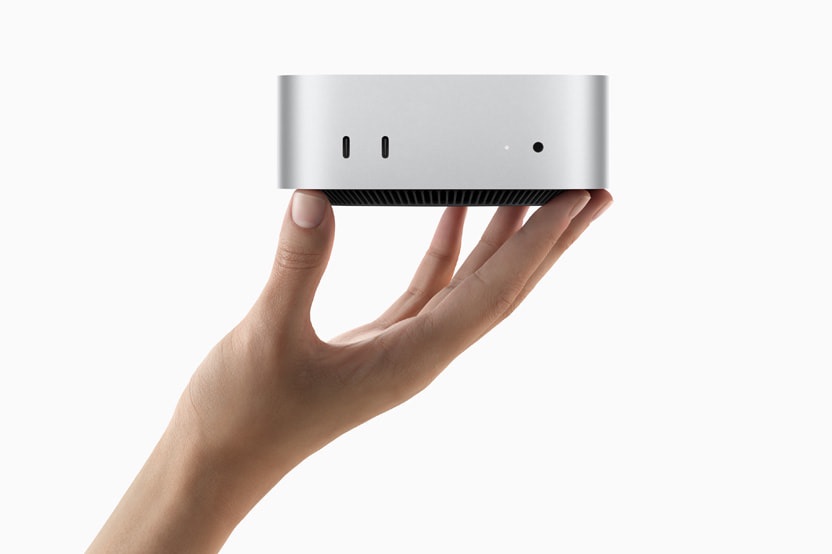
The Mac mini measures 5.0 inches wide by 5.0 inches deep by 2.0 inches tall. Apple says the footprint is less than half what the prior generation occupied. The M4 model weighs 1.5 pounds and the M4 Pro weighs 1.6 pounds. Apple sells the Mac mini only in silver.
The aluminum enclosure is the same square shape Mac mini buyers have known for years, just compressed. The reduction in footprint means the device takes up less space on a desk, while the slight increase in height accommodates a redesigned thermal path.
Thermal Architecture
Apple guides air through different levels of the system and vents it through the foot of the device. This approach allowed the smaller footprint without giving up the cooling headroom needed for the M4 Pro chip. Both M4 and M4 Pro share the same 5-by-5-inch chassis without acoustic compromises.
Power Button Placement
The power button is on the underside of the Mac mini. According to The Verge‘s Chris Welch, it sits near the rear-left corner of the bottom panel, requiring the device to be lifted whenever the user wants to power it on or off.
M4 Chip
The standard M4 chip features a 10-core CPU with 4 performance cores and 6 efficiency cores, a 10-core GPU with hardware-accelerated ray tracing, a 16-core Neural Engine, and 120GB/s of memory bandwidth.
Apple says the M4 Mac mini delivers up to 1.8x faster CPU performance and up to 2.2x faster GPU performance over the M1 Mac mini. The chip’s Media Engine includes hardware-accelerated H.264, HEVC, ProRes, and ProRes RAW, plus dedicated video decode and encode engines, ProRes encode and decode, and AV1 decode.
M4 Pro Variant
The M4 Pro is configurable to a 12-core or 14-core CPU and a 16-core or 20-core GPU, with 273GB/s of memory bandwidth, hardware-accelerated ray tracing, and a 16-core Neural Engine. Apple describes the M4 Pro as having the world’s fastest CPU core for single-threaded performance, with the GPU up to twice as powerful as the standard M4’s GPU and the Neural Engine over 3x faster than in the Mac mini with M1.
According to Engadget, the M4 Pro Mac mini configured with the 14-core CPU and 48GB of memory recorded a Geekbench 6 single-threaded score of 3,943 and a multi-threaded score of 22,850 in High Power mode. Engadget noted that competing Windows PCs the publication had tested that year typically scored in the 2,500 to 2,800 range.
RAM
The standard M4 Mac mini ships with 16GB of unified memory and is configurable to 24GB or 32GB. The M4 Pro Mac mini ships with 24GB and is configurable to 48GB or 64GB. According to iFixit, the memory is integrated into the Apple silicon and cannot be upgraded after purchase.
Storage
The M4 Mac mini ships with a 256GB SSD configurable to 512GB, 1TB, or 2TB. The M4 Pro Mac mini ships with a 512GB SSD configurable to 1TB, 2TB, 4TB, or 8TB.
The Mac mini’s SSD is physically modular. According to iFixit‘s teardown, the drive can be removed with a single screw, although Apple’s proprietary form factor makes third-party upgrades complicated. The teardown earned the 2024 Mac mini a provisional repairability score of 7 out of 10, with the modular SSD as the main contributor.
Connectivity
The Mac mini has front and rear ports for the first time in the product’s history. The total port count is five USB-C connectors plus HDMI, Ethernet, and a headphone jack.
Front Ports
Two USB-C ports sit on the front of the Mac mini, each supporting USB 3 at up to 10Gb/s. A 3.5 mm headphone jack with high-impedance support is also located on the front.
Rear Ports (M4)
The M4 Mac mini’s rear panel has three Thunderbolt 4 (USB-C) ports supporting up to 40Gb/s, an HDMI port, and a Gigabit Ethernet port configurable to 10Gb Ethernet.
Rear Ports (M4 Pro)
The M4 Pro Mac mini upgrades the three rear ports to Thunderbolt 5, with up to 120Gb/s of bandwidth. This is Apple’s first Thunderbolt 5 implementation in a Mac mini, and Apple says it more than doubles the throughput of Thunderbolt 4. The HDMI and Gigabit Ethernet ports remain the same.
According to Engadget, the current Mac mini has no USB-A ports. The previous M2 Mac mini included two USB-A connectors, so the redesign is the first Mac mini sold without legacy USB.
Wi-Fi and Bluetooth
The Mac mini supports Wi-Fi 6E (802.11ax) and Bluetooth 5.3. Apple has not updated the wireless to Wi-Fi 7 or Bluetooth 6, both of which arrived in the M5 Pro and M5 Max MacBook Pro Apple shipped in March 2026. Whether the rumored M5 Mac mini will gain the upgrade is unconfirmed.
Display Support
The M4 Mac mini supports up to three displays simultaneously. Combinations include two 6K displays at 60Hz over Thunderbolt plus one 5K display at 60Hz over Thunderbolt or 4K at 60Hz over HDMI.
The M4 Pro Mac mini supports up to three 6K displays at 60Hz, which Apple describes as more than 60 million pixels of total display area. The HDMI port on both M4 and M4 Pro models supports a single display at up to 8K at 60Hz or 4K at 240Hz.
Audio
The Mac mini has a built-in speaker, a 3.5 mm headphone jack with high-impedance support, and an HDMI port that supports multichannel audio output. Apple measures typical acoustic performance at 5 dBA from the operator position at idle, which is near silent in a normal room.
Apple Intelligence and Software
The Mac mini ships with the current version of macOS and was designed around Apple Intelligence, Apple’s personal-intelligence system. The 16-core Neural Engine handles features including Writing Tools, Genmoji, Image Playground, and the redesigned Siri, with on-device processing for routine tasks and Private Cloud Compute for heavier workloads.
Accessibility
macOS on the Mac mini supports the standard set of Apple accessibility features. These include VoiceOver, Voice Control, Zoom, Increase Contrast, Reduce Motion, Switch Control, Closed Captions, and Text to Speech, plus Siri and Dictation.
Environment
The Mac mini is Apple’s first carbon-neutral Mac. Apple claims a more than 80 percent reduction in greenhouse gas emissions across materials, manufacturing, transportation, and customer use, compared with a business-as-usual baseline. The remaining residual emissions are covered through nature-based carbon credits.
Recycled Materials
The Mac mini is made with more than 50 percent recycled content overall. The aluminum enclosure and thermal module use 100 percent recycled aluminum. The plating in all Apple-designed printed circuit boards uses 100 percent recycled gold. All magnets use 100 percent recycled rare earth elements. The Mac mini also ships in 100 percent fiber-based packaging.
Carbon Footprint by Configuration
According to Apple’s Product Environmental Report, residual carbon emissions for the Mac mini scale with configuration. The base 16GB/256GB M4 model has a residual footprint of 32 kg CO2e, while the maxed M4 Pro with 64GB and 8TB storage has a residual footprint of 121 kg CO2e. Apple covers the difference through carbon credits in both cases.
U.S. Manufacturing
Apple announced on February 24, 2026 that Mac mini production will move to a new factory at the company’s Houston manufacturing campus later in 2026. This is the first time the Mac mini will be produced in the United States. The new factory will double the footprint of the Houston campus.
Apple CEO Tim Cook said the company is “deeply committed to the future of American manufacturing,” and that the Houston expansion will significantly grow Apple’s footprint in the city when Mac mini production begins later in 2026.
Apple is also constructing a 20,000-square-foot Advanced Manufacturing Center on the Houston campus, scheduled to open later in 2026. The center is intended to provide hands-on training in advanced manufacturing techniques to students, supplier employees, and U.S. businesses of varying sizes.
What’s Next for the Mac mini
The current Mac mini is approaching the end of its product cycle, with M5 and M5 Pro successors expected later in 2026.
M5 and M5 Pro Chips
Apple has already shipped the M5 chip and the M5 Pro and M5 Max chips in MacBook Pro and other products. The M5 features a 10-core CPU, a next-generation 10-core GPU with a Neural Accelerator in each core, a 16-core Neural Engine, and 153GB/s of memory bandwidth. A future Mac mini using M5 and M5 Pro silicon would inherit these architectures along with the Neural Accelerator design Apple introduced in October 2025.
Expected Timing
In a public X post on November 9, 2025, Bloomberg‘s Mark Gurman listed the M5 and M5 Pro Mac mini among the products in Apple’s 2026 Mac plan. According to AppleInsider, leaked product identifiers J873g and J873s in macOS Tahoe data are believed to map to the next-generation Mac mini models.
Apple did not refresh the Mac mini at its early-March 2026 events, even though M5 Pro and M5 Max chips were unveiled for the MacBook Pro line at that time. According to Bloomberg‘s Mark Gurman, as reported by MacRumors, the Mac Studio refresh has slipped to roughly October 2026 because of memory chip shortages. The same supply pressure has implications for Mac mini timing.
Pricing Speculation
Macworld has reported that the M5 Mac mini’s starting price could rise approximately $100, to roughly $699, if Apple follows the storage-doubling precedent set by the M5 MacBook Pro and M5 MacBook Air. No source has confirmed a specific price.
Design Continuity
According to Bloomberg‘s Mark Gurman, as reported by MacRumors, the new Mac mini will look identical to the current model. Reports describe the upcoming refresh as an internal-only update, with the 5-by-5-inch chassis carried over.
Mac mini Timeline
April 22, 2026 — Base $599 Mac mini and other 256GB configurations are listed as currently unavailable on Apple’s online store, with shipping delays of six or more weeks across remaining configurations. 9to5Mac.
April 19, 2026 — Mark Gurman reportedly indicates the Mac Studio refresh has slipped to roughly October 2026 due to memory shortages, with implications for Mac mini timing. MacRumors, paraphrasing Gurman’s Power On.
March 8, 2026 — Gurman reports that 2026 Mac plans still include a new Mac mini with M5 and M5 Pro chip options, and a chassis identical to the current model. MacRumors, paraphrasing Gurman’s Power On.
March 3, 2026 — Apple introduces M5 Pro and M5 Max MacBook Pro, with no Mac mini update accompanying the announcement.
February 24, 2026 — Apple announces Mac mini production will move to Houston later in 2026, the first time the Mac mini will be made in the United States.
January 25, 2026 — AppleInsider reports product identifiers J873g and J873s in leaked macOS Tahoe data, believed to correspond to forthcoming M5 and M5 Pro Mac mini models.
November 9, 2025 — Mark Gurman publishes Apple’s 2026 Mac plan on X, listing M5 and M5 Pro Mac mini as part of the lineup.
October 15, 2025 — Apple unveils the M5 chip in the 14-inch MacBook Pro, the iPad Pro, and Apple Vision Pro.
November 12, 2024 — iFixit publishes its M4 Mac mini teardown, awarding a 7 out of 10 provisional repairability score and confirming modular SSD storage.
November 8, 2024 — Mac mini begins shipping to customers and arriving in Apple Stores.
November 7, 2024 — First reviews from The Verge, Engadget, TechRadar, and other outlets publish at the embargo lift.
October 30, 2024 — TechCrunch publishes analysis of how Apple uses renewable-power purchases and carbon credits to designate the Mac mini as carbon-neutral.
October 29, 2024 — Apple unveils the redesigned M4 and M4 Pro Mac mini at a 5-by-5-inch footprint, with pre-orders opening the same day.
January 24, 2023 — Predecessor M2 and M2 Pro Mac mini begins shipping.
January 17, 2023 — Apple announces the M2 and M2 Pro Mac mini at $599 and $1,299 starting prices.
Changelog
May 4, 2026 — Initial publication.
Note: See an error in this roundup or want to offer feedback? Send us an email here.