






iPhone 17
Apple's 2025 flagship iPhone.
Should You Buy the iPhone 17?
Apple released the iPhone 17 on September 19, 2025, in more than 63 countries, with a second wave following on September 26 in 22 additional markets. Seven months in, it is the cheapest of the four 2025 flagship iPhones at $799 (U.S.) for the 256GB configuration, with the iPhone Air at $999, the iPhone 17 Pro at $1,099, and the iPhone 17 Pro Max at $1,199. Apple’s footnote on the $799 advertised price requires a $30 connectivity discount through activation with AT&T, Boost Mobile, T-Mobile, or Verizon.
The iPhone 17 has the same 6.3-inch display size as the iPhone 17 Pro, and it shares the new ProMotion panel, the N1 networking chip, the 18MP Center Stage front camera, Ceramic Shield 2, and Memory Integrity Enforcement with the rest of the lineup. The Pro models step beyond it with the A19 Pro chip, a vapor-chamber thermal system, three rear cameras (including a tetraprism Telephoto with 8x optical-quality zoom at 200mm), ProRes RAW, Apple Log 2, and a USB 3 port.

According to The Verge‘s review, the iPhone 17 is the model “most people should get.” CNN Underscored reported approximately an 18% gain in overall performance over the iPhone 16 in Geekbench 6 testing, with scores nearly matching the iPhone Air despite the Air’s higher-end A19 Pro chip.
If you want a cheaper iPhone, the iPhone 17e starts at $599 with the same A19 chip and a 6.1-inch display. It uses Apple’s faster C1X modem and includes Ceramic Shield 2, but it skips the ProMotion display, the 48MP Dual Fusion rear system, the N1 chip, and 25W MagSafe charging.
A new base iPhone is not expected until early 2027. According to Bloomberg‘s Mark Gurman, Apple is splitting its iPhone launches between fall and spring, with the iPhone 18 Pro, iPhone 18 Pro Max, a foldable iPhone, and a second-generation iPhone Air arriving in fall 2026, and the iPhone 18 and a new iPhone 18e following in spring 2027.
Design
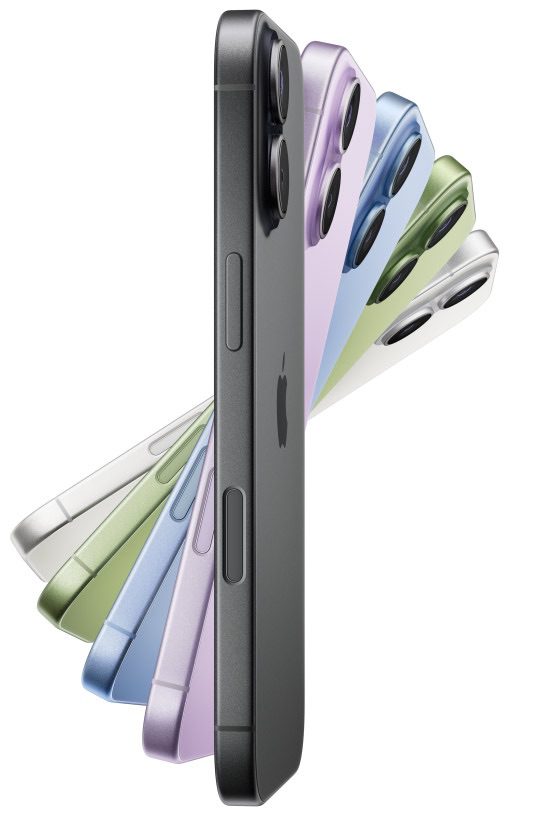
The iPhone 17 has an aluminum frame, a Ceramic Shield 2 front, and a color-infused glass back. Apple describes the design as featuring a sleek contoured edge with thinner borders than the previous generation. The phone measures 149.6 mm tall, 71.5 mm wide, and 7.95 mm thick, and weighs 177 grams (6.24 oz).
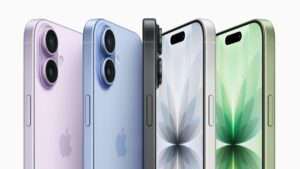
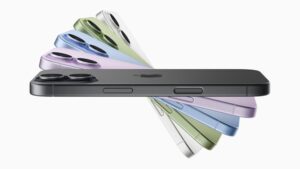
Five colors are available: black, lavender, mist blue, sage, and white. Apple uses color-infused glass on the back of the four colored finishes; the white model uses a different back-glass treatment.

Apple says Ceramic Shield 2 delivers 3x better scratch resistance than the previous generation and improves anti-reflection to cut glare. Apple also describes Ceramic Shield 2 as tougher than any smartphone glass or glass-ceramic. The iPhone 17 has an IP68 rating with a maximum depth of 6 meters for up to 30 minutes under IEC standard 60529.
External controls include volume up and down, a customizable Action button, a Camera Control button on the right side, a side power button, and a USB-C connector. The Action button can be set to Silent mode, Focus, Camera, Visual Intelligence, Flashlight, Voice Memo, Recognize Music, Translate, Magnifier, Controls, Shortcut, or Accessibility.
According to iFixit‘s teardown of the iPhone 17 Pro, the iPhone 17 family adopts a new electrically de-bonding battery adhesive that releases with a 5–20V electrical pulse. iFixit‘s repair guide for the standard iPhone 17 also notes that on iOS 26, the battery-health indicator works with both genuine and aftermarket replacement batteries once Apple’s Repair Assistant has run.
Display
The iPhone 17 has a 6.3-inch Super Retina XDR OLED display at 2622×1206 resolution with 460 ppi. Measured as a standard rectangle, the diagonal is 6.27 inches.
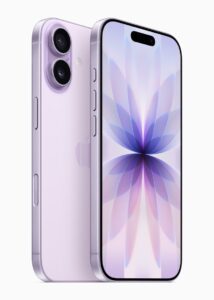
ProMotion is new to the standard iPhone at this generation, having previously been a Pro-only feature. The panel supports an adaptive refresh rate up to 120Hz, and when idle the Always-On display efficiently scales down to 1Hz. According to Trusted Reviews, this is the same LTPO behavior as the Pro models and goes lower than some 120Hz Android panels that hold a higher refresh-rate floor.
Brightness reaches 1000 nits typical, 1600 nits peak HDR, and 3000 nits peak outdoor, plus a 1-nit minimum for the Always-On display. Apple describes the 3000-nit figure as the highest ever on iPhone at launch, and claims 2x better outdoor contrast than the previous generation.
Other display features include the Dynamic Island, HDR support for Dolby Vision, HDR10, HDR10+, and HLG, True Tone, wide color (P3), Haptic Touch, a 2,000,000:1 typical contrast ratio, and a fingerprint-resistant oleophobic coating with an anti-reflective coating layered on top.
A19 Chip
The A19 chip is built on Apple’s third-generation 3-nanometer technology. It has a 6-core CPU with 2 performance cores and 4 efficiency cores, a 5-core GPU with Neural Accelerators built into each GPU core, a 16-core Neural Engine, and hardware-accelerated ray tracing.
Apple’s published comparisons reach back to the iPhone 13’s A15 Bionic rather than to the immediately prior generation. The A19 CPU is described as 1.5x faster than A15 Bionic, and the 5-core GPU as more than 2x faster than A15 Bionic.
According to CNN Underscored‘s review, real-world Geekbench 6 scores on the iPhone 17 are practically identical to those on the iPhone Air, despite the Air using the higher-end A19 Pro with an additional GPU core. CNN Underscored reported approximately an 18% gain in overall performance over the iPhone 16. Note that this benchmark figure has not yet been independently corroborated by another major outlet.
The iPhone 17 is also the first base iPhone to ship with Memory Integrity Enforcement, Apple’s always-on hardware-and-software memory-safety protection. Apple says MIE is built on Enhanced Memory Tagging Extension in synchronous mode, secure typed allocators, and Tag Confidentiality Enforcement policies, and that it hardens the kernel and over 70 userland processes to raise the cost of mercenary-spyware exploit chains. As part of the rollout, Apple is donating 1,000 iPhone 17 devices to civil-society organizations and including the iPhone 17 in its 2026 Security Research Device Program.
Camera
The rear camera is a 48MP Dual Fusion system. The 48MP Fusion Main sensor sits at a 26mm equivalent focal length with an f/1.6 aperture, sensor-shift optical image stabilization, and 100% Focus Pixels. The Main sensor also enables a 12MP optical-quality 2x Telephoto at 52mm, f/1.6, by cropping into the central portion of the sensor.
Sitting alongside it is a 48MP Fusion Ultra Wide at 13mm with an f/2.2 aperture and a 120-degree field of view. Apple says it captures up to 4x the resolution of the previous-generation Ultra Wide. The combined system covers a 4x total optical zoom range (2x in, 2x out), digital zoom up to 10x, and a sapphire crystal lens cover.
Video tops out at 4K Dolby Vision at 24, 25, 30, or 60 fps. Cinematic mode supports up to 4K Dolby Vision at 30 fps, Action mode reaches 2.8K Dolby Vision at 60 fps, and slo-mo records 1080p at 120 or 240 fps. Dual Capture records simultaneously on the front and rear cameras at up to 4K Dolby Vision 30 fps. Spatial video records at 1080p 30 fps.
The new 18MP Center Stage sensor is the first square front-camera sensor on iPhone, with an f/1.9 aperture, autofocus with Focus Pixels, and ultra-stabilized 4K HDR video. Because the sensor is square, you can shoot portrait or landscape photos and videos while holding the iPhone vertically, and Apple uses AI to automatically expand the field of view and rotate the frame from portrait to landscape for group shots.
iOS 26 also adds a new Bright Photographic Style. Apple has made it available on the iPhone 16, iPhone 16 Plus, iPhone 16 Pro, iPhone 16 Pro Max, iPhone 17, iPhone Air, iPhone 17 Pro, and iPhone 17 Pro Max.
Battery Life
Apple rates the iPhone 17 for up to 30 hours of video playback and up to 27 hours of streamed video. That figure is eight more hours than the previous generation, despite the addition of the always-on, higher-refresh-rate ProMotion panel.
Wired fast charging reaches up to 50% in 20 minutes with a 40W or higher USB-C adapter and a USB-C cable. Over MagSafe, the iPhone 17 can reach up to 50% in 30 minutes with a 30W or higher adapter. Apple ran its testing in July 2025 on preproduction iPhone 17 units using its new 40W Dynamic Power Adapter with 60W Max, which is sold separately and currently available only in Canada, China mainland, Japan, Mexico, Taiwan, the Philippines, and the U.S.
The iPhone 17 supports MagSafe wireless charging up to 25W and Qi2 wireless charging up to 25W. The 25W MagSafe peak requires a 30W or higher USB-C adapter behind the puck.
Adaptive Power Mode is a new iOS 26 feature that learns your typical battery consumption and intelligently conserves power when it anticipates a low-battery situation.
Apple Intelligence Updates
The iPhone 17 ships with iOS 26, which Apple released as a free software update on September 15, 2025. The most visible change is Liquid Glass, a new system-wide design language that runs across iOS 26, iPadOS 26, macOS Tahoe, watchOS 26, visionOS 26, and tvOS 26. iOS 26 also adds new screening tools for calls and messages, the new Apple Games app, and visual-intelligence actions that work directly from screenshots.
Apple Intelligence is in beta on the iPhone 17. Launch-day language support covers English, French, German, Italian, Portuguese (Brazil), Spanish, Chinese (simplified), Japanese, and Korean. Apple said Danish, Dutch, Norwegian, Portuguese (Portugal), Swedish, Turkish, Chinese (traditional), and Vietnamese would follow by the end of 2025.
Live Translation in Messages works in English (U.S. and UK), French (France), German, Italian, Japanese, Korean, Portuguese (Brazil), Spanish (Spain), and Chinese (simplified). Live Translation in Phone and FaceTime is more restricted, supporting one-on-one calls in English (U.S. and UK), French (France), German, Portuguese (Brazil), and Spanish (Spain).
Smaller Changes
The iPhone 17 introduces N1, Apple’s first in-house wireless networking chip. N1 enables Wi-Fi 7 (802.11be) with 2×2 MIMO, Bluetooth 6, and Thread, and Apple says it also improves the performance and reliability of Personal Hotspot and AirDrop. There is a second-generation Ultra Wideband chip, plus NFC with reader mode.
Cellular covers 5G with sub-6 GHz and mmWave at 4×4 MIMO, plus Gigabit LTE at 4×4 MIMO. GPS is precision dual-frequency and tracks GPS, GLONASS, Galileo, QZSS, BeiDou, and NavIC. The USB-C port supports charging, DisplayPort, and USB 2 (up to 480 Mb/s), slower than the USB 3 port on the iPhone 17 Pro and unchanged from the iPhone 16.
In several markets, the iPhone 17 is eSIM-only and ships without a physical SIM tray. The eSIM-only configuration is sold in Bahrain, Canada, Guam, Japan, Kuwait, Mexico, Oman, Qatar, Saudi Arabia, the UAE, the U.S., and the U.S. Virgin Islands. Dual eSIM allows two active and stores eight or more.
Environmental claims are extensive. Apple says the iPhone 17 is built with 30% recycled content, including 85% recycled aluminum in the enclosure, 100% recycled cobalt and 95% recycled lithium in the battery, 100% recycled gold plating and tin solder in all Apple-designed printed circuit boards, 100% recycled rare earth elements in all magnets, and 80% recycled plastic in the antenna lines made from textile waste. Approximately 35% of manufacturing electricity for the iPhone 17 comes from renewable sources, packaging is 100% fiber-based, and Apple says the new boxes ship 35% more units per trip than iPhone 16 packaging, with regional variation.
The box contains the iPhone 17, a 1-meter USB-C charge cable, and documentation. Apple does not include a power adapter or EarPods.
Accessibility coverage is the full Apple set: VoiceOver, Zoom, Magnifier, Voice Control, Switch Control, AssistiveTouch, Eye Tracking, RTT and TTY support, Closed Captions, Live Captions, Personal Voice, Live Speech, Type to Siri, Vocal Shortcuts, and Spoken Content. The iPhone 17 is also rated Hearing Aid Compatible.
Compatibility
The iPhone 17 ships with iOS 26 and supports the full iOS 26 feature set out of the box, including Liquid Glass, Apple Intelligence, Live Translation, Adaptive Power Mode, the Bright Photographic Style, and the new screening tools. Apple has not published an end-of-support date and describes the iPhone 17 as offering industry-leading software support.
The iPhone 17 supports all of Apple’s current satellite services: Emergency SOS via satellite, Messages via satellite, Find My via satellite, and Roadside Assistance via satellite. The satellite features run through Apple’s partnership with Globalstar. Apple has also extended the free satellite-services trial by an additional year for existing iPhone 14 and iPhone 15 owners who activated their device in a supported country before September 9, 2025.
What’s Next for iPhone
According to Bloomberg‘s Mark Gurman, Apple is moving to a staggered launch cadence for its iPhone lineup. The fall 2026 wave is expected to bring the iPhone 18 Pro, iPhone 18 Pro Max, the first foldable iPhone, and a second-generation iPhone Air. The standard iPhone 18 and a new iPhone 18e are expected to follow in spring 2027.
If that schedule holds, the iPhone 17 will remain Apple’s current standard flagship through the end of 2026 and into early 2027. That is an unusually long shelf life for a base iPhone.
iPhone 17 Timeline
April 8, 2026 — MacRumors publishes a summary of Mark Gurman’s reporting on Apple’s staggered iPhone 18 launch roadmap, which would keep the iPhone 17 as Apple’s current base flagship until spring 2027.
March 11, 2026 — iPhone 17e goes on sale at $599, completing the iPhone 17 family lineup.
March 2, 2026 — Apple announces the iPhone 17e with the A19 chip and the new C1X modem.
November 5, 2025 — iFixit publishes its iPhone 17 Pro chip ID page, identifying a Samsung 12GB LPDDR5X SDRAM package layered with the A19 Pro SoC. No equivalent disclosure has yet been published for the standard iPhone 17 SoC.
September 26, 2025 — Second wave of availability for the iPhone 17 in 22 additional countries.
September 23, 2025 — iFixit publishes its iPhone 17 Pro teardown, documenting the family’s new electrically de-bonding battery adhesive and giving the Pro model a provisional 7/10 repairability score.
September 19, 2025 — iPhone 17 officially goes on sale in 63+ launch countries.
September 19, 2025 — CNN Underscored publishes its hands-on review, reporting roughly an 18% overall performance gain over the iPhone 16 and Geekbench parity with the iPhone Air.
September 17, 2025 — The Verge publishes its iPhone 17 review, calling the standard model “the one to get.”
September 15, 2025 — Apple ships iOS 26 as a free software update.
September 12, 2025 — Pre-orders open at 5 a.m. PDT on apple.com and in the Apple Store app.
September 11, 2025 — Variety reports on iPhone 17 and iPhone Air pricing in the context of ongoing tariff pressure.
September 9, 2025 — Apple announces the iPhone 17 alongside the iPhone Air, iPhone 17 Pro, and iPhone 17 Pro Max, and simultaneously publishes its Memory Integrity Enforcement research blog.
September 9, 2025 — Bloomberg‘s Mark Gurman publishes a same-day summary of the iPhone 17 lineup announcement.
Changelog
May 3, 2026 — Initial publication.
Note: See an error in this roundup or want to offer feedback? Send us an email here.