




iPad Air
Apple's iPad Air is the middle-tier iPad starting at $599 in 11-inch and 13-inch size options.
Should You Buy the iPad Air (M4)?
Priced from $599, the iPad Air is Apple’s mid-range tablet, with an M4 chip, Touch ID, two display sizes, Wi-Fi 7, and Apple Pencil Pro support. The current generation arrived in March 2026, placing it within the first months of its lifecycle. There is no replacement expected before spring 2027 at the earliest.
For users who want a smaller and more portable tablet, the iPad mini with the A17 Pro chip is available from $499 and shares many of the iPad Air’s capabilities, including Apple Intelligence support. Buyers who need only the basics should consider the standard iPad with the A16 chip, which starts at $349 and includes Touch ID and a Liquid Retina display, but does not support Apple Intelligence and works with an older Apple Pencil set.
For more demanding workflows, the M5 iPad Pro starts at $999 for the 11-inch model and $1,299 for the 13-inch model. The Pro adds a Tandem OLED Ultra Retina XDR display with ProMotion, Face ID, Thunderbolt, the M5 chip with up to 16GB of memory, and fast charging. Display technology is currently the most prominent hardware gap between the Air and the Pro, and reviewers consistently flag it as the iPad Air’s biggest compromise.
Reviewers across major outlets describe the M4 iPad Air as the best tablet for most people in 2026, even with the iterative nature of the refresh. Per 9to5Mac, the M4 Air now closes much of the performance gap to the M5 iPad Pro, running just a few hundred points behind the Pro in CPU benchmarks while the Pro retains a graphics lead. 9to5Mac also includes the iPad Air with M4 in its current “buy now” recommendations for the Apple lineup.
How to Buy
Apple opened pre-orders for the M4 iPad Air on Wednesday, March 4, 2026, with general availability following on Wednesday, March 11. The launch covered 35 countries and regions, including the U.S. iPad Air is sold through the Apple Store online, Apple retail locations, and authorized resellers.
The 11-inch Wi-Fi model starts at $599, and the 13-inch Wi-Fi model starts at $799. Education pricing reduces the entry point to $549 for the 11-inch model and $749 for the 13-inch model. According to Macworld, the starting price is unchanged from the previous M3 generation despite the chip upgrade and a 50 percent increase in unified memory.
Storage Tiers
Storage configurations are 128GB, 256GB, 512GB, and 1TB across both sizes. The 128GB starting tier carries over from the M3 generation. According to Macworld, this stands out at the iPad Air’s price point given that Apple recently moved the iPhone 17e’s entry tier to 256GB.
Cellular Add-On
The cellular variant uses eSIM only and is not compatible with physical SIM cards. The cellular premium is $150 across both sizes and all storage tiers, putting the 11-inch Wi-Fi + Cellular at $749 and the 13-inch Wi-Fi + Cellular at $949. Cellular models add GPS/GNSS support; Wi-Fi-only models do not include GPS.
Reviews
The first wave of reviews lifted on March 9, 2026, two days before retail availability. Verdicts converged on a single line: the M4 iPad Air is faster as expected, but visually and structurally identical to the M3 model that preceded it.
Tom’s Guide awarded the M4 iPad Air four stars and named the 11-inch model the best iPad for most people in 2026. Engadget called it “still Apple’s best overall tablet, with a few caveats,” flagging the unchanged display and design while crediting the performance step-up over the basic iPad. The Verge, paraphrased in AppleInsider‘s review roundup, described it as a performance-focused refresh that feels much like the M3 model in everyday use, unless upgrading from a significantly older iPad.
AppleInsider‘s own review framed the M4 Air as “middle of the road is the best place to be,” emphasizing its position between the base iPad and iPad Pro. CNN Underscored assigned the iPad Air a 90 percent score and called it “still astonishing in 2026,” even with the iterative updates. PC Mag awarded the iPad Air an Editors’ Choice for offering the best balance of price and performance for students and creators.
The recurring criticisms across reviewers are the same four points: the unchanged 60Hz LCD display, the absence of Face ID, the absence of fast charging, and the same exterior design that has carried forward since 2020.
Design
The 2026 iPad Air keeps the same flat-edged aluminum chassis as the M3 model. Corners are rounded, and the display is fully laminated and sits flush within the frame. According to Tom’s Guide, the dimensions and rear camera are nearly identical to the iPad Air 4 from six years ago.
The 11-inch iPad Air measures 247.6 mm (9.74 in) in height, 178.5 mm (7.02 in) in width, and 6.1 mm (0.24 in) in depth. The Wi-Fi model weighs 464 grams (1.02 pounds), and the cellular variant adds approximately one gram to that figure. The 13-inch iPad Air measures 280.6 mm (11.04 in) in height, 214.9 mm (8.46 in) in width, and 6.1 mm in depth, weighing 616 grams (1.36 pounds) for Wi-Fi or 617 grams cellular.
iPad Air comes in four colors: blue, purple, starlight, and space gray. The colors carry over from the M3 generation. According to Engadget, the palette remains muted, and the publication asked Apple to push the saturation further in future generations.
There is no IP rating for water or dust resistance on the iPad Air. The Touch ID fingerprint sensor is built into the top button, and there is no Face ID. There is a single rear camera, and the front camera sits on the long edge for landscape video calls. Stereo speakers and a USB-C port sit at opposite ends of the chassis, with volume buttons and a magnetic Apple Pencil charging strip along the right side.
Display
iPad Air uses a Liquid Retina display, which is Apple’s name for its LED-backlit IPS LCD panel. Both sizes are fully laminated, support P3 wide color, include True Tone, and have an antireflective coating.
Resolution on the 11-inch model is 2,360 by 1,640 at 264 ppi, with up to 500 nits of brightness. Resolution on the 13-inch model is 2,732 by 2,048 at the same 264 ppi density, but with up to 600 nits of brightness. Both sizes work with Apple Pencil Pro, Apple Pencil (USB-C), and Apple Pencil hover.
60Hz Refresh Rate
The Liquid Retina display refreshes at 60Hz. There is no ProMotion or variable refresh rate on the iPad Air, both of which remain reserved for the iPad Pro and its Tandem OLED panel.
Across reviews from Cult of Mac, Slatepad, On my Om, and Tom’s Guide, the 60Hz refresh rate and LCD panel type are flagged as the iPad Air’s most-criticized hardware limitations relative to the iPad Pro’s display.
M4 Chip
M4 has an 8-core CPU with 3 performance cores and 5 efficiency cores, plus a 9-core GPU. According to Macworld, this is a binned configuration; the M4 used in the previous M4 iPad Pro shipped with up to 10 CPU cores and a 10-core GPU.
Per Apple, the new chip features up to 30 percent faster performance than iPad Air with M3, and up to 2.3x faster performance than iPad Air with M1. The 9-core GPU includes second-generation hardware-accelerated mesh shading and ray tracing, and Apple claims over 4x faster 3D pro rendering with ray tracing compared to iPad Air with M1. Memory bandwidth tops out at 120GB/s.
In Geekbench 6 testing, Engadget measured a 23 percent single-core gain, a 12 percent multi-core gain, and a 39 percent GPU gain over the M3 iPad Air. 9to5Mac‘s analysis of pre-launch Geekbench results, posted on March 3, averaged a 17.3 percent single-core gain and a 7.9 percent multi-core gain. The new chip closes much of the gap to the M5 iPad Pro, with the Air running just a few hundred points behind the Pro in CPU benchmarks per 9to5Mac‘s testing. The M5 Pro retains a graphics lead.
According to Slatepad, the M4 iPad Air develops a focused warm spot near the Apple Pencil charging strip on the landscape edge under sustained load, lacking the graphite heat-spreading sheets present in the iPad Pro. There is also a 16-core Neural Engine inside the M4, which Apple says is 3x faster than the Neural Engine in M1.
RAM
The M4 iPad Air has 12GB of unified memory across all storage configurations. That is a 50 percent jump from the 8GB used in the M3 generation.
Storage
Storage starts at 128GB and scales to 256GB, 512GB, and 1TB. The entry tier carries over from the M3 generation. According to MyNextTablet, 256GB should be the minimum at this price point, and 128GB will fill quickly for users editing video or photos.
Camera
The cameras carry over from the M3 generation. According to Engadget, the M4 iPad Air uses the same 12MP cameras on the front and back as its predecessor.
The rear camera is a 12MP Wide camera with a ƒ/1.8 aperture, a five-element lens, a sapphire crystal lens cover, autofocus with Focus Pixels, Smart HDR 4, and up to 5x digital zoom. The front camera is a landscape-oriented 12MP Center Stage camera with a ƒ/2.0 aperture and 1080p video recording at up to 60 fps. The landscape position keeps the user upright on FaceTime calls when the iPad is attached to a keyboard.
Video Capabilities
Rear video supports 4K recording at 24, 25, 30, or 60 fps, with 1080p slow-motion at 120 or 240 fps. Cinematic stabilization is included at 4K, 1080p, and 720p, and extended dynamic range is supported up to 30 fps. The 13-inch iPad Air also adds hardware-accelerated 8K H.264 in its Media Engine, a capability the 11-inch model does not list.
Battery Life
Apple rates both iPad Air sizes at up to 10 hours of Wi-Fi web surfing or video playback, and up to 9 hours of web surfing over cellular. The 11-inch iPad Air uses a 28.93 watt-hour battery, and the 13-inch model uses a 36.59 watt-hour battery.
Apple’s testing methodology is documented as a repeated 2-hour 23-minute movie purchased from the iTunes Store paired with a 20-popular-page web browsing loop, with measurements taken in January and February 2026. According to Engadget, real-world battery life is roughly the same as the M3 generation, neither materially better nor worse.
iPad Air ships with a 20W USB-C power adapter and a one-meter USB-C cable. There is no fast charging on the iPad Air, a capability Apple added to the M5 iPad Pro.
Connectivity
USB-C handles charging, DisplayPort output, and USB 3 data on the iPad Air at up to 10Gb/s. There is no Thunderbolt; that remains an iPad Pro feature. The port supports one external display at up to 6K resolution at 60Hz.
Wi-Fi 7 and N1
iPad Air uses Apple’s N1 wireless networking chip, which supports Wi-Fi 7 (802.11be) with 2×2 MIMO, Bluetooth 6, and Thread for smart home accessories. Apple says N1 brings better performance on 5GHz Wi-Fi networks and improves the reliability of Personal Hotspot and AirDrop. Wi-Fi 7 is available in countries and regions where the standard is supported.
C1X Cellular Modem
Cellular iPad Air models use Apple’s C1X cellular modem, which supports sub-6GHz 5G with 4×4 MIMO and Gigabit LTE with 4×4 MIMO. There is no mmWave 5G support. Apple says C1X offers up to 50 percent faster cellular data performance and, for active cellular users, up to 30 percent less modem energy usage compared to the iPad Air with M3.
In Tom’s Guide‘s testing on Verizon’s 5G network, the C1X downloaded a 2.98GB video file in 1 minute and 25 seconds with four bars of service. iPad Air uses eSIM only and is not compatible with physical SIM cards. The cellular configuration also adds GPS/GNSS support that the Wi-Fi-only model does not have.
5G NR support on Models A3460 and A3462 covers bands n1, n2, n3, n5, n7, n8, n12, n14, n20, n25, n26, n28, n29, n30, n38, n40, n41, n48, n66, n70, n71, n75, n77, n78, and n79.
Apple Intelligence
iPad Air with M4 supports Apple Intelligence, which Apple describes as available in beta. Processing happens on-device for many requests, with Private Cloud Compute handling more complex queries on Apple-managed servers. According to On my Om, the 12GB of unified memory is the most significant change for AI workflows, with transcription in Voice Memos and background removal in Pixelmator now running almost instantly.
Apple Intelligence supports English, Danish, Dutch, French, German, Italian, Norwegian, Portuguese, Spanish, Swedish, Turkish, Vietnamese, simplified and traditional Chinese, Japanese, and Korean.
iPadOS 26
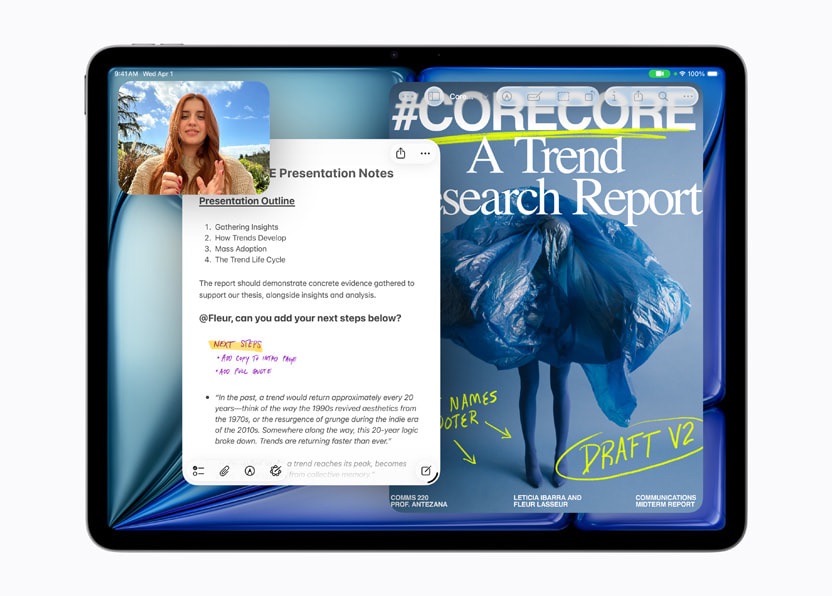
iPad Air with M4 ships with iPadOS 26, the current shipping version of which is iPadOS 26.4. Apple describes iPadOS 26 as introducing a Liquid Glass design, a new windowing system, a new menu bar, an updated Files app with folders in the Dock, and the new Preview app for sketching, viewing, and marking up PDFs and images.
iPadOS 26 also brings the Phone app to iPad, with Call Screening, Hold Assist, and Live Translation in Messages, FaceTime, and Phone. The M4 chip enables specific iPadOS 26 capabilities for the iPad Air, including audio input controls, local capture for high-quality recording, and Background Tasks.
Touch ID and Authentication
iPad Air uses Touch ID embedded in the top button to unlock the device, authenticate apps, and approve Apple Pay purchases. There is no Face ID on the iPad Air, and that gap is the most consistent reviewer criticism after the 60Hz refresh rate. According to On my Om, the absence of Face ID is “table-stakes technology” in 2026.
Accessories
Apple sells two main accessories alongside the iPad Air: the Magic Keyboard for iPad Air, which is the dedicated keyboard case, and Apple Pencil Pro or Apple Pencil (USB-C) for input.
Magic Keyboard for iPad Air
Magic Keyboard for iPad Air has a built-in trackpad, a 14-key function row, and a machined aluminum hinge with a USB-C port for pass-through charging. The keyboard attaches magnetically through the Smart Connector, which carries both power and data so the accessory does not need its own battery. It is available in black and white finishes.
Pricing is $269 for the 11-inch version and $319 for the 13-inch version, with education pricing of $249 and $299 respectively.
Apple Pencil Pro
Apple Pencil Pro is priced at $129 and is the most advanced Apple Pencil for the iPad Air. It supports squeeze gestures, barrel roll for orientation-aware tools, and Find My tracking. Apple Pencil hover, tilt sensitivity, and pressure sensitivity are all included.
Apple Pencil (USB-C) is also compatible with the iPad Air at $79. It is positioned as the note-taking and sketching option without the advanced gesture support of the Pro.
Accessibility
iPad Air supports Apple’s full set of accessibility features, including VoiceOver, Zoom, Magnifier, Spoken Content, Voice Control, Switch Control, AssistiveTouch, Siri and Dictation, Type to Siri, Real-Time Text, Audio Descriptions, Subtitles and Closed Captioning, and Live Captions. The features cover vision, mobility, hearing, and cognitive accessibility needs.
Environmental Claims
Apple states the iPad Air with M4 is made with 30 percent recycled content, including 100 percent recycled aluminum in the enclosure and 100 percent recycled cobalt in the battery. The battery uses 95 percent recycled lithium. Printed circuit boards use 100 percent recycled gold plating and tin solder, magnets use 100 percent recycled rare earth elements, and the Apple logo uses 80 percent recycled steel.
Apple says 40 percent of the manufacturing electricity for the iPad Air is sourced from renewable electricity, and the packaging is 100 percent fiber-based. The iPad Air is ENERGY STAR certified.
Other iPad Air Models
iPadOS 26 supports a long list of older iPad Air models alongside the new M4 generation. The full list includes iPad Air 11-inch (M4), iPad Air 13-inch (M4), iPad Air 11-inch (M3), iPad Air 13-inch (M3), iPad Air 11-inch (M2), iPad Air 13-inch (M2), iPad Air (5th generation), iPad Air (4th generation), and iPad Air (3rd generation). The current shipping iPadOS version on the iPad Air M4 is iPadOS 26.4.
What’s Next for iPad Air
According to a supply chain report from Korean trade outlet ETNews, surfaced in AppleInsider‘s reporting in April 2026, Apple is planning an OLED iPad Air for the first half of 2027, with Samsung Display set to begin mass production at the end of 2026 or in January 2027.
Display technology is currently the most prominent hardware gap between the Air and the Pro, with the Pro using a Tandem OLED panel and the Air using LCD. An OLED Air would likely use a more affordable LTPS single-stack OLED panel rather than the Pro’s Tandem OLED, which would still leave the Pro with the higher-end display option. Tom’s Guide‘s coverage of the same ETNews report suggests the OLED transition could also bring 120Hz ProMotion to the iPad Air for the first time.
iPad Air Timeline
April 24, 2026 — Cult of Mac publishes an updated long-form review of the M4 iPad Air, framing the M1-to-M4 jump as transformative for older-Air owners.
April 18, 2026 — 9to5Mac includes the M4 iPad Air in its “buy now” recommendations for the current Apple lineup.
April 15, 2026 — AppleInsider reports on an ETNews supply chain story expecting an OLED iPad Air in the first half of 2027, with Samsung Display mass production beginning at the end of 2026 or in January 2027.
March 31, 2026 — Slatepad publishes its M4 iPad Air review, noting a focused thermal warm spot near the Apple Pencil charging strip under sustained load.
March 25, 2026 — AppleInsider publishes its M4 iPad Air review under the framing “middle of the road is the best place to be.”
March 13, 2026 — Cult of Mac publishes its initial M4 iPad Air review.
March 12, 2026 — CNN Underscored publishes its M4 iPad Air review with a 90 percent score.
March 11, 2026 — iPad Air with M4 begins arriving to customers and Apple Store locations.
March 9, 2026 — AppleInsider aggregates the first wave of major-outlet reviews, including Engadget, Tom’s Guide, The Verge, and others.
March 4, 2026 — Pre-orders open for iPad Air with M4 in 35 countries and regions, including the U.S.
March 3, 2026 — 9to5Mac analyzes the first M4 iPad Air Geekbench results, estimating a 17.3 percent single-core gain and a 7.9 percent multi-core gain over the M3 13-inch.
March 2, 2026 — Apple unveils iPad Air with M4, increased RAM, Wi-Fi 7, and the C1X cellular modem.
October 22, 2025 — iPad Pro with M5, the iPad Air’s premium sibling, becomes available.
October 15, 2025 — Apple announces iPad Pro with the M5 chip.
March 12, 2025 — iPad Air with M3, the immediately preceding generation, becomes available.
March 4, 2025 — Apple announces iPad Air with M3 and an updated Magic Keyboard for iPad Air.
May 15, 2024 — iPad Air (M2) becomes available, introducing the 13-inch Air for the first time.
March 18, 2022 — iPad Air (5th generation) with the M1 chip becomes available, the M1 baseline used in Apple’s M4 performance comparisons.
October 23, 2020 — iPad Air (4th generation) becomes available, introducing the flat-edge design and USB-C port still used in 2026.
November 1, 2013 — Original iPad Air launches, marking the start of the iPad Air product line.
Changelog
May 3, 2026 — Initial publication.
Note: See an error in this roundup or want to offer feedback? Send us an email here.