




iMac
Apple's thin all-in-one desktop, updated with M4 chip.
Should You Buy the iMac?
The M4 iMac has been on sale since November 8, 2024, putting it about 18 months into its lifecycle. Pricing starts at $1,299 for the 8-core model and $1,499 for the 10-core, with education prices of $1,249 and $1,399.

If you want a desktop Mac with a built-in display, the iMac is the only option Apple sells. The Mac mini, Mac Studio, and Mac Pro all require a separate display. The Mac mini starts at $599, well below the iMac’s entry price, so a Mac mini paired with a third-party monitor remains the most direct value comparison for shoppers who do not need an all-in-one.
According to Bloomberg‘s Mark Gurman in his Power On newsletter, Apple is preparing a refreshed iMac with new colors. 9to5Mac expects an M5 update later this year. If you do not need a desktop right away, waiting a few months to see the next generation is reasonable.
How to Buy
The M4 iMac can be ordered from Apple’s online store, in Apple retail stores, and through other retailers. Pre-orders opened on October 28, 2024 in 28 countries and regions, with shipments and in-store availability beginning Friday, November 8, 2024.
According to Expert Reviews UK, prices in the U.K. start at £1,299 for the 8-core model and £1,499 for the 10-core. The publication notes the entry price is only about £50 above the M1 iMac’s launch price in 2021.
Configuration Options
The 8-core model includes 16GB of unified memory, a 256GB SSD, two Thunderbolt 4 / USB 4 ports, and the standard Magic Keyboard. Memory can be configured to 24GB, and storage can move up to 512GB or 1TB. Gigabit Ethernet and a Magic Keyboard with Touch ID and Numeric Keypad are configurable add-ons.
The 10-core model includes 16GB of memory, a 256GB SSD, four Thunderbolt 4 ports, Gigabit Ethernet built into the power adapter, and Magic Keyboard with Touch ID. Memory can be configured to 24GB or 32GB, and storage to 512GB, 1TB, or 2TB. Nano-texture glass is offered only on this tier. According to Expert Reviews UK, the upgrade from 16GB to 24GB is £200 in the U.K., the same step costs £200 again to reach 32GB, and each storage tier above 256GB also costs £200.
Reviews
Reviewer reaction to the M4 iMac was broadly positive, with most outlets concluding that it is the best iMac to date while acknowledging the upgrade is iterative rather than dramatic.

Six Colors‘ Jason Snell called the new iMac “gloriously niche”. He singled out the upgraded Center Stage camera, which he said looks sharper, with more contrast and more natural-looking skin tones than the original Center Stage camera on the Apple Studio Display. TechRadar described the M4 iMac as the best, and most colorful, all-in-one computer. AppleInsider concluded that minor changes lead to perfection. Macworld asked whether it was the best iMac ever and answered yes. Engadget‘s Steve Dent said the best all-in-one gets a lot faster. Cult of Mac‘s D. Griffin Jones called it stunning and powerful.
Nathan Edwards at The Verge took a more critical view; the published review URL describes the iMac as “expensive, beautiful, niche.”
Common criticisms across outlets include the lack of a height-adjustable stand and the absence of HDR support on the display. Several reviewers also call out the Magic Mouse charging port, which remains on the underside of the device despite the switch to USB-C. Tom’s Guide flags the missing HDR among the reviewer’s main complaints, plus the absence of a touchscreen option and a non-adjustable stand. Engadget echoes the concern about height adjustment, noting Apple offers it on the Studio Display but has not extended that option to the iMac. Several reviewers add that the M4 update may not feel meaningful to existing M3 iMac owners.
Design
The iMac keeps the all-in-one form factor introduced with the M1 redesign in April 2021. The body is 11.5mm thick (about 0.43 inches), a thinness Six Colors describes as an ultra-thin slab that looks like an oversized iPad attached to a stand. Engadget‘s review measures the same 0.43-inch frame.
The chassis is 21.5 inches (54.7 cm) wide and 18.1 inches (46.1 cm) tall, with a stand depth of 5.8 inches (14.7 cm) and a stand width of 5.1 inches (13 cm). Weight is 9.74 pounds (4.42 kg) for the 8-core configuration and 9.79 pounds (4.44 kg) for the 10-core. Apple notes that weight varies by configuration and manufacturing process.
Colors
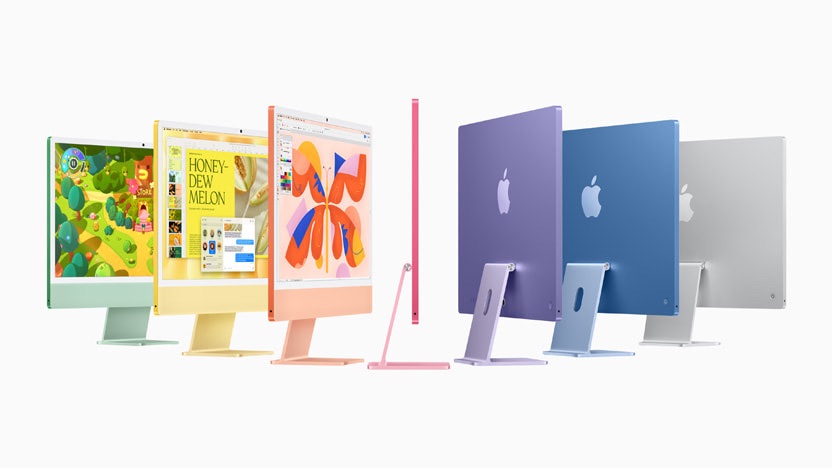
The M4 iMac comes in seven colors: green, yellow, orange, pink, purple, blue, and silver. The back of each iMac is a more saturated, bolder version of the color, while the front chin is paler and lighter. The display bezel is white on every color.
According to Engadget‘s Steve Dent, Apple subtly tweaked the seven colors compared with the M3 iMac, with the new palette appearing in slightly paler “fresh” shades. The publication notes the new green looks especially subtle.
Stand and Mounting
The iMac stand tilts but does not adjust in height. According to Engadget, Apple offers height adjustment on the Studio Display but has not extended that option to the iMac. For users who want third-party mounting, Apple sells a separate VESA mount configuration that ships without a stand.
Display
The iMac has a 24-inch 4.5K Retina display with a 4480-by-2520 native resolution, 218 pixels per inch, support for 1 billion colors, 500 nits of brightness, P3 wide color, and True Tone. Apple notes that the actual diagonal screen size is 23.5 inches.
The display does not support HDR. Tom’s Guide lists this and the lack of a touchscreen as recurring criticisms across reviews.
Nano-Texture Glass
Apple offers a nano-texture glass option that drastically reduces reflections and glare while maintaining image quality. The option is available only on models with the 10-core CPU and 10-core GPU, and a polishing cloth is included with the iMac when nano-texture is selected.
M4 Chip
The iMac uses the Apple M4 chip in two configurations. The 8-core variant has four performance cores, four efficiency cores, and an 8-core GPU. The 10-core variant has four performance cores, six efficiency cores, and a 10-core GPU. Both versions include hardware-accelerated ray tracing and a 16-core Neural Engine, plus 120GB/s memory bandwidth.
Apple says the M4 iMac is up to 1.7x faster than the iMac with M1 for daily productivity, and up to 2.1x faster than M1 for demanding workflows like photo editing and gaming. Apple also says the M4 iMac is up to 4.5x faster than the most popular 24-inch all-in-one PC with the latest Intel Core 7 processor, and up to 6x faster than the most popular Intel-based iMac. The Neural Engine is over 3x faster than on the iMac with M1, according to Apple.
Independent benchmarks back the gen-over-gen claims. AppleInsider‘s testing of the 10-core M4 iMac returned roughly 3,835 single-core and 13,589 multi-core in Geekbench 6. Tom’s Guide reports the M4 iMac landed within about 200 points of the M4 iPad Pro on both Geekbench 6 tests. Macworld‘s Cinebench testing showed the M4 iMac about 53 percent faster than the iMac Pro and 137 percent faster than an Intel Core i7 iMac.
RAM
Every M4 iMac includes 16GB of unified memory as standard, doubled from the 8GB starting point on the M3 iMac. The 8-core configuration is configurable to 24GB. The 10-core configuration is configurable to 24GB or 32GB. Apple uses faster LPDDR5X memory in the M4 generation, and memory bandwidth is 120GB/s, up from 100GB/s on the M3.
Storage
Base storage on every M4 iMac is 256GB SSD. The 8-core configuration is configurable to 512GB or 1TB. The 10-core configuration is configurable to 512GB, 1TB, or 2TB.
Camera
The iMac has a 12MP Center Stage camera that includes Desk View and 1080p HD video recording, along with an advanced image signal processor for computational video. Center Stage automatically keeps you framed during video calls, and Desk View lets you share what is on your physical desk during a call.
The new camera replaces the older 1080p webcam. The M1 and M3 iMacs both used that simpler module. According to Jason Snell at Six Colors, the new module looks sharper, with more contrast and more natural-looking skin tones than the Center Stage camera on the Apple Studio Display.
Audio
The iMac has a high-fidelity six-speaker system with force-cancelling woofers, wide stereo sound, and Spatial Audio support when playing music or video with Dolby Atmos. A studio-quality three-microphone array uses high signal-to-noise ratio components and directional beamforming to cut down on background noise. The mic array also supports “Hey Siri.”
Connectivity
On the 8-core iMac, two ports support Thunderbolt 4 / USB 4 at up to 40Gb/s, USB 3.1 Gen 2 at up to 10Gb/s, and DisplayPort. The 10-core configuration adds two more for a total of four ports, all with the same Thunderbolt 4 capabilities. Both models include a 3.5mm headphone jack with advanced support for high-impedance headphones.
Gigabit Ethernet is standard on the 10-core configuration, mounted on the power adapter rather than the iMac itself. On the 8-core, Ethernet is a paid configuration option.
The iMac supports Wi-Fi 6E (802.11ax) where supported, plus Bluetooth 5.3. The 10-core iMac drives up to two external displays at 6K/60Hz or one external display at 8K/60Hz, in addition to the built-in display. The 8-core model drives one external display at 6K/60Hz.
Touch ID and Authentication
Touch ID is included on the Magic Keyboard with the 10-core iMac as standard. The 8-core iMac ships with the standard Magic Keyboard, and customers can configure a Magic Keyboard with Touch ID and Numeric Keypad at the time of order.
Accessories
Every M4 iMac ships with a color-matched Magic Keyboard and Magic Mouse, both of which now charge over USB-C rather than Lightning. A color-matched Magic Trackpad is offered as a configure-to-order alternative.
The Magic Mouse charging port remains on the underside of the device, a design decision multiple reviewers have called out. According to The Disconnekt, the placement is one of the most questionable design decisions Apple has ever made, and the switch to USB-C has not addressed the issue.
In the Box
The 10-core iMac ships with the iMac, Magic Keyboard with Touch ID, Magic Mouse, 143W power adapter, 2-meter power cord, and USB-C charge cable. A polishing cloth is included only when nano-texture glass is selected.
The 8-core iMac ships with the same items, with two exceptions. It uses the standard Magic Keyboard (without Touch ID by default). The polishing cloth is also not included, since nano-texture is not offered at this tier.
Apple Intelligence and macOS
The M4 iMac shipped with macOS Sequoia 15.1, the first macOS version to include Apple Intelligence in U.S. English beta. Apple says iPhone Mirroring, systemwide Writing Tools, redesigned Siri, Image Playground, and Genmoji were part of the experience at launch, with ChatGPT integration in Siri and Writing Tools added in December 2024. Current iMacs now run later macOS versions.
Accessibility
Apple lists eight built-in accessibility features. The full set covers Voice Control, VoiceOver, Zoom, Increase Contrast, Reduce Motion, Siri and Dictation, Switch Control, and Live Captions, across both the 8-core and 10-core configurations.
Environmental Claims
The iMac stand uses 100 percent recycled aluminum. Apple also uses 100 percent recycled rare earth elements in all magnets and 100 percent recycled tin in the solder of multiple printed circuit boards. The same circuit boards use 100 percent recycled copper and 100 percent recycled gold in the plating. Apple says 13 components contain 50 percent or more recycled plastic.
Packaging is 100 percent fiber-based, with 76 percent recycled content in the fiber packaging. Apple says the iMac is ENERGY STAR certified, with more than 15 percent recycled content overall, over 20 percent of manufacturing electricity sourced from low-carbon sources, and a more than 20 percent emissions reduction against a business-as-usual scenario as modeled by Apple.
What’s Next for iMac
The M5 iMac
According to Bloomberg‘s Mark Gurman in his Power On newsletter, the next iMac will get a refreshed color palette, and the new iMac is expected after refreshed Mac Studio models that Gurman expects in the middle of 2026. According to 9to5Mac‘s Ryan Christoffel, the iMac is set for an M5 update later in 2026, and the publication says the new model will arrive before the M4 generation hits its 2-year mark. The M4 model launched 18 months prior.
According to AppleInsider, internal Apple data from leaked product identifiers points to an unreleased Mac with the identifier J833ct. The publication suggests this could be an M5-equipped iMac, because the 2023 24-inch iMac is internally known as J433. AppleInsider notes the connection is plausible but not definitive proof. A separate AppleInsider report on October 10, 2025 says macOS 26.4 includes references to a Mac known as J833ct, which the publication again suggests is likely the next iMac.
A High-End “iMac Pro”?
Leaked Apple kernel debug kit files reportedly reference an iMac with the identifier J833c running platform H17C, which corresponds to the M5 Max chip codenamed Sotra C. According to Technobezz, this could indicate a high-end iMac variant, possibly branded “iMac Pro.” The same article cautions that the leak references devices used exclusively for internal testing, so the M5 Max iMac entry could reflect a test platform rather than a retail product.
Nothing has been confirmed by Apple. Treat the M5 Max iMac as a possibility, not a planned shipping product.
OLED iMac
According to a ZDNet Korea report covered by AppleInsider, 9to5Mac, and Digitimes, Apple has asked Samsung Display, LG Display, and other suppliers to produce 24-inch OLED panel samples on their mass-production lines. The targeted specifications are roughly 218 PPI and 600 nits of brightness. Apple is expected to introduce the OLED iMac around 2029 or 2030. AppleInsider adds an important caveat. The publication notes that ZDNet Korea‘s accuracy on long-range timing predictions has been somewhat questionable.
According to 9to5Mac and Digitimes, Samsung Display is expected to ship the first 220 PPI QD-OLED samples to Apple in the second half of 2026, a step up from its current 160 PPI QD-OLED panels for monitors. LG Display is expected to follow with W-OLED panels using a still-in-development 5-stack design that adds a green layer for more brightness, plus an alternative manufacturing approach known as eLEAP that eliminates Fine Metal Masks.
iMac Timeline
April 17, 2026 — 9to5Mac reports that four new Macs are coming this year, including an M5 iMac with a refreshed color palette.
March 31, 2026 — Digitimes details Samsung Display and LG Display OLED panel development for a future iMac.
March 30, 2026 — AppleInsider and 9to5Mac, citing ZDNet Korea, report that Apple plans an OLED iMac for 2029 or 2030.
March 8, 2026 — Bloomberg‘s Mark Gurman reports in his Power On newsletter that the next iMac will come in refreshed colors.
January 2026 — Technobezz reports leaked kernel debug kit files referencing an iMac with identifier J833c running platform H17C, the M5 Max chip codenamed Sotra C.
October 10, 2025 — AppleInsider reports macOS Tahoe internal references to a Mac with identifier J833ct, likely an iMac, supported by macOS 26.4.
July 3, 2025 — AppleInsider reports leaked Mac product identifiers including J833ct, which the publication suspects is an M5 iMac.
December 30, 2024 — Expert Reviews UK publishes its M4 iMac review with U.K. pricing detail.
November 19, 2024 — AppleInsider publishes its M4 iMac review.
November 14, 2024 — Engadget‘s Steve Dent publishes his M4 iMac review.
November 12, 2024 — Cult of Mac‘s D. Griffin Jones publishes his M4 iMac review.
November 8, 2024 — Apple begins shipping the M4 iMac worldwide.
November 7, 2024 — First-day reviews from Six Colors, TechRadar, Macworld, Tom’s Guide, and others go live.
October 28, 2024 — Apple announces the M4 iMac and opens pre-orders.
November 7, 2023 — M3 iMac arrives in stores.
October 30, 2023 — Apple announces the M3 iMac at the “Scary Fast” event.
May 21, 2021 — M1 iMac arrives in stores, marking the first redesign of the iMac for Apple silicon.
April 30, 2021 — M1 iMac pre-orders open.
April 20, 2021 — Apple announces the M1 iMac with seven colors.
August 15, 1998 — The first iMac (Bondi Blue iMac G3) ships, according to Macworld‘s anniversary feature.
May 6, 1998 — Steve Jobs unveils the original iMac at the Flint Center.
Changelog
May 3, 2026 — Initial publication.
Note: See an error in this roundup or want to offer feedback? Send us an email here.