






With Eye Tracking, you can control iPhone using just your eyes. An onscreen pointer follows the movement of your eyes, and when you hold your gaze steady on an item—or dwell—you perform an action, such as a tap. All data used to set up and control Eye Tracking is processed on device.
It uses the built-in, front-facing camera, and you need to calibrate it every time you turn it on.
Before you begin
Eye Tracking relies on the built-in, front-facing camera on iPhone, so for the best results, make sure the camera has a clear view of your face and your face is adequately lit. Your iPhone should sit on a stable surface about a foot and a half from your face.
On supported iPhone models, Eye Tracking is available.
Turn on Eye Tracking
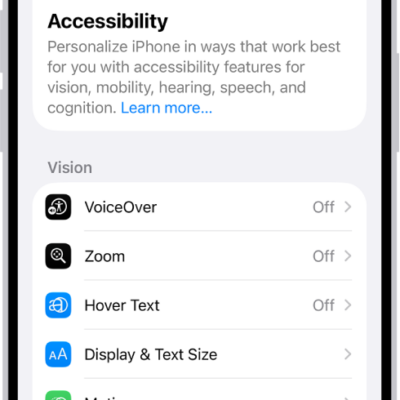
- Open Settings, tap Accessibility, tap Eye Tracking, and then turn on Eye Tracking.
- Follow the onscreen instructions to calibrate Eye Tracking. As a dot appears in different locations around the screen, follow its movement with your eyes.
Note: You need to calibrate Eye Tracking again each time you turn it on.
Use Eye Tracking
When you’ve turned on and calibrated Eye Tracking, iPhone follows the movement of your eyes. By default, an outline appears around an item on the screen when you look at it.
If Snap to Item is turned off, when you hold your gaze steady at a location on the screen, the dwell pointer appears where you’re looking and the dwell timer begins (the dwell pointer circle starts to fill). When the dwell timer finishes, an action—tap, by default—is performed.
Use the AssistiveTouch menu to perform additional onscreen gestures or physical button presses.
Recalibrate Eye Tracking
Changing the position of your face or your iPhone automatically starts Eye Tracking calibration if recalibration is needed, but you can also start calibration manually.
-
Look at the top-left corner of your screen and hold your gaze steady.
The dwell pointer appears and the dwell timer begins (the dwell pointer circle starts to fill). When the dwell timer finishes, Eye Tracking calibration starts.
- Follow the onscreen instructions to calibrate Eye Tracking. As a dot appears in different locations around the screen, follow its movement with your eyes.
To start recalibration, you need to look at a corner of the screen. You can change which corner that is, or assign actions to the other corners.
Set options for Eye Tracking
The Eye Tracking pointer has options you can set for how it responds to your gaze.
- Open Settings, tap Accessibility and tap Eye Tracking. Adjust any of the following:
- Smoothing: Increase this value to make the movement of the pointer smoother. Or decrease this value to make the pointer more responsive.
- Snap to Item: Have the Eye Tracking pointer automatically move to the item on the screen that’s closest to where you’re looking.
- Zoom on Keyboard Keys: When you dwell on the keyboard, zoom in on the section of the keyboard you’re looking at. Dwell again on a key to tap it.
- Auto-Hide: Show the Eye Tracking pointer when you hold your gaze steady for the amount of time specified. The pointer automatically fades while your eyes are moving.
- Dwell Control: Turn Dwell Control on or off.
- Show Face Guidance: Turn Show Face Guidance on or off to get help adjusting how you’re positioned.
To change the size or color of the Eye Tracking pointer, go to Settings > Accessibility > Pointer Control.