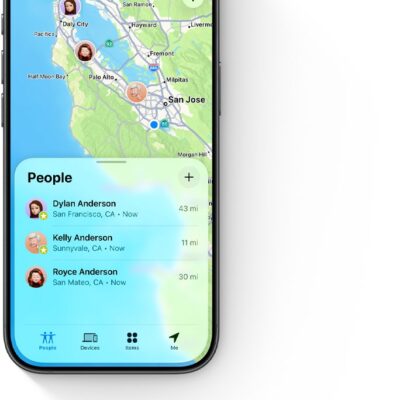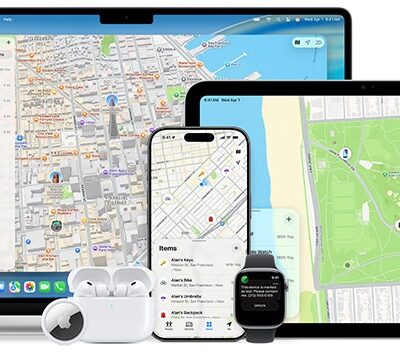






Find My lets you take a variety of remote actions on devices and short-range actions on items. Options vary in utility based on whether your device has fallen behind a couch cushion, or has been misplaced or stolen, and whether the device or item is directly reachable via a local network, the internet, or the Find My network. With devices, Apple follows up many actions with an email message sent to your Apple Account’s associated address.
You can set up notifications within Find My to provide a variety of information depending on the category:
- People: You can opt to receive alerts when they arrive and leave locations you define, or send them alerts based on your location.
- Devices and Items: You can be notified when a device is found if it’s marked as lost. You can also receive a prompt when you leave something behind.
People-based notifications let you track when someone (including you) arrives at or leaves a location. The alert can be set once or on a recurring basis. Here’s what to do:
- In a native Find My app on an iPhone, iPad, or Mac, bring up the sheet of actions for a person via the Person view.
- In the version 27 releases, beneath either Notify Me or Notify Person, tap or click Add Location Alert. In earlier releases, beneath Notifications, first tap or click Add, then select Notify Me or Notify Person.
- For Notify Me, you can select I Arrive or I Leave; for Notify Person, you can select Person Arrives, Person Leaves, or Person Is Not At.
- Pick a location. Some locations will be prefilled, such as you or another person’s current location.
- You can also tap or click New Location, then drag on the map or enter a location.
- Clicking or tapping in the search field brings up potential matches from the person’s contact card before you start typing.
- Optionally set a radius. Tap Small, Medium, or Large at the bottom of the map to switch among radii of 300, 800, and 1,250 feet (90 m, 240 m, and 380 m).
- Or drag the blue dot at the right out to a preferred distance; a label indicates the radius as you drag.
- The minimum is a 300-foot (90 m) radius. The maximum is 792,000 feet — 150 miles or 241 km.
- A wider area prevents excessive notifications for departures, or gives earlier warning of an arrival.
- Your final option varies based on the Arrives/Leaves/Is Not At selection:
- For yourself or someone else, Arrives/Leaves lets you pick Only Once or Every Time for notification frequency.
- For another person with Person Is Not At chosen, you can set a range of time and days of the week.
- Click or tap Add to complete. If you set this up to track someone else, they now receive a notification that you’ve done so.
If you’ve asked your child to remain within a certain distance of home, or want to know when they’re returning so you can hide the liquor—er, clean up around you—then changing the radius is useful. However, an older child might employ a Cat in the Hat strategy towards a parent.
This map selection tool is also used with Notify When Left Behind, a way Apple helps you avoid accidentally losing stuff.
Is Not At could be useful with an employee or child to know when they’re not in a place you expect at certain times.
The other person is always told
When you let other people know what you’re up to with notifications, they receive an alert that tells them what they can expect to receive. This appears across your devices and is an anti-stalking measure; see how to check whether someone is tracking you.
Your Apple Watch lets you notify or be notified about people’s locations, but it’s limited to Notify Me/Notify Person with two options. You can notify someone when you leave your location or arrive at theirs, or when they leave their location or arrive at yours. You can’t select locations or set up other nuances below.
If you want to see notifications about someone else’s comings and goings, you’re told what they will be informed of and given a chance to cancel, and they receive a notification about what you’ll be updated about.
For recurring alerts set to Every Time, you’re told that someone has to approve the action. The notification is slightly different for Person Is Not At recurring alerts, specifying that the other person will be notified at the moment the schedule first goes into effect. So if you set the schedule to Wednesday at 9 a.m. and it’s Sunday night, the alert will say a request will be sent for approval at 9 a.m. Wednesday. (The time zone will be whatever time zone the location you set is in, not your or the other person’s current time zone.)
For notifications that require permission, you see a Pending Request label on that person’s sheet of actions.
It can be useful to pause notifications for a lot of reasons; tap or click Pause to pick a time to resume: either “Until the end of Today” or from a calendar.
You can freak someone out by creating a notification without alerting them first. When you use Find My to track someone’s arrival or departure, that person receives a notification that you’ve done so. This can happen in the most benign circumstances.
After my wife texted that she was coming home with oodles of groceries a couple of years ago, I created a notification to alert me when she got home so I’d break off what I was doing and go down a couple of flights of stairs to the street level to help her. She was surprised by the alert she had received. At that time, Apple had just changed their system to provide this disclosure to others.
That disclosure is quite useful, because tracking can be used in non-benign situations, too: see how to check whether someone is tracking you.