







With Voice Control on your iPhone, you can speak commands to interact with what’s on the screen, perform gestures and button presses, dictate and edit text, and more. And with Apple Intelligence, you can describe onscreen elements in your own words instead of using exact labels—refer to an item by its name, what it does, its color, or where it appears on the screen.
You can pause or resume Voice Control, see what commands you can use, label onscreen items, and show a numbered grid on the screen.
Note: When Voice Control is on, you use Voice Control to dictate text; standard iOS Dictation isn’t available. Voice Control isn’t available in all languages.
Note: Apple Intelligence on iOS 27 or later is available on an Apple Intelligence-enabled iPhone 15 Pro, iPhone 15 Pro Max, or iPhone 16 model or later. Apple Intelligence is not available in all languages or regions. Usage limits may apply.* To use Apple Intelligence with Voice Control, you must have your system language and Voice Control language set to English.
Set up Voice Control
Before you turn on Voice Control for the first time, iPhone needs to be connected to the internet over a Wi-Fi network. Once iPhone finishes a one-time file download from Apple, Voice Control works without an internet connection.
- Start the Settings app on your iPhone.
-
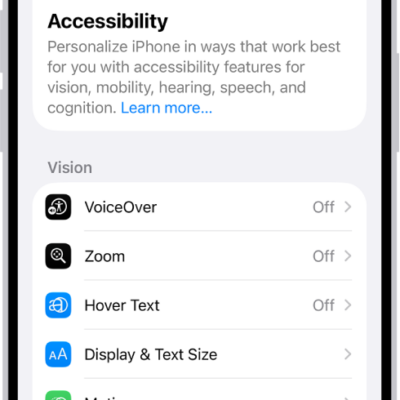
Tap Accessibility, tap Voice Control, tap Set Up Voice Control, and follow the onscreen instructions.
When the download is complete, the Voice Control icon appears in the status bar to indicate that Voice Control is turned on.
-
Set options such as the following:
- Language: Set the language and download languages for offline use.
- Commands: View the available commands and create new commands.
-
Vocabulary: Teach Voice Control to recognize new words and phrases. You can enter a word or phrase and teach Voice Control how you pronounce it, or import a vocabulary list.
Note: Not all Voice Control languages support a custom vocabulary.
- Show Confirmation: When Voice Control recognizes a command, a visual confirmation appears at the top of the screen.
- Play Sound: When Voice Control recognizes a command, a sound plays.
- Show Hints: See command suggestions and hints.
- Flexible Item Names: With Apple Intelligence, you can refer to onscreen items in your own words instead of using their exact labels. This is turned on by default and can be turned off to use exact labels.
- Continuous Overlay: Display numbers, names, or a grid over screen elements.
- Attention Aware: On an iPhone with Face ID, Voice Control wakes up when you look at your iPhone and goes to sleep when you look away.
- Prefer Bluetooth Headset: Use AirPods or Bluetooth® headsets when connected instead of the iPhone microphone.
Note: Using Voice Control with AirPods and third-party headsets impacts audio quality and audio features like Siri announcements and Share Audio with AirPods.
Turn Voice Control on or off
With Voice Control set up, any of the following turns it on or off quickly:
- Use Control Center if you’ve added Voice Control there.
- Use Accessibility Shortcut if you’ve set it up to turn on Voice Control.
Siri: Ask Siri something like, “Turn on Voice Control.”
Start using commands
You just say a command to use Voice Control on your iPhone. And Apple Intelligence lets you describe the item you want to act on rather than use its exact label.
Voice Control: Say, for example, “Open Control Center,” “Go home,” “Tap item name,” or “Turn up volume.” Or with Apple Intelligence, say “Tap the button that sends the message” or “Tap the button at the bottom right.”
Quick tip: The interactive Voice Control Tutorial helps you get familiar with Voice Control and practice essential commands. To open it, go to Settings > Accessibility > Voice Control and tap Open Voice Control Tutorial.
Pause or resume Voice Control
Pausing Voice Control keeps the words you say from being interpreted as commands or dictation. Resume it when you’re ready for Voice Control to listen for commands and dictation again.
Voice Control: Say “Stop listening” or “Start listening.”
See what commands you can use
The list shows the available commands, which change based on the app you’re working in and what you’re doing. While writing a document, for example, you’ll see text formatting commands. Apple Intelligence also means you can describe an item in your own words rather than use its exact label.
Note: Voice Control: Say “Show commands.”
To browse the full list of supported commands and see examples of how to use them, go to Settings > Accessibility > Voice Control > Commands.
Label onscreen items
Not sure what to call something? Show a name or number next to each item on the screen, then use that name or number to interact with the item. With Apple Intelligence, you’re also free to describe an item in your own words, without its name or number.
Voice Control: Say “Show names,” “Show numbers,” or “Show text numbers.” Or with Apple Intelligence, say “Tap the blue button at the bottom.”
To interact with an item, say its name or number, or say a command—such as “Long press”—followed by the item’s name or number. The item names or numbers disappear after you say the command.
Show a numbered grid on the screen
Superimposing a grid makes it easier to interact with a precise area of the screen.
Voice Control: Say “Show grid.”
- Interact with a location on the grid: If a number is at the location you want to interact with, say any command—such as “Tap”—followed by the grid number. The grid disappears after you say the command.
- Drill down on an area of the grid: If you need to further refine the location, say a grid number to show a more detailed grid in that area.
Say “Hide names,” “Hide numbers,” or “Hide grid” to turn the overlay off.
Enter text
In a text input area, you can dictate character by character (with Spelling mode) or word by word (with Dictation mode). And so you don’t mistakenly enter a Voice Control command as text, you can have Voice Control respond only to commands (with Command mode).
When you’re in a text input area and label onscreen items with numbers, numbers are shown next to each line of text. Select a line or another section of the text to display a number for each word in the selection; select a single word to show a number for each character in the word. To interact with a text item (such as a line or a word), say a command followed by the item’s name or number. For example, you can say “Delete [item number]” or “Uppercase [item number].”
| Command | Description |
|---|---|
| Voice Control: Say “Dictation mode.” | Dictate word by word. Any words you say that aren’t Voice Control commands are entered as text. Dictation mode is on by default. In some Voice Control languages, if several words phonetically match what you say, they appear onscreen. Tap to choose the one you want. |
| Voice Control: Say “Spelling mode.” | Dictate character by character. Spelling mode is helpful when you need to enter a password, a web address, or another sequence of characters that wouldn’t be recognized as a word in Dictation mode. When Spelling mode is on, the Spelling Mode icon appears in the text input area. To increase accuracy when entering letters, you can use the letter’s phonetic alphabet code word (for example, say “Alfa Bravo Charlie” to enter “abc”). Note: Spelling mode isn’t available in all Voice Control languages. |
| Voice Control: Say “Command mode.” | Voice Control responds only to commands. Words and characters that aren’t commands are ignored and aren’t entered as text. Command mode is helpful when you need to say a series of commands and don’t want them inadvertently entered in a text input area. When Command mode is on, the Command Mode icon appears in the text input area to indicate you can’t dictate to enter text. |
Apple Intelligence is available with Siri and device language set to Chinese (Simplified), Chinese (Traditional), Danish, Dutch, English, French, German, Italian, Japanese, Korean, Norwegian, Portuguese, Spanish, Swedish, Turkish, or Vietnamese. Some features may not be available in all regions or languages, Apple says. Some devices may not be available in all regions.
Siri AI is available in beta in iOS 27, iPadOS 27, macOS 27, watchOS 27, and visionOS 27 and requires an Apple Intelligence–enabled device set to a supported language. Available in English to start. Siri AI will not be initially available in the EU on iOS, iPadOS, and watchOS. Certain Apple Intelligence features that rely on server-side models are subject to daily usage limits, including but not limited to Siri AI, Intelligent Photo Editing Tools, Image Playground, and AFM 3 Cloud models in Shortcuts.
Daily limits may vary by feature, request complexity, system demand, system policies, and other factors. Expanded access to such features will be available for a fee in the future. Use of these features is subject to the Apple Intelligence Terms and Conditions.