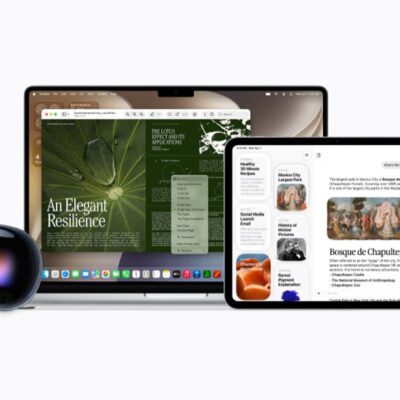








Apple released iOS 27 on Monday 14 September 2026, alongside iPadOS 27 and macOS 27 Golden Gate.
Apple tends to release operating system changes as a two-beat sequence, like our heart going LUB-dub: The LUB beat is a major flex, like the introduction of Liquid Glass across all their operating systems in 2025. This year is a “dub,” a building-or-rebuilding year, in which Apple largely tweaks the previous cycle and offers incremental improvements, though some may feel quite large.
Below, we have highlighted ten new features and changes in iOS 27 that you should try first. These ten features are worth ten minutes on the day you upgrade. Each is visible straight away, none needs new hardware, and most take under a minute.
For everything else, see what’s new in iOS 27, or the 37 changes that owe nothing to AI.
1. Dial down Liquid Glass
When you upgrade to iOS 27 or iPadOS 27, the last stages of the installation present a new screen that lets you choose to adjust Liquid Glass using a slider. If you don’t make the adjustment at that moment, you can do so later, or change your initial choice. Go to Settings > Appearance > Liquid Glass.
This new screen offers a slider you can drag from the left edge, which Apple describes as “More Clear” (most Liquid Glass effect) across a range to the right: “More Tinted” (most opaque). Apple makes it easy to visualize by providing a scrollable preview that shows Liquid Glass elements overlaid on a webpage with images and text.
See how to reduce Liquid Glass transparency for the two accessibility settings that go further.
2. Ask Siri a real question
While Apple has rebranded Siri as “Siri AI” on supported devices and in their marketing, you won’t see that name on your devices. It’s still called Siri. But everything is affected by the availability of Apple Intelligence. Whenever you invoke Siri on an Apple Intelligence-supported device, you’re invoking Siri AI.
Siri now provides much more accurate and detailed answers than before, even reaching into other apps to provide more information. Ask it a question, and it parses the results instead of trying to squeeze them into a format it understands.
Here are the most significant things Siri AI can do that its predecessor Siri could not:
- Use your data to produce better results or find things. One of the biggest ongoing complaints about Siri is that for software that ostensibly had access to our email, messages, contacts, calendar entries, photos, and other private data while running entirely on our devices, it sure didn’t know much about us. With Siri AI, you can ask, “Who did I have lunch with in 2013 in New Haven?” and it may be able to answer. (Whether that is invasive is a fair question.)
- Answer questions about what’s on screen. You could be looking at a webpage, reading a Wikipedia entry, having a conversation in Messages, or writing an email, and can ask Siri for more information about or to explain something that’s visible.
- Engage in a back-and-forth conversation. Siri has become something more like a chatbot, though it’s not quite as open-ended as the ones from Anthropic, Google, OpenAI, and others. However, it retains context and remembers aspects of conversations to provide better insight in the future.
- Create a plan. You might ask Siri to help you figure out the best sights to see in New York. Unlike chatbots that rely solely on synthesizing vast data stores, Siri can use your information, Apple’s human-made travel guides, map data, and other information to produce something that could be much more useful.
- Use a Siri app. You can revisit Siri conversations using the Siri app, the first time Apple has offered that kind of interaction with Siri.
One caveat before you try it: Siri AI ships in beta. Apple has hedged on details, stating only that it will be available in beta form, and not specifying when that beta might end. It needs an iPhone 15 Pro or later. It is English-only at launch, and is not offered in the European Union or China. In the beta period you had to request access at Settings > Siri. Check there first if you do not see it.
3. Find Siri’s new home
Instead of the glow around all four edges of your device in iOS 26/iPadOS 26, Siri in iOS 27/iPadOS 27 appears as an orb at the top of the screen. The design cleverly hides the non-screen areas in Dynamic Island on the many iPhone models with that carveout.
You can bring up Siri (by default), as in previous releases, by saying “Siri” or “Hey Siri,” or by pressing and holding the side button. However, the change introduced in iOS 26 that let you double-tap the bottom of the screen is gone. Instead, you can swipe down on a Home screen to reveal the new combination of Spotlight and Siri: a field labeled Search or Ask. You can type into that field, or tap the Dictation button and talk to Siri that way.
4. Set a Separate Alarm Volume
It took this long for Apple to let you set the volume of alarms and timers hitting zero seconds separately from your ringtone volume. Settings now includes an “Alarms and Timers” section with its own Match Ringtone Volume toggle. If you toggle it off, a dedicated slider appears that allows you to drop the ringer volume to nothing, and you’ll still be woken at whatever alarm volume you choose. Go to Settings > Sounds & Haptics and, under Alarms and Timers, disable Match Ringtone Volume. Drag the slider that appears to set your alarm and timer volume.
More in what’s new in Clock, Find My, Health and Podcasts.
5. Use both FaceTime cameras
After many, many years of FaceTime supporting a single camera view on iPhone, you can now use the front and back cameras simultaneously. The proviso? You need an iPhone 17, iPhone 17 Pro, iPhone 17 Pro Max, or iPhone Air and iOS 27. The other person or people can see your dual-camera feed only if they have iOS 27, iPadOS 27, or macOS 27. (This builds off the dual-capture mode in the Camera app on those models introduced in iOS 26.)
To use the dual-camera mode, in an active FaceTime session (or before someone has joined), tap the Flip Camera button in the inset selfie view. This shows both cameras by default.
If the person on the other end of the call has an older iPhone, they can still view your dual camera feed as long as their device is running iOS 27.
More in what changed in FaceTime, Messages, Phone and Wi-Fi.
6. Boost Your iPhone Wi-Fi With New Connectivity Assist Feature
Apple tried to tune up a key issue years ago with a feature they called Wi-Fi Assist: when you had a weak signal, there might be a better, higher-speed cellular connection available instead. Your device would then tap into the cell signal while the Wi-Fi signal was poor.
While Wi-Fi Assist helped, it didn’t solve the common problem you are certainly familiar with, when your iPhone won’t unclasp its Wi-Fi grasp as you walk out of one space—like your home or office—and there’s still a tendril of signal left.
Apple rebranded the feature as Connectivity Assist, and if you had Wi-Fi Assist enabled—it was by default—you’ll find the new feature already turned on in Settings > Wi-Fi.
I know how aggravating it is, because my house Wi-Fi barely reaches where we park our cars out front on the street. Whenever I try to pull up Maps for directions, I have to turn off Wi-Fi most days. Connectivity Assist promises to solve that precise issue.
7. Add keywords to photos
It took many years, but you can finally apply keywords to media in the Photos app on an iPhone and iPad. Huzzah? (Keywords are a useful way to link images for searching and organization.) However, you can still only apply keywords to items one at a time, as opposed to singly or in selections of two or more on a Mac. To add keywords, tap the info button, then tap Add Keywords.
More in keywords and Shared Albums in Photos.
8. Scan a card into Wallet
You can create entries for cards, membership cards, and other kinds of barcode/QR code-related proofs of entry or membership from scratch, a task formerly available only for third-party apps and websites.
Tap the Add button in Wallet, then tap Create a Pass. You’re guided through a few steps, one of which lets you scan the existing card, so that Wallet can pull in its number, barcode, or QR code. You can fill out details that aren’t present on the card or captured by Wallet.
More in what’s new in Apple Pay and Wallet.
9. Caption any video
Your iPhone and iPad now generate captions from any uncaptioned video you’re watching in Photos and other supported apps. (This isn’t related to tvOS or TV app captioning.) If captions already exist, you can have them automatically translated between supported languages.
More in the accessibility changes and the Action button.
10. Tap to Share at checkout
Entirely new iOS 27 feature is Tap to Share with merchants at the point of sale, such as in a store or at a fair. This makes in-person Apple Pay more akin to Apple Pay in Safari. Tap to Share lets an entire set of interactions occur before you pay. You start by approving a connection with a merchant’s iPhone that has a supported payment app. (Ostensibly, this may encompass not just companies like Square and Stripe, but in-house developer apps for retailers like Old Navy or Lowe’s.)
Once you begin, you can choose what you share with the business—like contact details, a shipping address, or your email. This also means you don’t have to state this information aloud or rely on the merchant typing it in correctly! A merchant can offer to sign you up for a membership or loyalty program. You can use a pass from the merchant, or they can issue one, related to discounts, credits, or other transaction-related purposes. Finally, you see the full cart as a digital receipt before completing payment with Apple Pay.
More in what’s new in Apple Pay and Wallet.
iOS 27 Compatible iPhones
These iPhone models are compatible with iOS 27:
- iPhone 18 Pro
- iPhone 18 Pro Max
- iPhone Duo
- iPhone 17e
- iPhone 17
- iPhone 17 Pro
- iPhone 17 Pro Max
- iPhone Air
- iPhone 16e
- iPhone 16
- iPhone 16 Plus
- iPhone 16 Pro
- iPhone 16 Pro Max
- iPhone 15
- iPhone 15 Plus
- iPhone 15 Pro
- iPhone 15 Pro Max
- iPhone 14
- iPhone 14 Plus
- iPhone 14 Pro
- iPhone 14 Pro Max
- iPhone 13
- iPhone 13 mini
- iPhone 13 Pro
- iPhone 13 Pro Max
- iPhone 12
- iPhone 12 mini
- iPhone 12 Pro
- iPhone 12 Pro Max
- iPhone 11
- iPhone 11 Pro
- iPhone 11 Pro Max
- iPhone SE (2nd generation and later)
More in iOS 27
Other new features in iOS 27 include iPhone Handoff, which moves a call and a phone number between two iPhones. There is also the ability to split a bill with Apple Cash; the ability to hide your location in Find My; and more. The full list runs to 37 changes that owe nothing to AI, on top of everything else in the release.