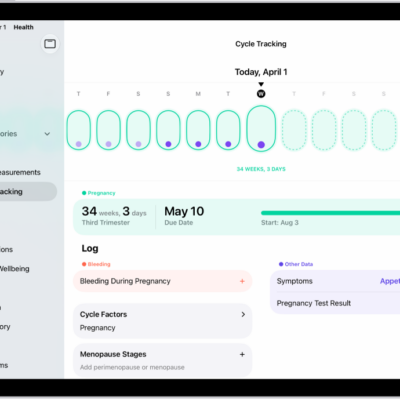
Cycle Tracking in the Health app can provide notifications when your logged cycle patterns are suggestive of perimenopause. You can track related symptoms and find support with educational resources.
You can log stages of perimenopause or menopause, and after logging, you can log related symptoms like hot flashes, night sweats, and sleep changes. When you track menopause, your perimenopause history is saved, and cycle deviation detection, predictions, and fertile window estimates are turned off.
Important: Cycle Tracking in the Health app should not be used for birth control or to diagnose a health condition. Cycle deviation notifications are based solely on the user’s logged cycle history. Cycle deviation notifications inclusive of perimenopause are for ages 40 and above. These notifications are not intended to replace traditional methods of diagnosis, monitoring, or treatment of perimenopause or menopause.
Log stages of perimenopause or menopause
- Open the Health app on your iPad.
- Tap the Browse button and tap Cycle Tracking.
- Tap Menopause Stages.
- Tap the Add button at the top right and then tap Next.
-
Do one of the following:
- Log perimenopause: Tap I’m in perimenopause.
- Log menopause: Tap I’ve reached menopause.
To learn more, tap Learn About Perimenopause and Menopause.
- Follow the onscreen instructions.
To track menopause after perimenopause, tap Menopause Stages, tap the Add button, then follow the onscreen instructions. Your perimenopause history is saved and all cycle deviation detection, predictions, and fertile window estimates are turned off.
When you’ve logged perimenopause and menopause, you can log related symptoms like sleep changes, hot flashes, night sweats, and more.
Log bleeding after menopause
- Open the Health app on your iPad.
- Tap the Browse button and tap Cycle Tracking.
- Swipe to select a day and tap Bleeding After Menopause.
- Tap Had Bleeding and tap a bleeding level. Tap Done.
Note: When you log bleeding after menopause, you receive a notification recommending that you contact your doctor.
About your health data and privacy
The information you add about yourself in Health is yours to use and share. You can decide what information is stored in Health as well as who can access your data.
When your iPad is locked with Face ID, Touch ID, or a passcode, all of your health and fitness data in Health, other than your Medical ID, is encrypted, according to Apple. Any health data synced to iCloud is encrypted both in transit and on Apple servers. And if you have a version of iPadOS, iOS, and watchOS (if you’re using iPhone and Apple Watch for cycle tracking) with default two-factor authentication and a passcode, your health and activity data is stored in a way that Apple can’t read it.
This means that when you use the Cycle Tracking feature and two-factor authentication, your health data synced to iCloud is encrypted end-to-end, and Apple doesn’t have the key to decrypt the data and therefore cannot read it.
See also