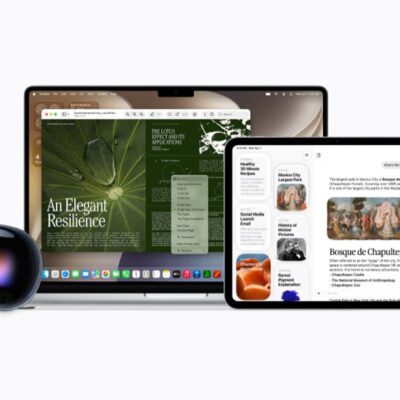









The previous two generations of macOS, iOS, and iPadOS included a collection of Apple Intelligence features that were collectively referred to as Writing Tools. They enabled your device to compose, rewrite, or proofread text and were available in nearly every app that provided text-editing capabilities. Starting in iOS 27, iPadOS 27, and macOS 27, the term Writing Tools has disappeared, and in its place are Write with Siri and Edit with Siri, depending on the context. The underlying capabilities are broadly similar, but the interface has changed significantly.
Users can write and edit with Siri AI virtually anywhere they type by just describing what they need.
Write with Siri AI
Thanks to Apple Intelligence, Siri can compose text out of thin air. If you want a snappy reply to an email or text message, a report on any imaginable subject, a résumé or cover letter, a fairy tale to tell your grandchildren, or pretty much anything else that can be built out of words, you can simply describe what you want and, usually within seconds, Siri will write it for you.
We are aware that lots of people, from corporate drones to university students to lazy authors, have become dependent on this type of AI writing, and as professional authors, we have…feelings about that. At a bare minimum, we would roundly reject the idea of passing off any AI-written text as our own, but more than that, it would feel like spending decades of hard work to become a great chef and then letting a robot come up with recipes and create your meals for you. That misses the whole point of the task.
So, yeah, we’re not super jazzed about letting Siri write stuff, and practically speaking, Siri has never written anything that actually sounds like the way either of us write, even if it’s otherwise accurate.
Other LLM-based tools produce better results, sometimes sounding sensible or even being fully factual. But wrestling with a chatbot when we have the knowledge, wordsmith skills, and commitment to what we do makes little sense for us.
All that said, the feature is there, and you can use it, if you like, in any of these ways:
- In most environments, including email, word processing documents, and forms on webpages, you can simply click or tap once in any spot where you can enter text, wait for the Write with Siri button to appear, and click or tap it to produce a Write with Siri field.
- If the Siri icon doesn’t appear (as is the case in Messages, for example), you can right-click or Control-click (on a Mac) and choose Ask Siri, or tap once to bring up the text menu (on an iPhone or iPad) and then tap the Siri button to display an “Ask Siri about this” field.
Then type a description of what you want into the field, and suggested text appears, which you can then revise (or ask Siri to revise) as needed.
Edit with Siri AI
To use Siri’s help with editing existing text, begin by selecting the text you’d like help with. Wait a moment, and you should see a white Edit with Siri button to its left. Click or tap that button, and it’s replaced with a series of controls.
In macOS 27 Golden Gate, there’s no longer a Writing Tools submenu on the Edit menu or the right-click/Control-click contextual menu. However, you can right-click or Control-click selected text and choose Ask Siri, which lets you access the same tools that are available in the Edit with Siri field.
Your options are as follows:
- Edit with Siri: In this field, type a description of how you’d like the text to change, and Siri offers a suggested rewrite. You can enter anything from a serious, specific request to Sprinkle in pop-culture references, Make it rhyme, or Use third-grade vocabulary, for example.
- How does this sound? Siri provides a brief analysis of the tone and structure. It may tell you the text is clear and friendly, that it’s awkward and terse, or any number of other things. (It does all this in what strikes us as an excessively patronizing way, as is common for large language models.)
-
Rewrite: You’ll be shocked to learn that Rewrite commands rewrite the text! If you click Rewrite on its own, Siri tries to maintain the general tone and meaning while rephrasing the text a bit. Or, use the pop-up menu to choose the type of rewriting you want:
- Friendly: The Friendly revision replaces the text with a more folksy version, which uses a simpler vocabulary and more informal phrasing.
- Professional: This revision is almost the exact opposite of Friendly. The Professional revision aims to eliminate any personal touch or casual language, making the text more appropriate for business-related purposes.
- Concise: The Concise revision is the “just the facts” version, with a minimum of extra detail and textual ornamentation.
- Proofread: This tool finds and corrects problems like incorrect verb forms, superfluous or missing words or punctuation, and other mechanical issues. When you click or tap Proofread, Siri analyzes the selected text and adjusts it to reflect everything it thinks ought to change, with altered bits showing a blue underline. Click or tap any of those blue underlines to see an explanation of the change. You can also use the left and right arrows to step through other corrections. If you want to ignore this change and revert it to the original text, click the Revert button. Click or tap the thumbs up or thumbs down button to send Apple feedback about the proposed proofreading changes.
A Proofread bar also appears, featuring an Edit with Siri field you can use to make additional requests, plus an Undo button and a superfluous, never-enabled Redo button.
Options that were formerly part of Writing Tools, such as Summary, Key Points, List, and Table, no longer explicitly appear in the Write/Edit with Siri interface, but you can still use them. In the Edit with Siri field, you can type Summarize this, or Make this into a list, for example, and Siri does just that.