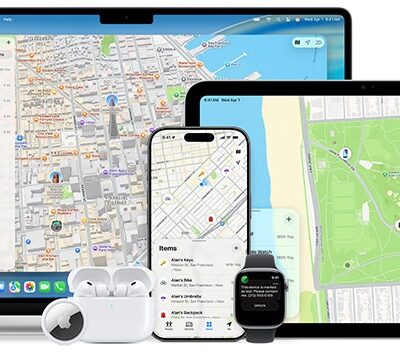






Most advice covers how you manage your own equipment. It’s incredibly useful to know how other people interact with your stuff when it’s lost or stolen and they find it. This lets you understand how someone might reply to you—by calling, emailing, or posting a note in a neighborhood forum—and what they would see that led them to it.
What a finder sees on an iPhone or Mac
Once the action is sent to an iPhone, iPad, iPod touch, or Apple Watch:
- If the device is connected to the internet and asleep, the next time it’s woken, a passcode must be entered to gain access.
- If the device is online and in use, the operating system drops the user into the Lock screen where the passcode-entry dialog or keypad is shown along with any message or phone number that was entered when setting up Lost Mode.
- If the device is offline, the next time it accesses any network with an internet connection, the passcode lock is put into place.
After a restart, or when the device is powered up after being shut down, your phone number or email address appears on the screen if you provided it, along with the preset message Apple showed during the lock process.
What a finder sees with an AirTag
Because Find My items lack screens, someone finding one that is not marked as lost can bring up certain information from it as described in how to identify an AirTag you have found. However, if you have marked your item lost, by enabling Share Contact Information, a person finding it can see the phone number or email address you entered when activating that mode.
If you find an item for which the owner hasn’t shared their contact information, or you can’t pull up a webpage associated with the device, you could post a description to find that person. Try any number of places: social networks, college forums, NextDoor, Bluesky, Craigslist, or a piece of paper posted around the neighborhood. Describe loosely where it was found and what it looks like.
Someone could confirm ownership of the found item by providing details only the owner might know, like what it was attached to, part of (like a bike), or found along with (like a handbag).
An owner can also provide good evidence of their identity by:
- Serial number: An AirTag and some third-party devices have serial numbers inscribed in the battery compartment. An owner can pull up a serial number via a Find My app. (See how to identify an AirTag you have found.)
- Phone number: If you can call someone, great, but if they respond via another method (perhaps their phone was stolen!), they can confirm either the last four digits of their number if the item isn’t marked as lost or their entire phone number if it is.
- Play sound: If you’re comfortable meeting up with a potential owner who hasn’t fully convinced you, if you’re within Bluetooth range they can trigger the item to play a sound from any Find My app they possess.
Apple has extra cues for someone near any Find My item (or Google Find Hub tracker) separated from its owner to aid that person in realizing there’s a tracker near them, see what an “AirTag Found Moving With You” alert means.
What a finder sees with AirPods
While marking audio hardware as lost follows the same steps as marking an item lost—providing contact information—someone finding your AirPods (3rd generation), AirPods 4 with Active Noise Cancellation, AirPods Pro (all generations), and AirPods Max can obtain information a little more easily.
With any AirPods earbuds, someone can open the case near an unlocked iPhone or iPad. This displays the message that the earbuds are lost, including contact information. With AirPods Max, someone would have to try to pair the headphones with an iPhone or iPad.
Turn on contact info for an item
Under Lost AirTag for Apple AirTags or Lost Item for third-party Find My network accessories, you see Show Contact Info and Share Item Information starting in iOS 18.2/iPadOS 18.2 and 15.2 Sequoia. This also appears for some Apple audio hardware: AirPods (3rd generation), AirPods 4 with Active Noise Cancellation, AirPods Pro (all generations), and AirPods Max.
Show Contact Info is the item equivalent of marking a device as lost. For more on Share Item Information, see how to track lost luggage with an AirTag.
Using Show Contact Info effectively marks the item as lost, but because it lacks features available for hardware with a screen, I can see why Apple chose to relabel it.
Here’s how to mark an item or audio hardware as lost on an iPhone, iPad, or Mac:
- Beneath Lost AirTag, Lost Item, or Lost Accessory, tap or click Show Contact Info. (In macOS 26 and earlier with audio hardware, you can also Control-click/right-click and choose Mark as Lost.)
- After reading the details about what will happen when you turn on contact info, tap Continue.
- Audio hardware shows a more lengthy set of info. Tap or click the Close button to back out.
If the item is in Bluetooth range of any of your devices, you receive an error: “Item Is With You” that reads “This feature is only available for items that are lost and not located in close proximity to you.” You cannot proceed and can only tap or click OK.
On an Apple Watch, select your item or supported audio device, tap Lost Mode, and then tap the switch to enable it. You’re then prompted to enter a phone number or email address. (With watchOS 26 or earlier, use the Find Items app for items, and the Find Devices app for audio hardware.)
When an item’s or accessory’s status is updated, you should receive a notification.
When the device comes into proximity with you again—within Bluetooth range of one of your devices—sharing contact information is disabled. If you shared a temporary link, that link becomes inactive at the same time.