In the FaceTime app, you can answer video and audio calls, decline calls, view video messages or listen to voicemails, and delete calls from your call history. If you’re on a FaceTime audio call and another one comes in, you can put the current call on hold, and Siri can announce incoming calls, too.
Note: Live Voicemail isn’t available in all languages or regions.
Answer a FaceTime call
Do any of the following when a FaceTime call comes in:
-
Accept the call: To answer a video call, tap the Video button, then tap Join. To answer an audio call, tap the Audio button.
If a slider appears, you can drag it right to answer.
-
Decline the call: Tap the Decline Video Call button (for a video call) or the Decline Audio Call button (for an audio call).
For FaceTime audio calls, tap Message to send a text message or tap Voicemail to send the caller to voicemail. (You may need to tap the incoming call banner to see these options.)
-
Put the current call on hold: Tap Hold and Accept.
Note: This option is only available if you’re on a FaceTime audio call and you receive another incoming FaceTime audio call. Otherwise, you can tap End & Accept to end the current call and answer the incoming call.
Quick tip: Siri can announce incoming calls, and you can accept or decline them with your voice.
View information when receiving a FaceTime call
With Apple Intelligence, when you receive a FaceTime call, a Call Context card with related information may appear. This can include an upcoming or recent birthday during a call to a contact, or it can include tickets, orders, or confirmation numbers during a call to certain businesses. Tap the card to view the information in the related app, such as Mail or Messages.
Note: Apple Intelligence on iPadOS 27 or later is available on an Apple Intelligence-enabled iPad mini (A17 Pro) and iPad models with M1 or later. Apple Intelligence is not available in all languages or regions. Usage limits may apply.*
View a video message or listen to a voicemail
If you miss an incoming video call and the caller leaves a video message, you receive a notification about the video message. A thumbnail image from the video also appears in your FaceTime call history. You can tap the notification or image to view the video message.
Note: Video messages can come only from saved contacts, people you’ve called, and anyone suggested by Siri.
If you miss an incoming audio call, the caller can leave a voicemail if you have Live Voicemail turned on in Settings > Apps > Phone, and your iPhone is signed in to the same Apple Account for FaceTime as your iPad.
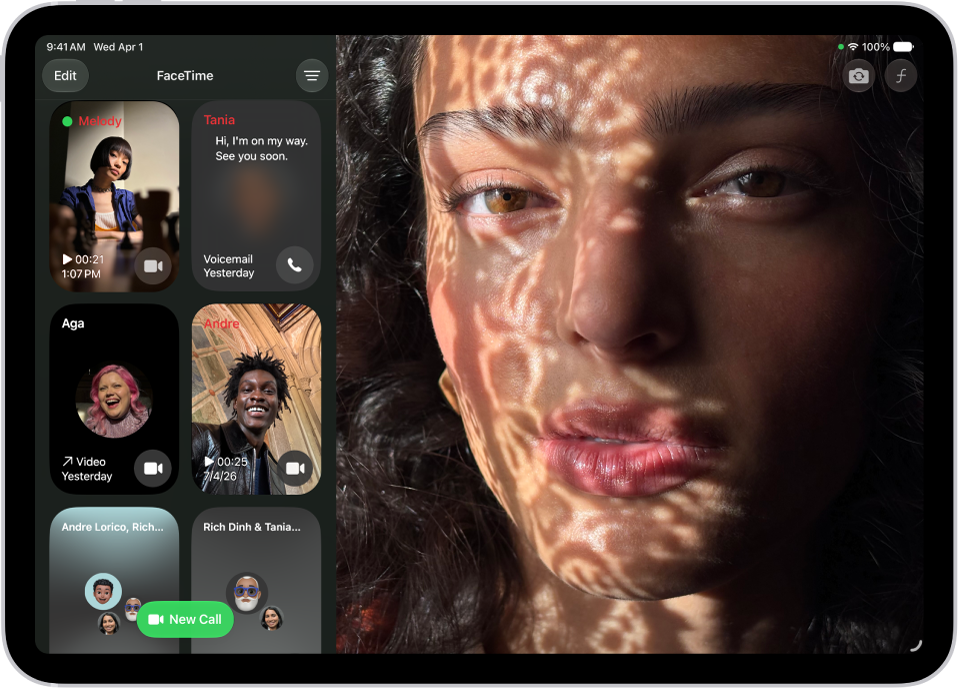
Quick tip: For quick access to all video messages or voicemails from one specific contact, tap their name in the call history and then tap the Voicemails button or the Videos button.
Delete a call from your call history
- Start the FaceTime app on your iPad.
- Touch and hold the call in your call history. Tap Delete.
*Apple Intelligence is available with Siri and device language set to Chinese (Simplified), Chinese (Traditional), Danish, Dutch, English, French, German, Italian, Japanese, Korean, Norwegian, Portuguese, Spanish, Swedish, Turkish, or Vietnamese. Some features may not be available in all regions or languages. Some devices may not be available in all regions. Siri AI is available in beta in iOS 27, iPadOS 27, macOS 27, watchOS 27, and visionOS 27 and requires an Apple Intelligence–enabled device set to a supported language. Available in English to start. Siri AI will not be initially available in the EU on iOS, iPadOS, and watchOS. Certain Apple Intelligence features that rely on server-side models are subject to daily usage limits, including but not limited to Siri AI, Intelligent Photo Editing Tools, Image Playground, and AFM 3 Cloud models in Shortcuts. Daily limits may vary by feature, request complexity, system demand, system policies, and other factors. Expanded access to such features will be available for a fee in the future. Use of these features is subject to the Apple Intelligence Terms and Conditions.
See also