









With Braille Access, you can turn your iPhone into a braille notetaker that can easily open any app by typing with a connected braille display. You can perform calculations, open Braille Ready Format (BRF) files, transcribe conversations with Live Captions, and more.
You navigate it from the Braille Access menu, and you can manage Braille Notes, BRF files, and Live Captions with Context Menus. And you can exit Braille Access whenever you want.
Note: Live Captions is available on iPhone 11 and later. Live Captions isn’t available in all countries or regions. The accuracy of Live Captions may vary and shouldn’t be relied upon in high-risk or emergency situations.
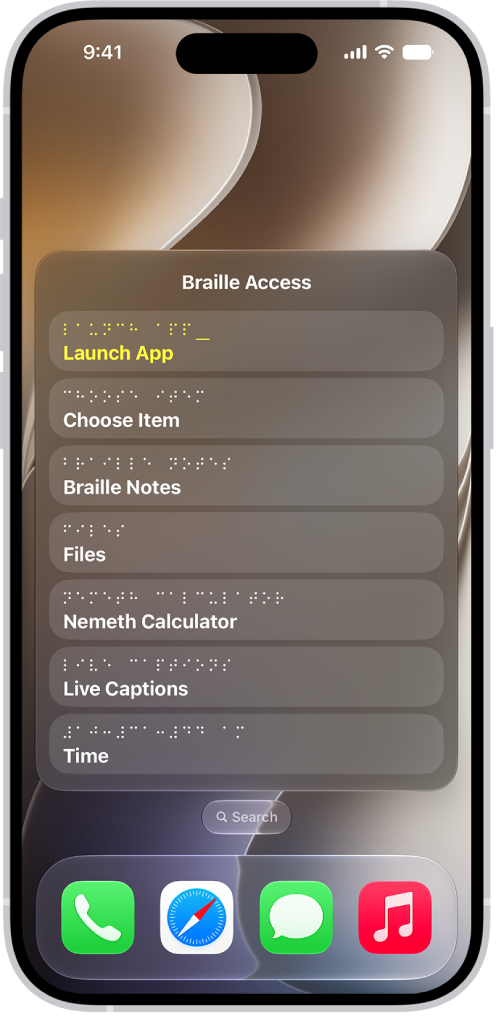
Navigate the Braille Access menu
- Connect your braille display to your iPhone and turn on VoiceOver.
-
Press dots 7 and 8 together or use the Toggle Braille Access command on your braille display.
If you’re using an eight-dot table, press dots 7 and 8 and the Space bar together.
To access the Toggle Braille Access command on your iPhone, go to the Settings app > Accessibility > VoiceOver > Braille > tap the information button next to your braille display (you may need to scroll down) > Braille Commands > Braille > Toggle Braille Access.
-
Do any of the following:
- Next item or line: Use the Next command (dot 4 + Space bar) or use the panning button on your braille display.
- Previous item or line: Use the Previous command (dot 1 + Space bar) or use the panning button on your braille display.
- Go to the first item on the menu: Use the First Item command (dots 1, 2, 3 + Space bar).
- Go to the last item on the menu: Use the Last Item command (dots 4, 5, 6 + Space bar).
- Go to the previous screen: Use the Back command (dots 1, 2, + Space bar).
- Select a menu item: Use the Return command (dot 8).
- Open a context menu: Use the Delete command (dot 7).
- Search for text: Use the Search command (dots 1, 2, 4 + Space bar).
- Exit Braille Access: Press dots 7 + 8.
Use Braille Access with a braille display
- Connect your braille display to your iPhone and turn on VoiceOver.
-
Press dots 7 and 8 together or use the Toggle Braille Access command on your braille display.
If you’re using an eight-dot table, press dots 7 and 8 and the Space bar together.
To access the Toggle Braille Access command on your iPhone, go to the Settings app > Accessibility > VoiceOver > Braille > tap the information button next to your braille display (you may need to scroll down) > Braille Commands > Braille > Toggle Braille Access.
-
Do any of the following:
- Launch App: Choose an app to open—such as Mail, News, or Wallet.
- Choose Item: Choose an item to open on the screen—such as dictate, compose, or edit.
-
Braille Notes: Enter New > New Note or New Folder to create a new note or folder. You can access your notes here after you create them.
Note: Your braille notes will sync to iCloud.
-
BRF Files: Enter New > File name or New folder name to create a new BRF file or folder. You can open your BRF files here after you create them. You can also search for text and add bookmarks that sync with iCloud. To search for text, use the context menu or Text Search command (dots 1, 2, 4 + Space). After you search for text or move a bookmark, use the Return command (dot 8) to keep searching or moving to other bookmarks.
Note: Opening Braille Access creates a BRF Files folder in iCloud Drive. You can’t change the location of BRF Files in iCloud.
-
Calculator: Use Nemeth or UEB Math to type calculations.
Note: A visual representation of the formula appears on the screen if Show Visuals is enabled.
-
Live Captions: Enter Live Captions, and iPhone listens to your surroundings and transcribes what it hears in braille on your device.
New transcriptions you haven’t read appear surrounded by full cells (dots 1, 2, 3, 4, 5, 6, 7, 8) on your braille display.
Note: Press any router key to bring the focus to the latest caption line.
- Time: Check the current time on your iPhone.
-
Close: Close the Braille Access menu.
Note: In most pages of Braille Access, you can select Close or Back at the bottom of the menu.
If the menu item ends with a cursor, you can start typing right away.
Manage Braille Notes, BRF files, and Live Captions with Context Menus
Once you’ve created Braille Notes and BRF files in Braille Access, Context Menus help you organize them. In Live Captions, you can also pause and listen to audio.
- Connect your braille display to your iPhone and turn on VoiceOver.
-
Press dots 7 and 8 together or use the Toggle Braille Access command on your braille display.
If you’re using an eight-dot table, press dots 7 and 8 and the Space bar together.
To access the Toggle Braille Access command on your iPhone, go to the Settings app > Accessibility > VoiceOver > Braille > tap the information button next to your braille display (you may need to scroll down) > Braille Commands > Braille > Toggle Braille Access.
-
Do any of the following:
-
Braille Notes: Go to a note or folder and open the Context Menu by using the Delete command (dot 7). Do any of the following:
- Move: Move the note or folder to a new location.
- Delete: Delete the note or folder.
- Pin: Pin the note or folder for easier access.
-
BRF Files: Go to a BRF file and then open the Context Menu by using the Delete command (dot 7). Do any of the following:
- Find: Find a specific BRF file.
- Previous Find: View your previous Find searches.
- Add Bookmark: Add a bookmark for easier access.
- Move: Move the file to a new location.
- Delete: Delete the file.
- Rename: Rename the file.
-
Live Captions: Open Live Captions and open the Context Menu by using the Delete command (dot 7). Do any of the following:
- Pause: Pause Live Captions.
- Listen to audio: Listen to audio descriptions of your surroundings.
- Type to speak: Type on your braille device to have iPhone speak it aloud.
- Summarize with Apple Intelligence: If you have Apple Intelligence turned on, you can get a summary of the audio in your surroundings.
Note: Apple Intelligence on iOS 27 or later is available on an Apple Intelligence-enabled iPhone 15 Pro, iPhone 15 Pro Max, or iPhone 16 model or later. Apple Intelligence is not available in all languages or regions. Usage limits may apply.*
-
Braille Notes: Go to a note or folder and open the Context Menu by using the Delete command (dot 7). Do any of the following:
Exit Braille Access
To exit Braille Access on your iPhone, do any of the following:
- Use the Home or Back command on your braille display.
- Press dots 7 and 8 together on your braille display.
- Select Close or Back at the bottom of the menu to exit Braille Access.
Change Braille Access settings
- Open the Settings app on your iPhone.
- Tap Accessibility, tap VoiceOver, tap Braille, and then tap Braille Access.
- Do any of the following:
- Main Menu Items: To customize which menu items appear in Braille Access, tap an item. To change the order that the items appear in, tap the Reorder button and drag to the desired place.
- Open to Last Position: Turn on Open to Last Position to allow previous settings to appear when Braille Access is reopened.
- Speak List Items: To have iPhone speak items aloud, turn on Speak List Items.
- Show Visuals: Turn Show Visuals on or off.
- Typing Speech Feedback: Turn Typing Speech feedback on or off.
- Braille Notes: Sort notes by the date edited or created. You can also sort the order of notes by oldest or newest.
- BRF Files: Turn Fit BRF Content on or off. Turn Hide BRF Page Indicators on or off.
- Calculator: Choose Nemeth or UEB Math as the math code.
- Live Captions: Choose Microphone or iPhone Audio as the source for Live Captions.
*Apple Intelligence is available with Siri and device language set to Chinese (Simplified), Chinese (Traditional), Danish, Dutch, English, French, German, Italian, Japanese, Korean, Norwegian, Portuguese, Spanish, Swedish, Turkish, or Vietnamese. Some features may not be available in all regions or languages. Some devices may not be available in all regions. Siri AI is available in beta in iOS 27, iPadOS 27, macOS 27, watchOS 27, and visionOS 27 and requires an Apple Intelligence–enabled device set to a supported language. Available in English to start. Siri AI will not be initially available in the EU on iOS, iPadOS, and watchOS. Certain Apple Intelligence features that rely on server-side models are subject to daily usage limits, including but not limited to Siri AI, Intelligent Photo Editing Tools, Image Playground, and AFM 3 Cloud models in Shortcuts. Daily limits may vary by feature, request complexity, system demand, system policies, and other factors. Expanded access to such features will be available for a fee in the future. Use of these features is subject to the Apple Intelligence Terms and Conditions.