Got a tip for us?

Apple Watch

The icons at the top of the Apple Watch face and Control Center provide status information such as unread notifications and Low Power Mode. It’s a lot to decode. Icons at the top of Control Center provide even more, like the connection to iPhone via Bluetooth and the Wi-Fi or cellular connection.
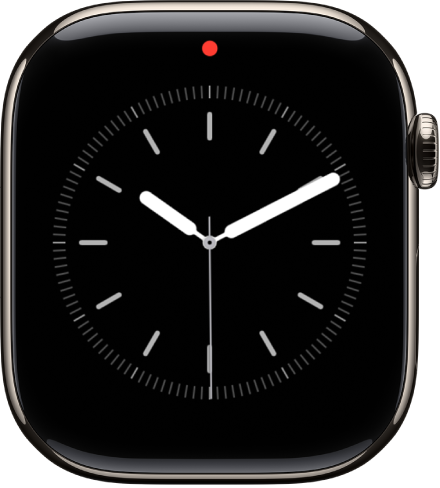
A red dot at the top center of the watch face, indicating unread notifications.

What do the status icons mean?

Status icon What it means
Notification icon You have an unread notification. Swipe down on the watch face to read it.
Charging icon Apple Watch is charging.
Low battery icon Apple Watch battery is low.
Low Power Mode icon Low Power Mode is on.
Lock icon Apple Watch is locked. Tap to enter the passcode and unlock.
Water Lock icon Water Lock is on, and the screen doesn’t respond to taps. Press and hold the Digital Crown to unlock.
Do Not Disturb icon Do Not Disturb is turned on. Calls and alerts won’t sound or light up the screen, but alarms are still in effect.
Personal Focus icon Personal Focus is turned on.
Work Focus icon Work Focus is turned on.
Sleep Focus icon Sleep Focus is turned on.
Airplane Mode icon Airplane Mode is turned on. Wireless is turned off, but nonwireless features are still available.
Theater Mode icon Theater Mode is turned on. Apple Watch is silenced and its display won’t light up when you raise your wrist.
Workout icon You have a workout in progress. To end the workout, see Use the workout controls.
No cellular icon—Apple Watch with cellular only Apple Watch has lost the connection to a cellular network (on models that support cellular). See Set up and use cellular service.
Disconnected iPhone icon Apple Watch has lost the connection with its paired iPhone. This happens when Apple Watch isn’t close enough to iPhone, or when Airplane Mode is enabled on iPhone.
Connected iPhone icon Apple Watch is connected to its paired iPhone.
Location indicator icon An app on Apple Watch is using location services.
Wi-Fi icon Apple Watch is connected to a known Wi-Fi network.
Wireless activity icon There’s wireless activity or an active process happening.
Microphone icon The microphone is on.
Cellular signal icon Apple Watch is connected to a cellular network. The number of green bars indicates signal strength.

Check the status in Control Center

For additional status information, check the icons at the top of Control Center. They show things like apps using your location, the Wi-Fi or cellular connection, the connection to iPhone via Bluetooth, and features such as Airplane Mode or Do Not Disturb.

  1. Press the side button to open Control Center and then see the status icons at the top.
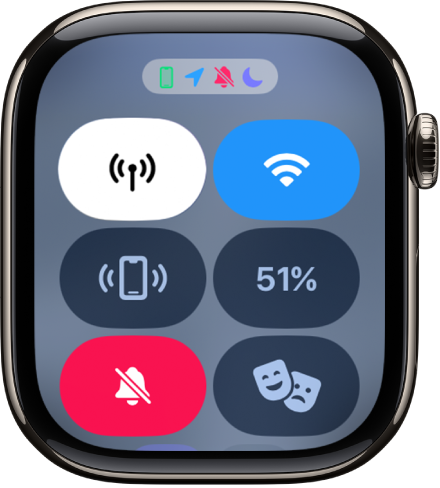
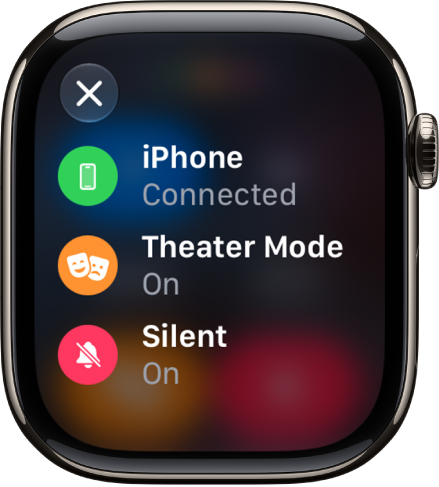
    Status icons in Control Center showing iPhone connected, Location Services, Silent Mode, and Do Not Disturb.

  2. To see more details, tap the icons.

    The status details showing iPhone connected, Location being used by Messages, Silent Mode turned on, and Do Not Disturb turned on.

See also

Tag: watchOS

If your iPhone is set up to use more than one language, you can choose which one appears on your Apple Watch. And if you’d like to move your Apple Watch to your other wrist, or you’d rather have the Digital Crown on the other side, your orientation settings make the Digital Crown move things in the direction you expect.

Choose the language or region

With your iPhone set up to use more than one language, you can pick which one appears on your Apple Watch.

  1. Start the Apple Watch app on your iPhone.
  2. Tap My Watch and tap General.
  3. Tap Language & Region, then tap Custom.
  4. Choose a language on your iPhone or tap Add Language to choose a different one.

    For languages that use grammatical gender, you can choose your term of address to specify how you would like to be addressed throughout the system (feminine, masculine, or neutral).

Switch wrists or Digital Crown orientation

When you move your Apple Watch to your other wrist or want the Digital Crown on the other side, adjust your orientation settings. That way, your Apple Watch wakes when you raise your wrist, and the Digital Crown moves things in the direction you expect when you turn it.

  1. Start the Settings app on your Apple Watch.
  2. Tap General, then tap Orientation.

You can also adjust the orientation settings on your iPhone—go to the Apple Watch app, tap My Watch, tap General, then tap Watch Orientation.

See also

Some airlines let you fly with Apple Watch (and iPhone) turned on if you put them in Airplane Mode. In Control Center on Apple Watch, Airplane Mode disables Wi-Fi and cellular while keeping Bluetooth active.

You can also mirror this setting with iPhone, so turning on Airplane Mode on one device turns it on for the other. And you can change the defaults, choosing whether Wi-Fi and Bluetooth turn off. Both devices must be within normal Bluetooth range to mirror.

Turn Airplane Mode on or off

  1. Press the side button to open Control Center on Apple Watch.
  2. Tap the Airplane Mode button.

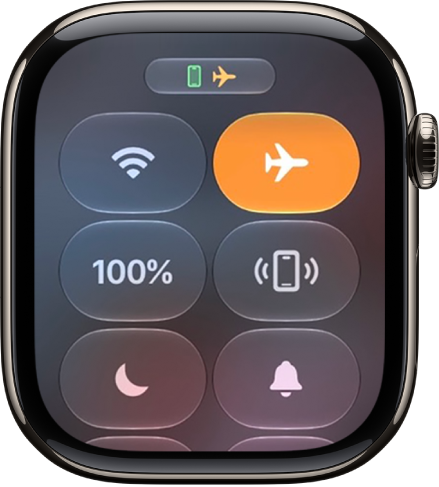
    Control Center with the Airplane Mode button highlighted to show that Airplane Mode is on.

Turn on Airplane Mode for both Apple Watch and iPhone

When you set Apple Watch to mirror your iPhone, switching to Airplane Mode on one device switches the other device to match. For this to work, iPhone and Apple Watch need to be within normal Bluetooth range of each other, that’s about 33 feet or 10 meters.

  1. Open the Apple Watch app on your iPhone.
  2. Tap My Watch and tap General. Then tap Airplane Mode.
  3. Turn on Mirror iPhone.

Change the default settings for Airplane Mode

By default, turning on Airplane Mode turns off Wi-Fi and cellular (on Apple Watch models with cellular) and keeps Bluetooth turned on. To change the default settings for Wi-Fi and Bluetooth, do the following:

  1. Open the Settings app on your Apple Watch.
  2. Tap Airplane Mode and turn Wi-Fi and Bluetooth on or off.

See also

You can manage the medications, vitamins, and supplements you take in the Health app on your iPhone or iPad. In the Medications app on your Apple Watch, you can keep track of your medications and log them with reminders.

You set up a medication schedule on your iPhone or iPad first. You can also turn on Follow Up Reminders and Critical Alerts.

Here’s how to track your medications on Apple Watch.

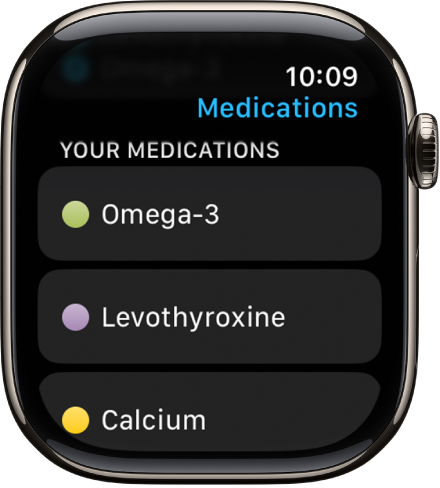
The Medications app showing a list of all medications.

Note: The Medications feature should not be used as a substitute for professional medical judgment. Additional information is available on the labels of your medications, but please consult your healthcare provider prior to making any decisions related to your health.

Set up a medication schedule on iPhone or iPad

  1. Go to the Health app on your iPhone or iPad.
  2. Do one of the following:

    • On iPhone: Tap Browse and tap Medications.
    • On iPad: Tap the sidebar, then tap Medications.
  3. Tap Add a Medication (to start your list) or Add Medication (to add to your list).
  4. To identify the medication, do one of the following:

    • Type the name: Tap the search field, enter the name, and then tap Add.

      In the U.S. only, suggestions appear as you begin typing. You can select a suggestion, or finish typing the name, then tap Add.

    • Use the camera: (U.S. only; on iPhone SE (2nd generation and later), iPhone XS, iPhone XR, and later) Tap the Camera button next to the search field. Follow the onscreen instructions.

      If a match isn’t found, tap Search by Name, then type the name (as described above).

  5. Do the following:

    • Choose the medication type: Tap an option and tap Next.
    • Choose the medication strength: Tap an option and tap Next.
    • Set a schedule: Follow the onscreen instructions to set the frequency and duration of your scheduled medication. Then tap Next.

      Tap Change under “When will you take this?” to choose a different schedule type, like On a Cyclical Schedule, or Every Few Days.

    • Choose the shape (optional): Tap an option and tap Next.
    • Choose the colors (optional): Tap an option and tap Next.
  6. When you’re finished, tap Done.

Log your medications

By default, your Apple Watch reminds you when it’s time to log your medications based on the schedule you’ve created in the Health app on iPhone or iPad. To log your medications, follow these steps.

Note: Health app data only syncs across devices that are signed in to the same Apple Account, have internet access, and run the latest OS version.

  1. If you’ve received a notification to log your medications, tap the notification. Otherwise, open the Medications app on your Apple Watch.
  2. Tap the current medications schedule—the medications you take in the morning, for example.
  3. Tap Log All as Taken.

    Apple Watch records the dosage, the number of units taken, and the time you took the medication.

  4. To log individual medications, scroll down, tap Taken below a medication, and tap the Done button.

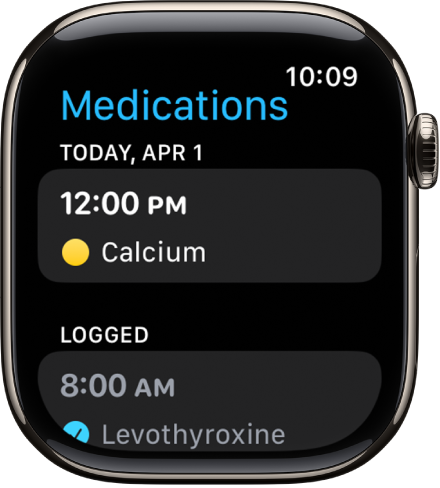
    The medication’s name and time logged appears below Logged.

  5. To change the status of a logged medication, tap it and tap Taken or Skipped. Then tap the Done button.

The Medications app showing logged medications.

To view the log and your medication history on your iPhone, open the Health app, tap Browse, then tap Medications. On iPad, open the Health app, tap the sidebar, then tap Medications.

Turn on Follow Up Reminders and Critical Alerts

If you set a medication schedule, the Health app sends notifications reminding you to log the medication. You can also get follow-up reminders when a medication hasn’t been logged 30 minutes after the scheduled time.

  1. Go to the Health app on your iPhone or iPad.
  2. Do one of the following:

    • On iPhone: Tap Browse and tap Medications.
    • On iPad: Tap the sidebar, then tap Medications.
  3. Tap Options at the bottom of the screen and turn on Follow Up Reminders.

    When you turn on Follow Up Reminders, you can also turn on Critical Alerts for each of your medications. Critical Alerts appear on the Lock Screen and play a sound (even if a Focus is on or your iPhone is muted).

  4. To receive critical alerts, tap Critical Alerts and tap the button next to a medication. Tap Allow.

To turn off all critical alerts, go to the Settings app on your iPhone or iPad, tap Apps, tap Health, tap Notifications, then tap the button next to Critical Alerts.

See also

Tag: Health

On supported models, Apple Watch can detect when you start washing your hands and encourage you to keep going for 20 seconds, the time recommended by global health organizations.

It starts a 20-second timer when it detects handwashing, and if you stop early, you’re encouraged to finish.

Turn on Handwashing

  1. Start the Settings app on your Apple Watch.
  2. Tap Handwashing and turn on Handwashing Timer.

Apple Watch starts a 20-second timer as soon as it detects that you’ve started washing your hands. Stop washing in less than 20 seconds, and your watch encourages you to finish the job.

To see a report of your average handwashing times, go to the Health app on your iPhone, tap Browse, tap Other Data, then tap Handwashing.

See also

Tag: Health

Apple Watch health features can help you meet your sleep goals, track important information related to your heart, keep a log of your emotions and mood, log your medications, track your menstrual cycle, and encourage you to wash your hands. Here’s a quick tour.

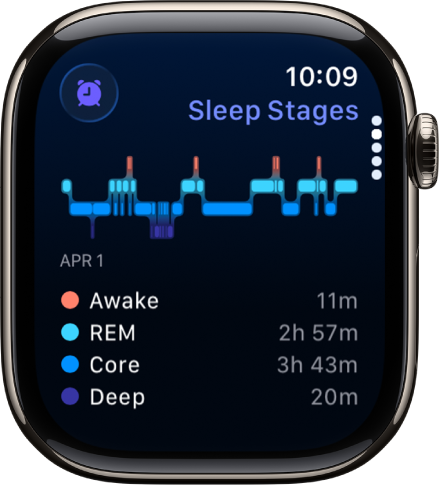
With the Sleep app, for example, you can create a sleep schedule.

The Sleep app showing estimated time spent awake and in REM, Core, and Deep sleep.

Prioritize your sleep

You can create a sleep schedule, review your recent sleep history, and set a sleep duration goal in the Sleep app on Apple Watch. To get started, follow the onscreen instructions after you open the Sleep app on your Apple Watch. Then wear your watch to bed. Apple Watch does the rest.

Set up sleep schedules on Apple Watch

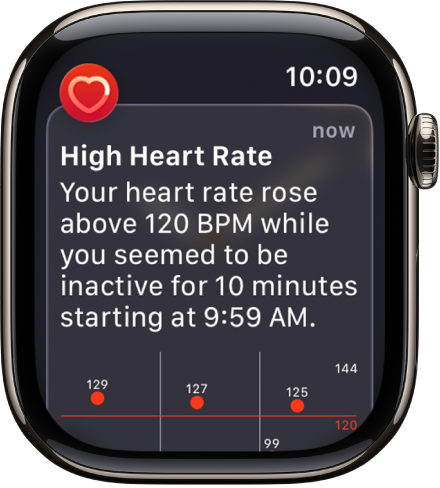
A Heart Rate Alert screen indicating that a high heart rate has been detected.

Get heart health notifications

You can enable notifications from the Heart Rate app on your Apple Watch to alert you to high or low heart rates, as well as irregular heart rhythms that may be suggestive of atrial fibrillation (AFib). If you have already been diagnosed with AFib, you can turn on AFib History to see an estimate of how frequently your heart is in this arrhythmia. You can also turn on alerts for low cardio fitness.

Monitor your heart health on Apple Watch

The Medications app showing scheduled and logged medications.

Stay on top of your medications

To keep track of your medications, vitamins, and supplements, use the Medications app. Add your medications to the Health app on your iPhone, then log them on your Apple Watch.

Track your medications on Apple Watch

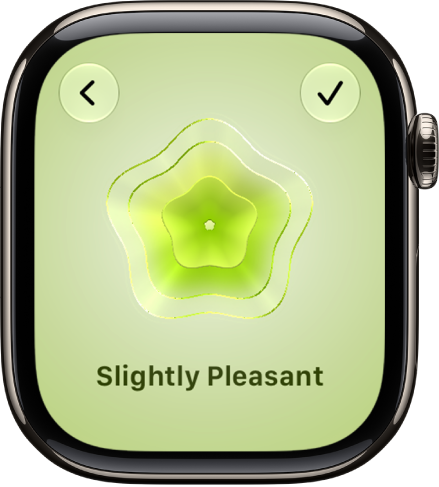
The Mindfulness app showing a state of mind status.

Log your state of mind

In addition to offering opportunities to breathe mindfully and promote moments of reflection, the Mindfulness app can help you build emotional awareness and resilience by identifying your feelings. Just open the Mindfulness app, tap State of Mind, then log your momentary emotions and daily moods.

Log your state of mind on Apple Watch

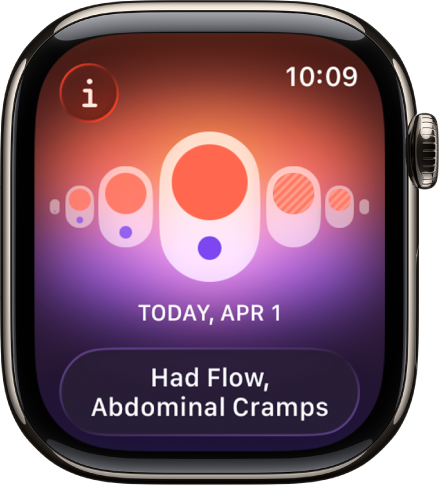
A screen in the Cycle Tracking app showing a logged period with logged symptoms at the bottom of the screen.

Track your menstrual cycle

The Cycle Tracking app is where you log daily information about your menstrual cycle, which your Apple Watch uses to provide period and fertile window predictions. Cycle Tracking can also use heart rate data, in addition to data you’ve logged, to improve predictions. Wear Apple Watch to sleep each night, and the app can also use wrist temperature to improve period predictions and provide retrospective ovulation estimates.

Use Cycle Tracking on Apple Watch

Note: The retrospective ovulation estimates feature isn’t available in all countries or regions.

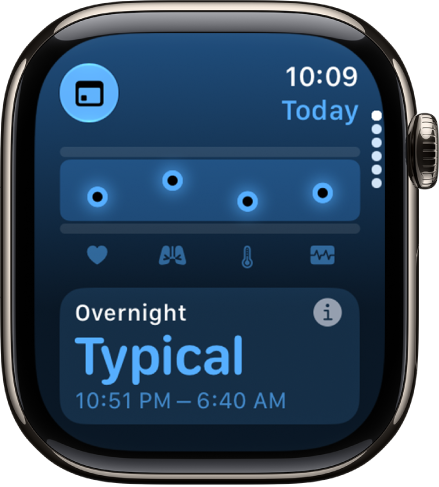
A screen in the Vitals app showing overnight health metrics.

Better understand your daily health status

With the Vitals app, you can quickly see your overnight health metrics right on your watch: heart rate, respiratory rate, wrist temperature, blood oxygen*, and sleep duration. When you wear your Apple Watch to sleep, the Vitals app establishes a typical range for each of your health metrics. If multiple metrics are outside your typical range, you receive a notification along with context for factors that may be involved—like medications or illness, for example.

Track your vitals on Apple Watch

Note: For models of Apple Watch purchased in the United States on or after January 18, 2024 with part numbers ending in LW/A or LS/A, Blood Oxygen is not available in the Vitals app.

*Not all features are available in all areas and on all models.

See also

Tag: Health

The ambient light sensor in your Apple Watch automatically estimates how much time you spend outdoors in daylight each day.

Time in daylight data needs Motion Calibration & Distance turned on. You can see your time in daylight in the Health app on your iPhone, and turn it off whenever you like. You can also get started with health features on Apple Watch.

Here’s how to see time spent in daylight on Apple Watch.

See your time in daylight

  1. Open the Health app on your iPhone.
  2. Tap Browse and tap Other Data.
  3. Tap Time in Daylight.

Turn off time in daylight

  1. Open the Settings app on your Apple Watch.
  2. Go to Privacy & Security and tap Health.
  3. Tap Time in Daylight and turn off Time in Daylight.

You can also open the Apple Watch app on your iPhone, tap My Watch, tap Privacy, then turn off Time in Daylight.

See also

Tag: Health

To personalize your experience, you can update your date of birth, sex, height, weight, and wheelchair status in Health Details. It matters. Your Apple Watch uses the information you provide about your height, weight, sex, age, and wheelchair status to calculate how many calories you burn, how far you travel, and other health and fitness data. You can make the changes in the Apple Watch app on your iPhone, in Health Details.

  1. Start the Apple Watch app on your iPhone.
  2. Tap My Watch and tap Apps. Tap Health.
  3. Tap Health Details and tap Edit.
  4. To make a change, tap a field.

See also

Tag: Health

You can reflect on how you’re feeling and log your momentary emotions and daily moods to keep track of your mental wellbeing.

You can log a momentary emotion or a daily mood, and pick words that describe how you’re feeling and what’s having the biggest impact on you. Over time, your state of mind history shows how your feelings may correlate with lifestyle factors, like sleep, exercise, time spent in daylight, and mindful minutes.

Here’s how to log your state of mind on Apple Watch.

Log your state of mind

  1. Go to the Mindfulness app on your Apple Watch.
  2. Tap State of Mind.

    If this is your first time using State of Mind, tap Get Started.

  3. Choose one of the following:

    • Log a momentary emotion: Tap Log how you’re feeling right now.
    • Log a daily mood: Tap Log how you’ve felt overall today.
  4. Turn the Digital Crown to indicate how you’re feeling, then tap the Done button.
  5. Tap any words that describe how you’re feeling (optional) and then tap the Done button.
  6. Tap any words that describe what’s having the biggest impact on you (optional). Tap the Done button.

The Mindfulness app screen showing the State of Mind screen with a visual in the center. An emotion is listed below.

View your state of mind history

With your state of mind logged, you can see how it may correlate with lifestyle factors such as time spent in daylight, sleep, exercise, and mindful minutes.

  1. Open the Health app on your iPhone.
  2. Tap Browse, tap Mental Wellbeing, and then tap State of Mind.
  3. Tap Show in Charts, then do any of the following:

    • View your state of mind over time: Tap an option from the time range selections at the top of the chart.
    • View the types of entries you’ve logged: Tap States. Then tap Daily Moods or Momentary Emotions to view those entries on the graph.
    • View factors associated with your entries: Tap Associations. Then scroll through the different factors you logged in your state of mind entries.
    • View lifestyle factors associated with your entries: Tap Life Factors and tap a lifestyle factor to see it alongside your state of mind entries.

      You can also tap the Info button next to each lifestyle factor to learn more about how it can impact your mental wellbeing.

See also

Tag: Health

Use the Cycle Tracking app to log details about your menstrual cycle. You can add flow information and record symptoms such as headaches or cramps, and the app can alert you when it estimates that your next period or fertile window is about to start.

In addition to using data you’ve logged, Cycle Tracking can also use heart rate data to improve predictions. And if you wear Apple Watch to sleep each night, the app can use wrist temperature to improve period predictions and provide retrospective ovulation estimates. You set it up in the Health app on your iPhone or iPad.

Note: The Health app is designed to protect your information and enable you to choose what to share.

Set up Cycle Tracking on iPhone or iPad

  1. Go to the Health app on your iPhone or iPad.
  2. Do one of the following:
    • On iPhone: Tap Browse, then tap Cycle Tracking.
    • On iPad: Tap the sidebar, then tap Cycle Tracking.
  3. Tap Get Started, then follow the onscreen instructions to set notifications and other options.

To add or remove options after setting up Cycle Tracking, go to the Health app on your iPhone, tap Browse, tap Cycle Tracking, then tap Options next to Cycle Log.

Log your cycle on Apple Watch

  1. Start the Cycle Tracking app on your Apple Watch.
  2. Do any of the following:
    • Log a period on a specific day: With the day showing in the timeline, tap Log. Tap Period and tap a flow level. Tap the Done button.
    • Log symptoms, spotting, or other information: With the day showing in the timeline, tap Log. Tap a category and choose an option. Then tap the Done button.

Observations you provide show up in the Cycle log on iPhone. With Period Notifications and Fertility Notifications turned on in the Health app on iPhone, Apple Watch notifies you about upcoming periods, fertile window predictions, and retrospective ovulation estimates.

A screen in the Cycle Tracking app showing a logged period with logged symptoms at the bottom of the screen.

Manage cycle factors on iPhone or iPad

Factors that could impact your cycle, like pregnancy, lactation, and contraceptive use, can also be logged in the Health app on iPhone.

  1. Go to the Health app on your iPhone or iPad.
  2. Do one of the following:
    • On iPhone: Tap Browse, then tap Cycle Tracking.
    • On iPad: Tap the sidebar, then tap Cycle Tracking.
  3. Scroll down and tap Factors. Do any of the following:
    • Add a factor: Tap Add Factor, select a factor, tap Started if you need to change the start date, and then tap Add.
    • Change the end date for a current factor: Tap the factor, tap Ended and select a date. Then tap Done.
    • Delete a current factor: Tap the factor and tap Delete Factor.

The factors you select may turn off your period predictions, fertile window predictions, and retrospective ovulation estimates on iPhone and Apple Watch.

Important: The Cycle Tracking app should not be used as a form of birth control. Data from the Cycle Tracking app should not be used to diagnose a health condition.

See also

Tag: Health