
Got a tip for us?

watchOS 6 added the Voice Memos app. To use it, tap on the Digital Crown on your Apple Watch to see your apps, then:

Choose the Voice Memos app.

Choose Tap to Record.

Record your message.

Tap the End button when you’re done recording.

To find and listen to your recordings:

Tap the Voice Memos app.

Click on your recording in the app.

Tap the Play icon to listen to your recording.

Select the forward or back button to move your recording by 15 seconds.

Tap the delete button to delete the recording.

You can use your HomePod to control HomeKit accessories—such as lights, thermostats, and window shades—that you’ve set up in the Home app on your iOS device. Then you can say things like “Hey Siri, set the thermostat to 72 degrees” or “Hey Siri, did I lock the front door?”

HomeKit is a framework that allows control of compatible home automation devices through iOS and Siri. It works with the Home app, allowing you to control all your HomeKit accessories.

The commands that work when you’re speaking to HomePod depend on which smart home accessories you have set up. To control a single accessory, use the name you gave it in the Home app. For example, say “Hey Siri, turn on the porch light.” You can check the status of an accessory by saying something like “Hey Siri, is the porch light on?” You can also say, for example, “Hey Siri, turn off the lights in here,” to control the accessories that are in the same room as HomePod.

You can use HomePod to lock or check the status of door locks and other HomeKit security accessories. To unlock security accessories, you must use your iOS device because unlocking requires authentication using Face ID, Touch ID, or a passcode.

You can set up scenes in the Home app to control a number of accessories all at once. After a scene is defined, refer to it by name. For example, say “Hey Siri, good night” to run a scene named “good night” that turns off your lights, sets the thermostat, and draws the window shades.

The HomePod automatically acts as a home hub. This allows you to control your home’s accessories using the Home app when you’re away. You can also trigger accessories based on time of day, your location, or the action of another accessory, such as a sensor.

You can take an electrocardiogram (ECG) with the ECG app in watchOS 5.1.2 and later on the Apple Watch Series 4 or higher.

An ECG (or EKG) is a test that records the timing and strength of the electrical signals that make the heart beat. By looking at an ECG, a doctor can gain insights about your heart rhythm and look for irregularities.

The ECG app can record your heartbeat and rhythm using the electrical heart sensor on Apple Watch Series 4 and then check the recording for atrial fibrillation (AFib), a form of irregular rhythm.

The ECG app records an electrocardiogram which represents the electrical pulses that make your heart beat. The ECG app checks these pulses to get your heart rate and see if the upper and lower chambers of your heart are in rhythm. If they’re out of rhythm, that could be AFib.

Follow these steps to set up the app:

Make sure that the software on your iPhone and Apple Watch is up to date.

Open the Health app on your iPhone.

Follow the onscreen steps. If you don’t see a prompt to set up, tap Health Data > Heart > Electrocardiogram (ECG).

After you set up ECG in the Health app, the ECG app appears on your Apple Watch.

You can take an ECG at any time, when you’re feeling symptoms such as a rapid or skipped heartbeat, when you have other general concerns about your heart health, or when you receive an irregular rhythm notification. Here’s how:

Make sure that your Apple Watch is snug and on the wrist that you selected in the Apple Watch app. To check, open the Apple Watch app, tap the My Watch tab, then go to General > Watch Orientation.

Open the ECG app on your Apple Watch.

Rest your arms on a table or in your lap.

With the hand opposite your watch, hold your finger on the Digital Crown. You don’t need to press the Digital Crown during the session.

Wait. The recording takes 30 seconds. At the end of the recording, you will receive a classification, then you can tap Add Symptoms and choose your symptoms.

Tap Save to note any symptoms, then tap Done.

The app will walk you through the steps for reading the results.

introduction

When you think of productivity, tools like your computer, Google Docs, and Slack may spring to mind. However, I’ve found one of my most important productivity tools is actually my iPhone. The iPhone could be a very useful tool, but the vast majority of people use their iPhone as a life-shortening distraction device. However, if you follow the iPhone productivity instructions given in this article, you will be more productive, more focused, and — I’m not kidding at all — improve your mental health.
The very, very best iPhone productivity tips
Essentially, each iPhone setup choice has tradeoffs. I’ll tell you about ideal defaults and then trust you to make the right decision about whether that default is good for you.

The very, very best iPhone productivity tips

If you follow these iPhone productivity tips carefully, you’ll find that your iPhone can help you be more productive throughout the day—adding to the amount you can achieve and the quality of that work.
Let’s get started.

#1. Turn OFF (almost) all notifications

To make sure you’re not using your iPhone for nonwork stuff during work hours, i recommend that you turn off virtually all notifications.
To do this: Start the Settings App on your iPhone, then head over to the Notifications Section. You are going to need to get good at launching the Settings app, therefore, master the location of this icon.

Scroll down app by app, turning off all notifications.

essentially, almost all of your apps should have a notifications setting that looks like this, that is, with no notifications:

There are just one or two reasons to leave notifications on for a given app. Here are those reasons:

  • Leave notifications on for all delivery apps. These notifications are supposed to only come when you want them to, i.e. if you’re standing on the corner
    trying to get a Lyft. Apps in this list includes: Uber, Lyft, Postmates, Food Panda, Caviar. Of those, Postmates is the major villain of spamming you with undesired
    interruptive notifications. Consider removing that app.
  • In case you receive very few text messages, turn off badging on your Messages app but leave banners on. Because you are setting your iPhone up to have pretty few notifications,
    You will actually end up seeing most of your text messages on your home screen as they come in (before, they were perhaps flooded by other notifications).
    Then, the unread badge for messages is just overkill to make you anxious about messages you already saw. If you get loads of text messages, then the best thing is to turn off
    all notifications and take text messages like an inbox that you only check at set intervals. If you belong to a group of people who send hundreds of text messages
    all day long, then you are eccentric and wasting your life away.
  • Leave notifications on for your calendar app. Not missing appointments is essentially the main reason of having an iPhone.
  • Leave notifications on for Apple Maps and Google Maps. These apps only sends notifications when you are actively getting directions.
  • Leave notifications on for phone calls. However, think of disabling them and updating your voicemail to state that phone calls are a dead medium. My
    voicemail will tell you something like this: “You have reached my voicemail meaning you tried to call me meaning you are a dinosaur. Kindly upgrade your life and try me through
    text message or email.” (I’m kidding.)
  • For all the notifications that you left on, revisit and check to ensure badges are turned off. Badges are the red dots with numbers in them to indicate that a new message, email, push notification, or voicemail is waiting. They can give you anxiety
    that there is something noteworthy going on in that app. You’ll improve your mental health if you don’t see those badges.

This article is all about iPhone productivity hacks. In this regard, I started this post with the advice to turn off notifications on your iPhone because it’s the biggest offender. Moreover, you will not read this post to the end if you leave your
notifications turned on.

The following are the iPhone productivity objectives that should make you careful with notifications.

#1: Notifications are wild disruptions from your main objectives. They keep you from ever getting into a flow state. You should take charge of
what you do and when — not your iPhone.
#2: The brain science behind learning requires constant attention to
trigger myelin growth around active neural pathways.
That’s what brain malleability is all about. However, if you continue to interfere with that process, you will never attain the myelin growth that locks in whatever you
were learning. In essence, notifications bring about a underdeveloped life.

#3: Those red dots leads to anxiety, and anxiety leads to health issues like heart disease. It’s not exaggeration that I discussed the issue of mental health in the
introduction of this article. Not particular to red dots, but
mild anxiety was shown to increase mortality by 20% over a ten year period.

#2. Hide social media slot machines

‘Slot machine apps’ is a disapproving phrase to refer to apps that
Are designed to be addictive and they should equally be regulated. Basically, social media apps works the same way as “Slot machine,” except their aim is to keep you in the app for as long as possible, rather than taking your money.
Apps that fall in this category includes: Facebook, Twitter, Instagram, Snapchat and more.

Luckily, it’s easy to configure all of your social media to get rid of the addictive elements.

  • Move Facebook, Twitter, Snapchat, Instagram, Pinterest, Periscope, LinkedIn and Tumblr into a folder on your second screen. These apps are designed to get and hold your attention as long as possible.
  • Most people name this folder ‘Social’ or ‘Media’. For sometimes, I named my folder Useless. That was pretty condemnatory. I’d suggest naming this folder
    Leisure so that you’re being clear with yourself about when to check it.
  • This setup goes far deeper, however: hide your favorite social apps on the second screen of that folder.

Here is the logic behind this iPhone productivity set up. When your addictions are in the first screen of a folder, they are still visibly luring you. That’s not so good:

Your best bet is to move your apps to the second screen of that folder, like so (the first screen has only one app, the second screen has the rest):
This technique of second-screen-of-folder-on-second-screen requires that at least one app be visible. When you arrive at this result point for social media apps,
you apparently should choose LinkedIn. It’s less addictive.

Special acknowledgment for people who want to achieve maximum iPhone productivity: just uninstall your social media apps and be done with them.

#3. Hide messaging slot machines

This is the same approach as #2, just for messaging apps. Messaging apps also have some element of addiction — which qualifies them as slot machines.

  • Move Messenger, Whatsapp, Slack, Messages, and Mail app into a folder on your second screen. You decide when you check these. Live a life
    Free from disturbances!
  • I’ve named my folder Messages. The default folder title recommendation by iOS is Productivity. That is a white lie.
  • Follow the same strategy from #2, hide all but leave one app on the first screen of the folder.

The productivity secret to manage your inbox is to decide carefully when you want to open your messages apps. Then, attend to all your messages as one huge batch. Batch processing
puts you in control. Ill-advisedly, many people live life reactively, regularly checking their inboxes for messages to react to. For you to realize your
full potential, consider adopting the batch processing approach for all of your inboxes.

For productivity fanatics, consider uninstalling your social media apps and do away with them. People who set a strict time for when and where they check their inboxes often realize they can do
all of their emailing from a laptop or desktop computer. For Slack users, private messages and channel notifications are meant to be asynchronous — which is to say you
don’t require instant alerts.

#4. Disable App Review requests

You start an app with an aim to do something productive, and then that app prompts you to leave a rating or a review. This kind of interruption is annoying, and your goal is to eliminate
as many interruptions as possible.

So disable these unwanted In-App Ratings and Reviews requests on iPhone. Simply follow these steps:

  • Head over to Settings > Apple ID > iTunes & App Store. Turn of the switch next to In-App Ratings & Reviews.

Is it wacky how we think of iPhones as productivity tools but then allow so many unproductive features? Honestly, it’s wacky. This isn’t just some app-developer
trick, it’s actually a
built-in feature designed by Apple.
That’s how Apple is unconcerned by the harm caused by interrupting your work flow.

The thing about In-App Review Requests is that when you use free apps, you are essentially entering a partnership with the app developer where you are working
on their behalf, mostly by clicking on advertisements, or in the case of app reviews, by acting as promoting agent.

Apps with a huge number of positive reviews are ranked higher by Apple. As a result, app developers have a tendency to interrupt you with in-app ratings and review requests just when you are in the middle of
doing something productive.

Of course, you can always head over to the App Store, browse through your list of downloaded
apps, and write a reviews for each of them. Share your favorite iPhone productivity apps with your friends (as I’m doing in this article). Or, go for the pro or paid versions. I’m
finding that I almost at all times choose to get a pid or pro virsion for an app.

#5. Turn on Do Not Disturb

Most people should have their iPhone on Do Not Disturb at all times.

Do Not Disturb is not as severe as you might think, thanks to a sub-feature, you can make an exception for a group of contacts on the Do Not Disturb settings screens. This means, , you can allow your kid, significant other or best friend
to interrupt or or wake you up.

If you want to set the Do Not Disturb feature to work all day, you need to turn it on from the same time to the same time, such as from 8am to 8am. I tested the feature
And it works just fine (I was concerned it would effectively turn itself on and off again in the same minute).

If, however, you would like certain people to be able to contact you (for example, your kids or spouse,), then just set Do Not Disturb for your sleep and leisure
Time.
The do Not Disturb feature can help you be more productive on your iPhone so you aren’t constantly getting disruptions from Facebook Event invites and WhatsApp messages when you are just trying to do something productive on your iPhone. That’s because Do Not Disturb can be enabled to block annoying notifications while you’re actively using your iPhone. Simply follow these steps:

  1. Head over to Settings >Do Not Disturb
  2. Do Not Disturb feature works slightly differently on your iPhoneversus on your Mac. On a Mac, Do Not Disturb feature is always scheduled, and therefore, turning it on all day requires tweaking the schedule to be something like 8am to 8am where as on the iPhone, you only need to toggle it on and ensure you don’t toggle
    the Scheduled option.
    Majority of the people though will choose to just have it on for a set period of time, like 5pm to 8am.
  3. Allow calls from your favorites. Favorite here has a deeper meaning: this is a group of people who you would allow to interrupt
    you.
  4. There’s a Repeated Calls option to allow repeat callers to get through. Do not enable this. We totally do not want to give interrupters a room.
  5. The logic behind this iPhone productivity set up is similar to the one given above. Limited interruptions has numerous benefits, such as the science of brain plasticity,
    the effects of anxiety on health, as well as the productivity benefits of optimizing for deep work (all.

    The reasons why I love do not disturb feature is the ability to pre-select a limited number of people whom I’d like to interrupt my day. For me, that’s my spouse, kids and my dog loy.

    #6. Be strategic about your wallpaper

    The very best wallpaper should have complete black background. Selecting black makes your iPhone less attractive thereby destroying the notion that your iPhone is some flashy toy that you need to keep staring
    at all the time.

    Furthermore, with OLED screens (majority of latest iPhones), black actually saves up to 60% of battery power.

    If you find yourself running out of battery power or are a real productivity fanatic, then black is the most appropriate option for you.

  • On your iPhone, headover to Settings > Wallpaper > select a New Wallpaper > Stills. The all-black option is right there at the bottom.

If you can’t stomach making a thousand dollar iPhone appear like something out of the 1940s, select the black with rainbow stripe option which is right next to the black option in
the Stills.

More options are available:

In case you are shy, select a wallpaper that will serve as a conversation starter.

  • The most recommended conversation starter is a pet. If you don’t mind, try getting a pet. Dogs are best (
    74% of people prefer dogs, while only 41% prefer cats).
    Keep in mind to adopt from a pound,
    As opposed to breeder. And even better, owning a dog corresponded with a
    20% reduction in mortality.
  • Take a photo of your pet.
  • Wallpaper > Choose a New Wallpaper > Camera Roll

  • Choose the picture of your Pet. Pick Still (saves battery power).

In case you prefer inspirational images:

  • Confirm that this is you by looking at your walls. You should have at least one inspirational quote hanging somewhere in your house.
  • Go ahead and browse for striking inspiration quote.
  • Save the image to your iPhone.
  • Head over to Settings > Wallpaper > Choose a New Wallpaper > Camera Roll
  • Choose the motivational wallpaper. Pick Still (saves battery power) and Set Both.

The major drawback with inspirational images is that words could make your iPhonescreen look cluttered. I recommend an image, such as a mountain or a person working
out, rather than having a quote or motivational phrase.

If you prefer affirmation or motivational text, the best trick is to creat a background of yourself in Instagram Stories. Instagram will allow you to
save the Story to your iPhone’s camera roll.

To achieve best results, try sticking to just a single word, and put that word low enough that it appears below your Do-Not-Disturb message. If you use this method,
there are two things you need to consider:

  1. Use this just for your Lock screen instead of your Home screen.In my experience, I’ve found text yielding better results on your Lock screen than it does behind the apps on your
    Home screen.
  2. Consider making a new wallpaper after a few weeks that holds similar affirmation, but a different background. As such, you don’t become blind to your affirmation.

In case you are not decided on the most appropriate strategy, choose an image with a dominant color that tells a color story to trigger one of the following emotions.

  • Red: action, ambition, determination
  • Green: Natural, Stable, Prosperous
  • Blue: Serene, Trustworthy, peace
  • Gold: success, achievement, triumph
  • White: Clean, Virtuous, Healthy

Caution! Don’t choose orange (cheap) or yellow In case you’re not sure, Choose Red. Picking these colors can drain your iPhone’s battery power more than a red background,
but you may find the emotional benefits to be valuable.

Personally, I interchange between a red background and a meaningful picture. There is some possible science backing the benefits of small
changes to your work environment to create productivity boost.
Unfortunately, I can’t find a reference, though I’m 98% sure I read this in
David Rock
’s
Your Brain at Work.
Basically, the theory states that shaking up your environment a small amount puts your brain on alert (but not so much to the point of causing anxiety).

#7. Turn off Raise to Wake

TheRaise to Wake is a feature that turns on your iPhones screen when you pick up the iPhone allowing you to quickly see notifications on your lock screen just by lifting your iPhone.

This is not a good idea. You don’t want to inadvertently see notifications on your lock screen when you pick up your iPhone to do something productive. You want
only see notifications on purpose.

The real productivity fanatics check their notifications on their own schedule.

  • Head over to Settings > Display & Brightness > Raise to Wake. Turn off.

This is yet another setting to make sure you are the one in control.

#8. Add the Screen Time widget

The Screen Time widget is a new feature from Apple and it informs you about the total amount of time you spent on your iPhone during the previous 24 hours, as well as additional information about which categories of apps you used while browsing your device. Ideally, the Social Media category will not appear on this list.

Simply follow these steps to add the Screen Time widget to your today view:

  1. Swipe right on your iPhone home screen to get to the Today view.
  2. Scroll down to the bottom of the Today screen, and tap Edit. This will reveal a list of apps that have widgets.
  3. Scroll down to find the screen time and Tap the green plus button next to it. This will add the screen time widget in Today view. Tap and hold on the three-horizontal-lines button to reorder the widget to be
    near the top. By the end of this post you are going to have 3 widgets at the top of your Today view: Google Calendar, Weather, &Screen Time.

This widget will serve as a reality check against your own biased memory.

I’ll recommend additional widgets later in the article, and then trust that you’ll develop the habit of checking the Today View by swiping right from
Your iPhone’s home screen (Typically, it dwells to the left of your home screen).

It does seem to be roughly true that what gets measured gets done. There are a number of variants of that quote, but my favorite is “
What gets measured gets done, what gets measured and fed back gets done well, what gets rewarded gets repeated

.” The main objective for most of the steps provided in this post is for you to use your iPhone less, and to use social media apps much, much less.

This widget will provide you with the feedback if you’re heading in the right direction. I consider it the feedback part of the above quote. Then hopefully the reward is an intrinsic satisfaction
in your own life and productivity.

On top of adding the Screen Time Widget in today view, it’s imperative that you set yourself a goal for social media usage. Think of it this way, you had a kid and were setting a limit for how much
Computer games they could play each day. Is 1 hour realistic? Probably. Is 6 hours realistic? No.

Now, instead of this kid, assume that you are setting limits for yourself, and that social media has replaced your computer games playing time.
How much “leisure” time every day do you think is reasonable for yourself? If you’re not sure, pick 30 minutes. That’s sufficient time to check your Facebook
and Instagram, drop loads of likes on your friends, send a tweet, and get the gist of the news.

#9. Enable content restrictions

Blocking yourself from certain websites has some benefits. I don’t mind treating myself like a kid in need of parental
controls. The fact is that we all could use some strict blocks to thwart our nasty habits.

On the iPhone, the feature to limit adult websites is located in the Screen Time settings or
Restrictions,
depending on the iOS version that you are running.

I’m not trying to make any point at all about your adult website usage. I’m just trying to help you find the feature (and it’s the most hidden feature
in this post).

  • Head over to Settings > Screen Time > Content & Privacy Restrictions > Web Content and then tap “Limit Adult Websites.”

Turning on this feature allows you to then add specific websites, which don’t necessarily have to be adult websites at all.

Think about it this way, do you have any habitual behaviors around checking specific websites? If so, use this feature to break those habits.
For instance, I used to reside in Cupertino and so had a habit of checking the website for the daily paper. That’s the one site I block because I don’t
want to have that habit anymore.

If I were content restrictions for productivity designer, I’d implement a feature called Google-only, which would enable you to Google any term and then click any
result. But you’d be blocked from going directly to any sites or clicking deeper into any site.

However, since I’m not Apple CEO, the above option is the best available solution and is perhaps ideal for most people. I will provide a more hardcore
solution below.

#10. (Optional) Use restrictions to turn off Safari

Most of you will disregard this… but I tried a month with zero access to a web browser. If you are up for this, I certainly would love to hear from you.

The idea is that the browser is one of the addictive element that grabs your attention and wastes your time.

So I used parental controls to disableSafari.

Actually, I would very seldom need a web browser, so I’d download the
Microsoft Edge app,
do my browsing, and then delete the Microsoft Edge app.

If this approach of reclaiming your iPhone at all sounds good to you, here’s the trick:

  • Head over to Settings > Screen Time > Content & Privacy Restrictions > Allowed Apps and then disable Safari.

When I tested this, I choose Microsoft Edge as my occasional web browser because the process of removing access again was quick. I found it easier to delete the
Microsoft Edge app than to remember to find Safari restriction option that is deeply buried inside five taps.

#11. Organize your apps and folders alphabetically

You can organize your apps in four different ways: by function, by color, by random chance, and alphabetically.

I recommend that you organize your screens by function. Do the same to apps within folders. Place the tools in the home screen.
Place apps organized into folders in the second screen. Place junk, namely Apple apps you aren’t allowed to delete in the third screen.

Nevertheless, on all screens and within all folders you have to go a step further to organize . You should pick alphabetically.

  • On your home screen, organize all of your apps by name, with numbers (like 1Password) coming before letters.
  • In your folders, organize the apps hidden behind the first screen alphabetically as well.
  • On your second screen, organize your folders alphabetically.
  • I’m going to leave it mostly up to you on how to organize apps beyond the first screen. Probably, they should mostly be inside folders.
  • I think it’s a bad sign if you have apps spilling out into a third screen. Put them in folders! The only thing on the third screen should be apps that
    you are not allowed to unstall. The latest iOS allows you to uninstall all the built in apps with the exception of Wallet, Safari, Find My, and App Store. I placed all
    these Apple apps into a folder on my third screen, mostly as a precaution in the event I need them one day.

Here is the idea, when you decide to open an app, I want you to have the actual title of the app in mind. That way it’s easier for you to
be acting logically and purposely. That’s the logic behind using an alphabetical organizing structure.

Another good reason is that alphabetical is far way easier. Organizing by function is challenging because sometimes apps have multiple function. Organizing
by app title is less confusing in contrast.

#12. Choose Gmail

For most people, the best iPhone setup is to embrace Google Cloud services such as: mail, calendar, photos, maps and pair them with Apple hardware.

If you are using a different platform, such as Apple email or Outlook, then stay with that. It’s not worth switching.

You can often configure the Apple apps to connect to the Google services. But it’s always better to just use the Google-specific app. In this case, I’m
going to talk about Gmail.

Don’t use Apple’s Mail product. Google’s actual Gmail app just works more smoothly, especially search.

And don’t bother with any app that promises any sort of “smart” filtering or sorting of your email. Relying on somebody else’s algorithms is hugely overrated. Simply follow these steps:

  • Sign up for
    a Google account
    (probably, you have one already).
  • Now, head over to app store and download the
    Gmail app.
  • Next, put the Gmail app you have just downloaded in that “Messages folder” we created in Step #3.
  • Keep in mind to turn off the notifications (also Step #3).
  • Next on, delete Apple’s mail app. Apple has only recently started to allow you to delete built-in apps. Take advantage of it!
  • Now, Navigate to Gmail on your computer and disable your inbox tabs. Perhaps, you think Google is helping you by automatically categorizing your incoming email,
    but you’ll be at an advantage making the habit of unsubscribing and manually filtering.

So, armed with the above settings, you should be working on your email habits. Basically, that means unsubscribing and blocking aggressively. I receive loads
of additional email too that I consider for the record — for instance, I like having a history of all of the newsletters I send out, but I don’t need to read each one
as they get delivered to my inbox. I filter those into folders and only check those folders once in a while.

#13. Choose Google Calendar

Another iPhone productivity hack is to use the native Google Calendar app and ignore Apple’s Calendar app. Simply follow these steps:

  • Download and install the
    Google Calendar app.
  • This is an app that you are going to turn on notifications but turn off badges. Never allow badges anywhere.
  • Now go to the Google Calendar settings.
  • You can configure the week to start from Sunday to Monday (or in some locations, Saturday). I choose Monday. I don’t understand how any person thinks
    the week starts on Sunday since Sunday is literally part of the weekEND. But whatever, people have strong opinions on this and I can’t dissuade them.
  • Now, disable “Show declined events.” You declined the event so that you wouldn’t have to think about it.
  • Disable “Show event illustrations.” That feature is useless.
  • Next, head over to Default event duration and set the default to 30 minutes. You do not require an hour for most meetings. If you’re the the host of the meeting,
    you can be in control of saving your and everyone else’s time.
  • Finally, add the Google Calendar widget to the top of your Today screen: To Add a Widget on todays view: swipe right from your home screen > scroll to the bottom
    And tap edit button > turn on Google Calendar > Move Google Calendar to the top of the screen.

#14. Replace Apple Maps with Google Maps

Apple Maps is good , but Google Maps is better. You’ll only need to use Apple Maps when you use Siri (it’s Siri’s permanent default).

Use Google Maps every other time. Simply follow these steps:

  • Download theGoogle Maps app.
  • Add Home and Work addresses to My Places in the app. This will involve connecting to a Google account. In case you have problems and are using a custom Google
    domain, then you should enable some permissions from the site admin panel. In such scenario, these are the
    instructions that helped me.
  • Head over to Google Maps Settings > Navigation settings and turn “Keep map north up” on. This is a handy setting for people who actually desire to develop their
    sense of direction.
  • Move Google Maps to your home screen. This is another useful tool.

This is yet another example of favoring the Google Cloud. And the custom settings for Home and Work are just small time-savers. There is not a huge extra
productivity clarification.

#15. Install the Gboard keyboard for faster typing

This will allow you to type faster through swiping. The
world record
for typing on a iPhone is set through the swipe method: just swipe your finger over the letters of the word you’re trying to type. The keyboard will figure
out what you intend to type.

In the beginning this will feel a bit uncomfortable, but it will quickly become part of you.

Gboard, from Google, also has
Numerous great features
too such as GIF and emoji search. Simply follow these steps:

  • Download theGboard app.
  • Now, on your iPhone, head over to Settings > General > Keyboard > Add New Keyboard.
  • It’s easy to inadvertently switch back to the old default keyboard, so delete that (don’t worry, you can get it back). Head over to Settings > General > Keyboard
    > Edit. Then delete the default one. It’s possibly named as a language, like English (United Kingdom).
  • In case Gboard is not appearing when you want to type a message (perhaps you skipped the above step), just tap the globe icon to cycle back to it.
  • I also set my keyboard to black before knowing that I could delete the default Apple Keyboard. That helped me to determine through the appearance, which keyboard was active.
    You can also choose your keyboard theme by launching the Gboard app and tapping on themes.

Actually, I was so unsatisfied with the native Apple keyboard that I’d stop using it completely. I’m a fast laptop typist, so I’d always delay
writing until I got to my desk.

Now, with swiping, I can type a little bit faster and that’s the difference between typing nothing and being ready to type lengthier text.

Where that ties into iPhone productivity is what majority of the people call the “touch it once” principle. Particulary with email, you want to stop the habit of reading the same
email twice. So if I happen to read an email that needs a feedback , I want to write the feedback immediately.

#16. Switch to Google Photos

This is the final of the iPhone productivity set up to use the Google Cloud rather than Apple’s built-in options.

The major advantage of Google Photos is that the search feature is wonderful. They use machine learning algorithm to categorize all of your photos so that you can later search
them. For instance, without any hassle I can find all my photos by simply searching for the word me. And I can easily reveal photos of my dogs by searching for
dog. Google Photos is smart enough to create an album that collects photos taken during a specific period — such as a vacation — organized into an album of showing the “best” photos from the trip.

For photos, simply follow these steps:

  1. Download
    Google Photos app
    and follow the on-screen prompts to configure the app.
  2. Move Google Photos app to your home screen.
  3. If you’ve been storing photos in iCloud, you can now disable that.
    Follow these steps to copy your photos over
  4. You can try turning off iCloud storage for photos: Head over to Settings > Apple ID > iCloud > turn off the switch next to Photos. However, when I did this, I ran into trouble so I’ve left it on. This
    step is not important.
  5. The vast majority of people would need to upgrade their Cloud photo storage to accommodate their entire photo library. I’m presently on
    Google’s $1.99/month plan
    for 100GB, but am about to upgrade to the $9.99/month for 1TB.

Typically, I store my photos in four different places: Google photos, iCloud, laptop and Dropbox sync. This is because I’m overly suspicious. I should perhaps remove them
From Dropbox.

Of those, Google Photos offers the best experience for viewing my photos, thanks to the machine learning algorithm behind Google’s search. This is a great achievement worthy of a thousand accolades. Search is more reliable and faster than you trying to manually categorize every
photo.

#17. Use Evernote for all note taking, to-do lists, everything

If you already love your note taking app and to-do list app, then by all means, stick with those. Don’t switch

However, if you don’t use a note taking app or to-do list app, or would love to have a different experience, let me give you an idea that will lead you
to Evernote: go messy and trust search.

Place your to-do list in Evernote, either by creating one long note that you edit daily or a new note for every day. Then place every other note in
Evernote too. Don’t worry specifically with categorization. Instead, just trust that you’ll be able to find anything you need afterwards via the search feature of Evernote’s.

In the end, you will have a messy but lasting functional system. The other method, always switching apps, systems, and categorization schemes always
breaks. Always.

The main advantage of a messy to-do list is that not everything has to be a check list item. You can mix in quick drafts and longer notes to yourself. Simply follow these steps:

  1. Download theEvernote app
  2. Move it to your home screen.

The major drawback of productivity systems is that they break. Consequently, many productivity fanatics spend a lot of their time creating new productivity
systems time and again. This, apparently, is not productive.

Therefore, where possible, I recommend that you use messy systems instead of rigid systems. The definitive messy system that I’m sure all of you know
is the paper notebook. A paper notebook offers you great flexibility: you can write down notes the way you want, write drafts, sketch outlines, draw
pictures, write to-do lists, and more. A to-do list app does not allow you to do that.

The only drawback to paper notebooks is that it’s impossible (or at least pretty difficult ) to find an old note.

All of that is the rationale behind merging your to-do lists with your notes, and then putting them all into a single cloud-backed note taking system with
Powerful search features.

Although Evernote is packed with advanced features that might or (perhaps) may not be a pleasure to use, the basics works just fine. I suggest starting with
free and then upgrading ($60/year) if you run into a limit on bandwidth or offline availability.

#18. The case for Calm as your go to meditation app

When we meditate, we inject far-reaching and long-lasting benefits into our lives: We lower our stress levels, we get to know our pain, we connect better,
we improve our focus, and we’re kinder to ourselves. That’s a good option. Actually, the vast majority of people I know who
meditate don’t need a everyday guide.

Once you learn to meditating on your own, Calm is the most recommended option because of their built-in timer and tracking feature. Simply follow these steps:

  1. Download the
    Calm app.
  2. Calm is a wonderful app and it’s worth every penny. It’s $59.99/year.
  3. Locate the Open Ended Meditation in the Meditation section. Choose one with a bell playing every few minutes (my setting is for 5 minutes).
  4. As such, you can take a seat and meditate for a set period of time while also being assured that your iPhone has not run out of battery.

  5. Similarly, locate the Breathe option in the More section. This can be a very good technique to reset your body.
  6. Also, I choose not to have any background noise from my meditation app. In Calm, turn this off in the Calm app by navigating to More > Scenes and then adjusting
    the background Volume slider to zero.

Here are the reasons why the Calm app is about performance and not just “calm.”

Most people cite meditation as a relaxing or spiritual practice. That’s okay for them. However this is a productivity article, therefore, I’m going to tell you
The benefits of meditation for your productivity.

The fundamental idea comes from the world of deliberate practice, which is when you identify the components of skills that are vital to your success, and
then practice those components one by one. I recommend that you approach meditation as a practice session for a skill that you’re going to use to improve your
productivity.

With meditation, you’re practicing a two-step process that you will apply outside of the meditation. The first step is becoming aware of where your mind
drifted, acknowledging the thought and then putting the thought down. Call that Awareness. The second step is bringing your focus back to your point of
focus (usually your breath). Call that Focus.

This Awareness-Focus loop is what you are practicing during a meditation session. The vast majority of people feel bad when their mind drifts in the course of meditation. However,
you should in fact feel good. The more frequent your mind drifts, the more times you get to practice this Awareness-Focus loop. I tell people what they
are doing is mental pushups. The more drifting they do, the more pushups they get in.
After the practice, try to apply the Awareness-Focus loop in ways to be more productive.

#19. Install the right goal tracker for you

Essentially, there are two philosophies for how to use a goal tracking app. Both encompass choosing a set of small goals or habits and marking them off in the app
each time you do them. This will help you stay accountable and
on track with your goals and habits virtually anywhere you go.

I recommend that you install
Strides
It will helps you get organized as far as tracking your goals and habits are concerned, helping you in developing the right routine to be successful in life. It has
four different tracker types, step-by-step goal-setting, it’ll present you with helpful charts of your progress, it’s easy to set up, and you can track
virtually anything you want.

#20. Store all your passwords in a password manager, probably LastPass

Trying to remember hundreds of passwords can waste a lot of your time. Using identical password for all your accounts is the easiest way to get hacked. However, a good password manager is your first defense against getting hacked.

There are numerous good third-party password managers that are far way easier to use than Apple’s built in Keychain. If you are already using a password manager on your iPhone, then
stick with it.

I use 1Password but that’s not the pick I’m going to recommend to you. I signed up with them a long time ago when they had a pay-once option. But now they’ve
moved to a subscription model that’s quite a bit more expensive than other better options.
So, if you are looking to use a password manager for the first time, then install LastPass. The free version of LastPass stands out as the best
password manager. You can also upgrade to a premium version at $36/year.

Download LastPass here.
You will need to set it up in 3 places: as an app on your iPhone, as an app on your desktop, and as an extension in your computer’s web browser.

On your iPhone, you will also need to set up LastPass to fill passwords in Safari. Select your password manager from iOS Settings > Passwords & Accounts

Autofill Passwords.

The idea behind the benefits of a password manager is anchored on pragmatic security and reduced cognitive load.

Your parents used to memorize people’s iPhone numbers. Now that’s a thing of the past. The same concept applies to passwords — you have better things to remember.
That’s a cognitive load reduction.

In addition, password managers can prove to be a great time saver. A common trap is to half-way embrace unique passwords for each app or site, but then find yourself constantly forgetting
and having to go through a lost-password routine. This is wasted time.

As far as security is concern, many people who don’t use a password manager result in reusing passwords. So when a hacker manage to get hold of your password to one site, they get
it for all sites. Password managers are not insusceptible to getting hacked either, but at least if you use a popular one you’re likely to hear about it when the
hack occurs.

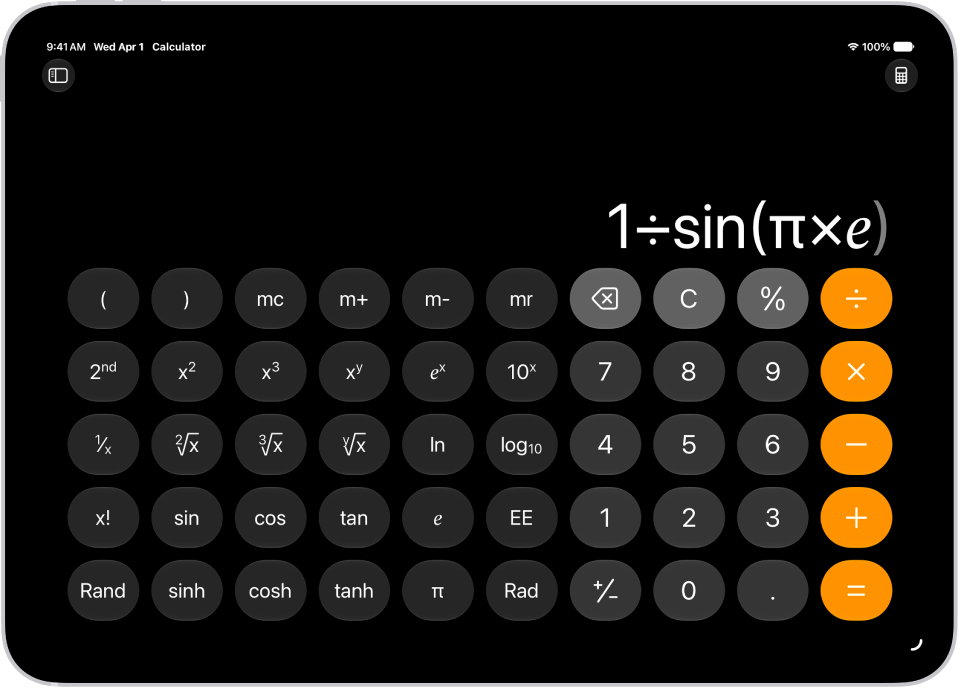
#21. Use Numerical as your default calculator

After accuracy, the next most important feature for calculators is a history. Otherwise you’re going to make an error and fail to notice.

Unfortunately, Apple’s built-in calculator does not come with a history feature. So:

See the second line of numbers at the top of the screen? That’s a history. Having that history saves you time and decreases your errors because you can easily notice when you’ve
Typed a wrong an entry. Reduce your anxiety and have peace of mind.

#22. Put the Camera app in your dock

You can launch camera from your control center, tap the camera on the lock screen, or swipe left from your lock screen.

The option to swipe-left from the lock screen is really convenient. Practice that. But also add the camera to your dock. Simply follow these steps:

  • Move the camera app to the dock.
  • Now, head over to Settings > Camera and turn on the switch next to Preserve Settings. This means that the app will preserve the last mode you were in, such us video
    or photo.
  • Still in Camera settings, if you have enough storage, set the resolution on Record Video to 4K at 60 FPS and Record Slo-mo to 1080P HD at 240 FPS.
  • Finally, still in Camera settings, most people’s pictures will be framed perfectly if they turn on grid mode. Implement that.

The camera is a wonderful tool for pleasure and gratefulness. I do not mean you preen in front of the camera the whole day. I mean you take the
most beautiful moments of your day for posterity and to share with friends and family.

The main objective of this article is to set your iPhoneup to be more connected with the world. Looking for photos to take is one way to stay connected with
The world around you. Stopping a meal so that you can capture your food, however, is not the path to living in the moment.

If you ever want to post photos to Instagram or Facebook, you can consider the placement of the Camera app to be a substitute habit that allows you
to schedule your social media usage. Capture a photo in the Camera app and then post it later, during your assigned leisure time.

#23. Install a Doppler Radar app

What does 70% chance of rain mean? At times it means there is a 70% chance of rain over 100% of your locale. However,it can equally mean there is 100% certainty
of rain, but just over part of your 70% of your locale.

That’s confusing. Therefore, the only perfect way to check the weather is to compare it to the Doppler radar. These radars visualize the rain and the direction
that the rain is pointing to. That way you can figure out if the rain is really going to affect you.

  • Install the
    NOAA Radar app.
  • Move the Doppler app to your home screen.
  • Head over to your Today screen and turn on Apple’s Weather widget.

Productivity is all about planning. You’ve probably heard millions and millions of people complain about how incorrect weather forecasting is. Therefore, here’s my suggestion: be
your own forecaster.

#24. Use this Pomodoro app

The Pomodoro Technique is a time management system that encourages people to work with the time they have—rather than against it. Using this method, you
break your workday into 25-minute chunks separated by five-minute breaks. These intervals are referred to as pomodoros. After about four pomodoros, you
take a longer break of about 15 to 20 minutes. This improves your focus and increase your productivity

The Pomodoro technique will train you to avoid procrastination. As a result, you constantly push yourself much harder to get to the end of your work
period, knowing that you’ll get a short reward after.

The rules of Pomodoro are not complex; however, I suggest you have a dedicated app. There are two good apps, but I’d recommend
BeFocused Pro
for $1.99 because it can easily categorize your Pomodoros.

When do you use Pomodoro? You use it when you are doing individual work, such as checking your email or working on a project. You wouldn’t use this technique
At a meeting.

This is one of a handful of technique in this post for overcoming procrastination. My intent is that you use all of them simultaneously. For instance, the
Meditation section is typically dedicated to meditation as training that allows you to catch and fight the moods that bring about procrastination.

The Pomodoro method conquers procrastination from a different angle. It makes it easy to break tasks into smaller, more achievable goal. The vast majority of people get down on themselves if
they can’t go an entire 8-hour work day without procrastinating. Pomodoro helps you get things done by breaking up individual tasks among
discrete intervals, say 25 minutes separated by short breaks. And if that’s too long,
you can configure your Pomodoro to be even shorter. You can always start small and build up to your ultimate goal.

(The third main technique for overcoming procrastination is next — using Brain.fm for background noise.)

#25. Use Brain.fm for background noise

The vast majority of people have adopted the habit of listening to music as they work. However, virtually all research have proven that performance is poorer in the presence of
a background sound.

One obvious advantage , though, of music is social. You put on your headPhones and people know not to interrupt you. I usually wear headPhones that have no audio just
to indicate to my colleagues that I’m busy.

The research, however, on
music as a background noise
is quite tricky — there are random benefits to productivity but also a lot, a lot of drawbacks. There is alternative technique: an emerging field of auditory
science used to improve focus and decrease mind-drifting.

Brain.fm app is by far the best in these brain music category.

  • Install the
    Brain.fm app.
  • It offers a one week trial period and then $49.99 per year.
  • Use their focus music as you work if you are experiencing lack of focus or procrastination.

My experience with Brain.fm is that it’s great and works exactly as itthe says. At times, without audio , my brain will have a propensity to drift. With
the Brain.fm focus music, it in some way eliminates that drifting during any dead spots in my work (like if I’m waiting for an app to load). Consequently,
I have more constant periods of focus.

Though, I find their explanation of the science to be enigmatic. It sounds exactly like the type of pop-culture brain science that most people spout.
This does not trouble me, provided that it does the job.

I need to underscore that this is a corporate-run research that mysteriously ended up with a self-serving outcome. Therefore, more than the science, I just want you to
take my word for it enough to try it out for yourself (Keep in mind , the app offers a free trial).

#26. Listen to podcasts

Your podcast app should be on your home screen and you should train yourself to listen to podcasts:

  • during your commute to and from work
  • While waiting in line (in the store, post office, coffee shop,)
  • While doing household chores (cleaning, tidying up, doing the dishes)
  • When you are out for a walk
  • When you are taking a break (from work, or writing, or reading).

I recommend that you train yourself to listen to podcast during your commute instead of playing
games and scrolling Instagram. Be a single-tasker.

Apple has done a lot for the podcast medium over the years, but the default Apple Podcasts app is definitely not the best option for serious podcast listeners.
Overcast is my favorite because of its powerful playback customization options, the ability to organize your podcasts using smart playlists, a fair and transparent
pricing model, and regular app updates that consistently deliver new features and functionality.

Don’t approach your podcast subscriptions as if you need to listen to all episodes. Instead, listen to the latest episodes that sounds relevant
to you.

#27. Install the Kindle app, but never read it in bed

Kindle app has so many benefits. Firstly, it takes a short time to get used to, and as a result I’ve started to read more. There are times when I still feel I’m missing out on the physical
sensation of holding a book in my hand but mostly I LOVE it. Secondly, you don’t get weighted down with too many hardcover books with no where to store them. You literally hold your very own library in your hand. It’s AH-mazing.
, install the
Kindle app.
This is a good app for your home screen. Try to substitute unproductive social media habits with reading or listening to podcasts.

However, you are not done.

If you enjoy reading before going to sleep, do not bring your iPhone to bed. That kills your sleep, bad sleep kills your health, and
in the end your bad health is going to kill you.
I recommend that you buy a
Kindle Paperwhite
and put that next to your bed. If you own an iPhone, you can manage to pay for this second device.

I highly recommend that you treat Kindle as a replacement for Facebook and Twitter. How much smart would you be if you replaced almost all your social
media usage with reading?

#28. Use Safari this way

I’ve tried and like Microsoft edge and Google Chrome, but here is a problem. Either you’ll end up cutting and pasting URLs that auto-opened in Safari or
you’ll end up having to manage individual app’s preferences about how to handle a URL click.

Avoid those problems. Safari is great.

There’s a little known feature on safari calledReader mode. This mode strips out all of the in-article ads, clutter and junk. I find that it does
a great job by allowing me to peruse a webpage without distractions from ads, videos, sponsored content links, and other web elements i
may not consider essential to the article I’m reading.

To turn on reader mode just once, there’s a little four line icon at the top left of Safari. I was able to find that on my own.

What I had not figured out was that if you long press on that icon, you’ll get an option to turn on Reader mode permanently for that site. This is wonderful
and totally improved my browsing experience.

There are two things that you’re setting up here.

One is that you’ll save time by getting rid of any ads. That’s a small productivity gain each day.

The second is about being in control of your iPhone. You don’t want to see ads because you don’t want your iPhoneto be the one suggesting what you should buy and when.

#29. Organize your home screen for meaningful learning

You’ve hidden all of your shallow social media experiences in a folder on your second screen. Now, find something to replace those habit in case you would be tempted to check Twitter or Facebook.

Choose the media that will actually add a value in your live and then put apps for that on your home screen.

In my case, i’ve picked Medium, Kindle and overcast app.

These apps will surely make you smart. You just need to make sure that you can locate them easily than your old, time wasting, addictive apps.

Replacement habits are a very common technique for breaking an habit. The logic is that, it’s
easier to develop a new habit than to erase an old habit.

#30. Track steps this way

Skip this step if you already have a way you track steps. Most of you have Fitbits or other ways to do this.

If you are not already using a pedometer, your iPhone automatically tracks your steps within the Health App. Though, you don’t want to have to launch
The health app every time you want to check your step count.

In this regard, I recommend that you install an app that comes with a Today screen widget. My best pick is Pedometer++.

  • Head over to Settings > Privacy> Motion & Fitness and make sure that Fitness Tracking is turned on.
  • Now, download the
    Pedometer++ app.
  • Add the Pedometer++ to your Today view.

Now, you have enough reasons to check your Today screen on a daily basis. That’s great.

Also, I traversed the internet looking for some research to back up the idea behind ten thousands steps.
I found that there is ritch research on the health benefits of even minimal walking (much less than ten thousands steps):
trading two minutes of sitting per hour for two minutes of walking per hour reduced mortality by Thirty Three Percent

That’s not to say you do less than ten thousands steps though. The science for doing more walking is mixed, and requires you to make self deductions.

So, my recommendation is you put science aside and trust your instant instead. For vast majority of people, walking feels good. It’s an opportunity to keep your body fit, to build
up pride in a consistent amount of activity, to listen to your favorite podcasts, to explore your town or city. Those are enough justifications.

#31. Schedule Night Shift starting 4 hours before you normally go to bed

Night shift“shifts” the colors of your display away from the blue spectrum and toward the warmer (redder) spectrum. That’s supposed to help you sleep better.

  • Head over to Settings > Display & Brightness > Night Shift.
  • Now, schedule Night Shift starting four hours before your regular bed time.
  • Move the warmth slider all the way to the right (More Warm).

The normal recommendation seems to be to avoid screen time and blue light starting two hours before your bed time.

Though, I’ve found that majority of the people are often sleeping much later than they should, mostly because ofiPhone addiction. Starting
Night Shift four hours earlier offers you an opportunity to both go to sleep more easily and also to shift your bed time up. If you find yourself going
to bed earlier, then just get up earlier. Congratulations, you’ve become an early bird.

So, the main reason I love this feature is because it’s a prompt to begin working on your evening routine to go to bed. Essentially, it’s just a color coded
reminder. That’s it.

#32. Set up Medical ID

The Medical ID feature makes important medical details available to strangers when your iPhoneis locked.

In case you are incapacitated during a medical emergency, a stranger can go to your power-off screen (long press right button and volume up on modern iPhones).
That’s where your Medical ID details will be found.

  • Head over to Health App > Medical ID > Edit
  • I recommend that you add an emergency medical contact.
  • Your medications and medical conditions would be available to any person who picks up your iPhone. If you are not comfortable with that, put a note instead: “Call emergency contact
    for medications and medical conditions.”
  • Knowing your blood type is not very important in an emergency situation.
    Paramedics aren’t carrying blood
    — they pump you with fluids instead. Then when you reach the hospital, they’ll give you the universal donor, B-negative.
  • I labeled myself an Organ Donor and went through Apple’s DonateLife integration. Then I tweeted about it. The more people who sign up for Organ Donation,
    the more likely your own life is going to be saved. So the selfish step here is to use your own organ donation status to encourage other people to become
    organ donors.

In my opinion, Medical ID has three concrete benefits to you, in order of likelihood.

  • A kind stranger finds your lost iPhone and calls your emergency contact.
  • You have a life-threatening situation, and the doctors call your emergency contact.
  • You influence someone else to become an Organ Donor and then they end up donating an organ to you. The literal probability of this is very, very low.

#33. Change Siri to a man

Most people choose female voices for services like Siri and Alexa. Consider changing that

  • Head over to Settings > Siri & Search > Siri Voice. I chose American male.

Initially, I’d looked into changing Siri’s voice because somebody had told me that male have a likelihood of being cruel to female digital assistants. You know what
I mean about getting irritated when Siri or Alexa provides you with wrong information. Alexa, particularly, is fond of interrupting and is just begging to be told to shut up. I’m
constantly having to tell Alexa, “Alexa, stop.” but how close am I to cracking and yelling “Shut up, bitch?”

I’ve never treated any woman in my life that way and I don’t want to start with digital assistants.

#34. Change your iPhone’s name

The default is something like, “Moses’ iPhone.” That exposes your privacy when you have your hotspot turned on, and announces to everybody that you don’t know how to customize your iPhone.

Here’s how tochange your iPhone name:

  • Open the Settings app > General > About > Name.

#35. Turn off advertising tracking

If youturn off advertising tracking on your iPhone, then the ads you see won’t be specifically targeted to you and what advertisers know about you. The idea is
that receiving few targeted ads is great. You want to spend cash on purpose.

When you want to purchase something, you want to use your iPhone for research and then make a purchase
based on that research. You do not want the vice versa, where your iPhone is suggesting to you what you should buy. You are the one in control.

  • Head over to Settings > Privacy > Advertising. Turn on Limit Ad Tracking.

You’re still going to get some advertisements in some areas, However, the tip I’ve given here includes paying for the ad-free version of the apps
you use.

Paying for ad-free apps perhaps saves you some cash , as you are unlikely to purchase something you don’t need.

#36. Set auto-lock to the maximum time

When you stop using your iPhone, it’ll auto-lock to prevent some snoopers from taking your iPhone and perusing through your personal information. That’s basically
a great feature, however, the problem is that most often you’ll end up locking yourself out.

Majority of the people keep their iPhones on their person — so keeping your iPhone locked is not a big security risk. We are only talking about 5 minutes —
that’s the maximum auto-lock setting.
Instead of unlocking your iPhone every time, try extending the auto-lock time.

  • Head over to General > Settings > Display & Brightness > Auto-Lock.
  • Set up auto-lock to 5 minutes.

My take on the value of saving time here is that those few seconds of waiting for an iPhone to wake up is when you are at risk for getting distracted. So,
worst case this setting saves you a few minutes of time.If you like these iPhone productivity tips, please share it with others.Thanks for reading.

It’s no doubt
Working from home
is becoming an increasingly common practice. This has kept me searching for the best Mac apps that can increase my productivity and improve my workflow.

In 2020, the necessity to effectively
work remotely
is critical to productivity more than ever. Here at GeeksModo, we refuse to pretend as if remote work is a new trend.

Having said that, there is a delicate balance between working from home and effectively working from home. This delicate balance boils down to the apps a person could use to stay productive. 

For macOS users, there is a nearly never-ending list of native features and
apps
to carry out various tasks. The team here at GeeksModo has traversed through the internet to find the most useful macOS apps for everyone who is working remotely. 

Best Mac apps for working from home

Here are the best Mac apps for working from home in 2020:

1. DemoPro

($1.99)

An integral part of working from home is video conferencing whether it’s on Zoom or Google meet. If you are presenting your screen can sometimes prove challenging to grab the audience attention to a certain section of the screen.

Most peple just start wiggling the cursor around with half of the audience wondering what is happening with your computer.

DemoPro offers a solution to this by turning the whole screen into a canvas which allows you to draw or highlight any section of the screen.

2. CleanShot X

($29)

Sometimes it’s difficult to explain to your coworker what you mean via a slack message. I love taking screenshots as I know I won’t have to go back and forth explaining myself and we both are discussing the same thing.

Besides being able to edit and style the screenshots you take. The app also allows you to record your screen as a video or as a Gif.

3. Paste

($0.99/month or $9.99/year)

Imagine a clipboard that can save all your cuts and copies from the last month, Paste has all that ability. You can search through the clipboard and arrange them in different categories for easy access.

4. Duet Display

($9.99)/SideCar — free

It’s always a good idea to add an extra screen to be more productive. Now that’s where these two apps come in handy. Both perform the same task – Sidecar will turn your iPad into a seamless second display for your MacBook or iMac. It is free and comes in all devices compatible with iOS 13 (iPadOS) and macOS Catalina.

In case you are running an older Mac model not compatible with Sidecar, you should try Duet Display instead.

5. Time Out

($2.99/3 months, $4.99/6 months or $9.99/year)

Working from home made me stick to my computer for long periods of time. Consequently, I have had a lot of backaches and headaches.

Time Out offered me a solution. I love the Pomodoro method to keep myself productive so I have set up the Time Out app to hide my screen for 5 minutes after every 25 minutes of work.

The app offers several customizations according to the screen cover you want.

The best macOS apps for productivity during remote work should consistently serve the everchanging needs of the remote worker. Sometimes it’s hard to craft the best environment for productivity during working remotely. Still, I sincerely hope this list has helped you sort through tons of macOS apps that are available on the app store. Please, let us know what you think or if you have any recommendations for our list of the best macOS apps for productivity when working from home. 

And that covers everything about best Mac apps for working from home. If you enjoyed this article, please share it with your friends and comment if you have any favorite productivity apps for Mac of your own!

This is a very useful, but somehow also dangerous trick. Useful because you can still access your
Mac
even if you forgot your password. Dangerous because anybody could bypass your Mac password by changing it. As always it depends on the person’s intention. There are good persons, using knowledge and tools for the right things and bad persons misusing knowledge. Be a good person.
in this article, I’ll tell you how to bypass Mac password login and how I discovered the trick. Actually, you do not forget the passwords you use every day. That’s what I thought. One day at work I tried to access my MacBook and I was 100% sure it was the correct password. I tried several different variations. Turned it off. Thought about it. Tried again. Searched in my documents for the passwords. Tried again, but could not access it. Somehow I must have forgotten a tiny part of it, just a special character as ? or : or maybe any of the signs was uppercase. I tried to remember but could not figure it out.
So what to do?
The first idea that crossed my mind, was the apparently easiest solution: just asking the IT guys for help. However, I knew that the team was overloaded due to its small size. So asking for help regarding such an annoying problem was somehow embarrassing, but also stressing for them. Next to asking my co-workers, there was the more unlikely possibility of trying to do it myself. However, I thought that Macbooks have reputable security and it would certainly not be possible to gain access without having any kind of password or a third-party tool. Far from it! Actually, it is a pretty easy and quick solution from which I was really surprised.
You just need to perform a few simple steps, so let’s jump into it and see how to bypass Mac password in 2020. If you just want to try it, but know your password then you should load this guide on another device because the first step involves shutting down your Mac. And I guess you might still need to follow the instructions step by step when executing it. So let’s start by turning off the computer.
Next, turn on your Mac and hold immediately the keys “CMD+R” together until you see the  logo on the screen. The recovery mode of your Mac will launch. It should open a window with the header macOS utilities. On the uppermost part of the screen you can see the top bar with the following menu points as can also be seen on the image below:

Bypass Mac password

Click on Utilities and choose Terminal to launch the Mac Shell Terminal. It should appear a new window that looks like the window below.

Bypass Mac password

Click in the terminal and type resetpassword. A new window will appear with the header Reset password. On this window, you can see all user accounts with their names and profile pictures. Choose the user account for which you intend to change the password. Enter a new password, confirm it and hit save. Boom, a new password has been set. Restart your Mac and login with your new password. It should work. In case it does not, repeat the above steps. So in case you are forgetful, don’t worry. The above solution should help you bypass Mac password in no time.
Considering my slightly embarrassing situation, the above solution was a quite quick and easy fix. So, what lesson can you learn from the story?
As soon as a problem arises, there is already an answer to it. You just have to go out there and find it. I hope you learned something and maybe you were as surprised as I was.
You can achieve the same on Windows or Linux-based systems such as Ubuntu. If you are interested in a similar article for other operating systems, please let me know down in the comments.

A lone
MacBook
is a powerful and impressive device. However, add some accessories into the mix, and they’ll enable an almost magical experience. There are numerous options of accessories for a MacBook, even so, many that it is difficult to see which ones will help you to get work done on your Mac. Finding the accessories that suits your needs can prove challenging, so it helps focus on the essentials. However, some accessories benefit power users as well as casual ones.

1. Mouse

It’s a good idea to have a reliable, precise mouse for your MacBook. Even though MacBook’s comes with best in class trackpads you can ever find in a computer, they don’t quite manage to beat the experience a mouse provides.

There are tons of outstanding mice out there. Which one you should get to accompany you, and your MacBook heavily depends on your needs.

When purchasing a new mouse, I suggest that you look for wireless connectivity, preferably via Bluetooth, and a USB-C charging that lets you use it even while on the charger (sorry Apple Magic Mouse 2).

Accessories for MacBook

Personal Recommendation

My personal recommendation for a mouse is the Logitech MX Master 3. It features all the things I want it to have plus so much more. Starting with the essential features, it has wireless connectivity via Bluetooth and even has multi-device support. With just a press of a button on the mouse’s underside, you can switch the device you want it to control. It charges via USB-C and has an excellent battery life. Over the half-year I’ve owned it, I had to charge it once.

On top of these major features, the mouse has Logitech’s Magspeed scroll wheel. It is the best scrolling you’ll ever find, switching seamlessly from precision scrolling to the fast, 1’000 lines of text in a second scrolling.

In addition, the mouse comes with a gesture button that is perfect for the Mac, a thumb scrolling wheel, and two customizable buttons. The sensor is also brilliant and works smoothly on almost any surface.

The only minor downside of this mouse is the size. Since it is an ergonomically designed and feature-packed mouse, it is a bit bulky.

Having said that, if you are looking for one of the best mice in the market, you cannot go wrong with the Logitech Master MX 3.

2. USB-C Hub

When getting a new MacBook, you’ll get four Thunderbolt 3 ports at most. Because not everyone uses peripherals with USB-C connectivity, owning a USB-C hub can prove helpful.

Having one protects you from the awkward moment when you have to explain your coworker that you can’t read a USB stick, but it will also increase your flexibility.

When buying a USB-C hub, you should always make sure the one you choose has all the ports you want it to have, such as an SD-Card reader and HDMI.

It is also important to look out how many ports the hub will need to work. There are a couple of options out there, some only need one Thunderbolt 3 connector others need two.

Accessories for macbook

Personal Recommendation

As far as I’m concern, a USB-C hub ought to be portable and have a lot of input options. With that in mind, I chose the Satechi ST-SCMA2M. It comes in proper Mac colorways, and henceforth doesn’t take away the beautiful aesthetics of a Mac, it also gives me a broad range of input options. It comes with an HDMI, an SD-Card reader, a micro SD-card reader, two standard USB type A readers, and a USB-C port, which allows for passthrough charging.

The Satechi ST-SCMA2M also only needs one Thunderbolt 3 port to connect, and that’s all what I need.

The sleek form factor and the multitude of ports are pretty good, which makes me recommend this hub for everyone.

3. Headphones

Love listening to music while getting work done? Well, if you want to be able to listen to your music all the time, you should grab a pair of headphones.

Although all MacBooks comes with a headphone jack, when purchasing headphones to go along with your MacBook, I highly recommend looking for wireless headphones.

No matter your budget, you’ll get good wireless headphones in every price range, from sub 100$ to +300$.

When looking for a good headphones to complement your MacBook, I suggest that you think about the essential features. Do you need good microphones because you find yourself in conference calls a lot? Do you need active noise canceling because your workspace is too loud otherwise?

Outline all the features you want to have and then look for the headphones that suits your needs. Nowadays there are a wide range of valuable options, there is one for everybody.

Of course, getting Apple headphones (Beats also included) you’ll get some features the other headphones can’t provide, so I advice you to look into the Apple headphones first. However, the features they offer are not game-changing at all, and if you find yourself liking the headphones of a different company more, go for them.

Accessories for MacBook

Personal Recommendation

As far as I’m concerned, one of the best headphones to complement your MacBook are the
Apple AirPods Pro.
The AirPods Pro have a super active noise canceling feature. In addition, they are super portable and perfectly integrated into the
Apple ecosystem.

If you are looking for one pair of headphones for all your needs, including to pair it with other devices, then your MacBook, the AirPods Pro Might be only headphones you’ll ever need.

AirPods Pro offers a great sound, and the battery life of about 4.5 hours with active noise canceling should be enough for almost everybody.

The only downside of the AirPods Pro is that they are quite expensive , and when compared to other headphones in their price tag, the sound isn’t that superb anymore.

However, due to their small size, the one headphones for all needs aspect, and their excellent active noise canceling, it’s pretty easy to recommend the AirPods Pro as headphones Companion for your MacBook. Additionally, the fact that they are designed by Apple gives them a unique connection with the MacBook and makes them easy to use.
See also:
AirPods 2 Vs. AirPods Pro – FIGHT!

4. External storage

One of the best utility apps that come pre-installed on the MacBook is Time Machine. Apple’s backup program is fantastic, and everyone should take advantage of it. To do so, you need a reliable external hard drive or SSD storage.

In addition, having an external storage solution allows you to free up space on the MacBook’s internal storage.

When looking for the perfect external storage solution, the most important thing is reliability. If you find yourself needing the backup, you want to be sure that your external storage can handle it.

Another essential factor to consider is the type of storage, hard drive, or solid-state storage (SSD). Both have their pros and cons, but they are both greatoptions.

SSD’s usually come in at a little higher price but have higher write and read speeds, where hard drive mostly costs a bit less but can’t provide as fast speeds. It is said that SSD’s don’t have the same lifespan as hard drives, however, although this is technically true, no regular user will ever have problems with this.

Accessories for MacBook

Personal Recommendation

I wouldn’t recommend going all out on a high capacity, lighting-fast external SSD as your solution for external storage, except you need the fastest speeds to transfer data.

As far as I’m concerned, western digital’s “my passport” line is a perfect option for everyone. The hard drives offer a quick transfer speed and very high capacities while maintaining a reasonable price. They also have no known reliability issues, and personally, I use two of them as my storage solutions.

For time machine, I use a LaCie rugged 4TB hard drive that I got as a present. However, while it’s quite appealing and also is very reliable, the price of this hard drive is only justified by its looks, and there are more great options out there.

5. A backpack

Laptops standout feature is their portability. MacBooks are powerful machines that’ll go where ever you take them. Whether you use it to get work done on the train, edit videos in the airplane, or take your lecture notes in the auditorium, the MacBook is part of your daily carry.

In order to facilitate that portability of a MacBook or, for that matter, any Laptop, you’ll need a means of transportation for it. I highly recommend a backpack for transporting your MacBook. It is easier to carry than a sleeve, and it also has room for additional stuff you bring around.

When getting a Backpack for your MacBook, ensure it has a good pocket for your device. It should be padded well, and if there are zippers close to it, look for a lining that separates the zipper from the MacBook.

Once you’ve made sure that the backpack has a functional pocket for your MacBook and does not damage it while carrying around, find a bag that fits your needs. If you carry around a camera with you a lot, maybe you want a backpack that allows you to take your camera with you also. Do you need waterproofing?

As with the headphones, make a list and look for the backpack that ticks all the boxes for you.

Accessories for MacBook

Personal Recommendation

To carry around my 16’ MacBook Pro, I use Douchebags the “Backpack”. With a dedicated Laptop compartment right against your back, it keeps the MacBook safe from all the other stuff I lug around on a daily basis. The main compartment is also easily accessible and has sufficient space for all the stuff I need to carry around.

In addition, the “Backpack” has a simple, yet modern and fresh look that perfectly complements the MacBook. If you are also into photography, there is a camera inlet that fits perfectly into the “Backpack”. So carrying around your camera and the MacBook is easy and secure.

While it a bit pricy, it ticks all my boxes and is the perfect means of transportation for my MacBook.

Wondering how to update apps on your Apple Watch? It’s easy to do manually and there’s an option to do it automatically.

Update Apps on Apple Watch

It’s important to keep the apps in your
watch
updated all the time. You can either set your Apple Watch to automatically download new updates, or check for them manually yourself. In this guide, we’ll discuss both methods of keeping Apple Watch apps up to date.

While setting your apps to update automatically is the easiest and most convenient way to ensure you’re running the latest versions, there might be times where you would prefer more control over when an update is installed. We’ll leave you too choose the option that you prefer.

How to Set Apple Watch Apps To Update Automatically

Like
iPhone apps
,your
Apple Watch
apps also need to be updated. When you update an app on your iPhone, its effect will be seen on your Apple Watch too. For this to work, you need to turn Automatic App Install ON in your My Watch section. You can take this approach if you don’t want to keep updating apps yourself.

  1. Press the Digital Crown to bring up your apps and then tap the “Settings” icon.
  2. Now, tap on “App Store”.
  3. Here, ensure that the switch next to “Automatic Updates” is turned on.

How to Update Apple Watch Apps Manually

You can choose this option if you prefer to read release notes before installing the update.

  1. Press the Digital Crown to bring up your apps and then tap the “App Store” icon.
  2. Now, scroll all the way to the bottom of the screen and tap “Account”.
  3. Next, tap on “Updates”.
  4. Next on, tap “Update” next to any app that you want to install the update for. If you want to update all apps at once, tap “Update All”.

Whichever method you choose, whether automatic or manual, you’ll be able to update apps to the latest versions made available by the apps developer.

And that covers everything on how to update apps on Apple Watch.

Tag: Update

Making FaceTime calls on your
Apple Watch
might not seem like something you would do, especially taking into account there’s no camera built into it (yet anyway). But
FaceTime
can do more than video calls. Your Apple Watch can make crystal clear audio calls over the internet, too. And the Cupertino based company has bundled a high quality speaker and a microphone inside the Apple Watch.

Or, even better, why not make calls using AirPods and Apple Watch? However you decide to do it, making a FaceTime audio call on your Apple Watch is quick and easy. In this article, I’ll walk you step-by-step’s on how to make FaceTime audio call on Apple Watch.

Just like
making FaceTime audio calls from a Mac, iPhone or iPad,
you can start a FaceTime call on an Apple Watch in a number of ways. The easiest is to use Siri, but you can also tap your way through the built-in Phone app as well. And, of course, we’ll discuss both methods. Without any father Ado, here are the instructions for how to make a FaceTime call on Apple Watch.

How to Make a FaceTime Audio Call on Apple Watch Using Siri

Siri
isn’t always smart in everything, but it is very good at making calls for you. Here’s how it works with Apple Watch:

  1. Say “Hey Siri” or if you’re using Raise To Speak, raise your watch to your mouth. You can also press and hold the Digital Crown, too.
  2. Say “FaceTime” and then the name of the person you’re trying to call.
  3. The full command could be something like “Hey Siri, FaceTime Dad”.
  4. Siri will then initiate the call using either the built-in speaker or any
    Bluetooth
    audio devices that are paired at the time. Like
    AirPods,
    AirPods Pro,
    or any other headphones.

How to Make a FaceTime Audio Call from Apple Watch Using the Phone app

You can use the Phone app to make FaceTime calls on your Apple Watch if you prefer to use this method. The call will be the same, it’s only the method to place a call which is different.

  1. Press the Digital Crown to bring up all of the apps installed on your Apple Watch.
  2. Now, tap the Phone app’s icon.
  3. Next, tap “Contacts”.
  4. Next on, tap on the contact that you want to call.
  5. Finally, tap the phone icon followed by “FaceTime Audio”.
    A FaceTime Audio call will then be started, and you can talk and chat away as much as you like.

Again, any headphones that are connected via Bluetooth at the time will be used to make the call.

The Apple Watch’s microphone and speaker will be used if no audio device is connected, so if you don’t use AirPods or another wireless audio solution than you can simply talk through the Watch.

It’s worth noting that Apple Watch will need an internet connection to be able to make a FaceTime call. That means if the Apple Watch is a cellular model, or if Apple Watch is paired to an iPhone that has cellular service it will work perfectly, and if Apple Watch is on a wi-fi network it will also make the call too. But if the Apple Watch is not near a paired device, on wi-fi, or doesn’t have it’s own cellular capability, you won’t be able to initiate a call from watchOS of course.

Do you make FaceTime calls from Apple Watch? What do you think of this feature? Do you have any nifty tips or tricks for making FaceTime calls on Apple Watch? Let us know your tips, experiences, and thoughts with using FaceTime chat from Apple Watch in the comments section below.

If you own the latest
iPhone SE
model (from 2020), you might want to know how you can put your device into recovery mode. Recovery Mode can come in handy when you want to troubleshoot various software related issues you’re facing on your
iPhone.

You can take advantage of recovery mode when your iPhone is acting up, whether it’s
stuck on the Apple logo
,Flashing apple logo
or if it’s asking you to
connect to iTunes
for whatever reason, especially if your computer is not able to
recognize it through iTunes
or Finder as usual. These could be signs of a failed iOS firmware upgrade amongst other issues. You can put your iPhone into Recovery mode if you are facing these more extreme issues while trying to update or restore the software on your iPhone.

To properly put iPhone SE 2020 in recovery mode, you’ll need a Lightning to USB cable and a computer running the latest version of iTunes.

In this guide, we’ll walk you step-by-step on how to enter and exit recovery mode on your new iPhone SE 2020.

How to Enter Recovery Mode on iPhone SE (2020 model)

Before you jump into it, make sure you have your
data backed up to either iCloud or iTunes
on the computer, to avoid losing your data. Now here are the steps for how to put iPhone SE 2020 into recovery mode:

  1. Start by pressing and releasing the Volume Up button on your iPhone. Next, press and release the Volume Down button. Next on, press and hold the side/power button. Your device will reboot and you’ll see the Apple logo on the screen.
    how to put iPhone SE 2020 into recovery mode
  2. Keep holding the power button even after the Apple logo appears and after a few seconds, your iPhone will indicate you to connect the device to a computer.
    how to put iPhone SE 2020 into recovery mode
  3. Now, simply connect your iPhone to the computer using the Lightning to USB cable and open iTunes. You’ll see a pop-up in iTunes indicating that there’s a problem with the iPhone and you’ll have the option to either restore or update it.
    how to put iPhone SE 2020 into recovery mode

Assuming you were successful, you now know how to enter recovery mode on your new iPhone SE.

Exiting Recovery Mode on iPhone SE 2020

In order to manually exit recovery mode, disconnect your iPhone from the computer and just continue holding the power or side button until the “Connect to computer” indicator disappears.

That’s all what it takes to exit if you accidentally put iPhone SE 2020 in recovery mode or if you don’t want to update or restore your device.

Once you exit Recovery Mode, your iPhone will return to whatever the previous state was before it was placed into recovery mode in the first place.

Having said that, your iPhone SE should automatically exit recovery mode once iTunes or Finder updates or restores the device.